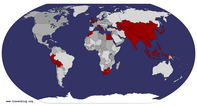
I've always had wanderlust. Don't know where it comes from. When I was 26 I bought a 'round the world' ticket and flew off to New York. I thought after a year travelling I would have 'been there, seen it, done it' and it would be out of my system. Of course it didn't work like that. I travelled for two years and only went home when the money ran out. Then life took over for a few years, and travelling was confined to month long trips around Christmas, and shorter city breaks.
In 2009 Jim retired. Not to be outdone I also gave up work - at least for the forseeable future. We gave our flat in Amsterdam back to the housing corporation, gave away almost everything else and set off for India. We travel for seven to eight month stretches, and go back to England and Holland in the summer; because we want to stay in touch with family and friends, reflect on where we've been, and take time to plan the next trip. We'll do this for as long it's fun..... then - who knows.....
At the moment, just enjoying this incredible life.

The Western Desert is vast, stretching from the Nile and the Mediterranean to the Sudanese and Libyan borders. The Great undulating Sand Sea contains some of the largest dunes on earth. The strange rock formations of the White Desert litter the sandscape like meringues gone mad; and the charred dark peaks of the Black Desert exude an other-worldly feel. It's an isolated, desolate, sometimes eerie landscape. Out on a limb, away from the desert circuit road, lies Siwa, a tiny, tranquil, still largely traditional oasis, surrounded by ruins, springs and date palms. But Siwa is changing. Mahdi Hweiti has lived in Siwa all of his life. 'For every person it's different. I cannot be away from my village for more than a week'. When Mahdi was a boy there was no road at all - not
... read moreThe donkeys, dwarfed by the Colossi of Memnon, gave an occasional shake of the head and waited patiently. The cart, a simple affair, was ready in no time. A matress, covered with an old blanket, was thrown on the back and a bolster cushion snatched from 'Dreams of Memnon' the small cafe where we'd met Abdul and Ali. Ali twitched the reins and we were off. Traversing narrow dirt roads, bordered by shoulder-high sugar cane and vivid green fields of wheat. A day in the country, a break from the monuments. A day in twenty-first century, not ancient Egypt. We followed small canals, which ran in straight lines through the fields and off into the distance. Mudbrick houses - were they half-built or falling down? - were surrounded by livestock; tethered cows, sheep imprisoned in palm
... read moreIn Luxor it's not possible to go far without hearing the shouts of the horse and carriage drivers hustling for a ride, or seeing overburdened donkeys pulling carts piled sky-high with everything from sacks of grain to gas cannisters. Away from the antiquities trail, Luxor is still a working farming community and families rely on their animals to make a living. Some of these animals are in poor condition, overworked, over-loaded and underfed. Animal Care Eqypt (ACE) is there to make a difference. We were shown around by Jan from Coventry, who's worked as a volunteer at ACE for eight years. 'I came on holiday with a friend', she explained. 'I could've turned round and gone right back - I thought men in skirts, what is this place'? And then she met one of those men,
... read moreEgypt is all about ancient history. A history that's vast, sweeping and epic. There's so much of it it's difficult to get your head around. Too many pharaohs, so many dynasties, all those facts and half-facts, gods and mythological creatures. What I like is knowing about the lives of ordinary people. We all make history - it's just that not all of us are remembered. I like the monuments, but what I like even more, is the thought of what lies underfoot, waiting to be discovered. Walking almost anywhere in Egypt is an adventure. The rubble underfoot is composed of bits of ancient pottery, human bones, fragments of winding sheets, even perhaps scraps of wooden sarcophagi. Major finds are not just a thing of the past. Abdul, who's lived all his life opposite the Colossi of
... read more'No hassle here my friend'. And so it starts. If Luxor had a sound-track it would be 'Money, money, money'. It's said with charm and delivered with a smile, but hear anything too often and it begins to grate. The concept of baksheesh can be hard to take. 'Something for me, for help', wheedled the young man at the visitors center in the Valley of the Kings. This is 'baksheesh' in it's purest form - a bit extra, a tip - and it's often expected for nothing. The young man had simply turned on the information film. Agree a price with a boatman, or a taxi driver, and they still ask for a 'present'. One caleche driver (coachman) asked for baksheesh 'for the horse'. Kids run up to us in the street and before they had
... read moreThe medina - a 250-hectare honeycomb of 9,400 streets and alleyways;a warren of dog-leg passages and dead ends; 320 mosques, 5,000 furniture shops and 400,000 people. A map is no help at all. We saw an Italian man trying to scribble his own map at every turning - impossible - so many Mohammeds and Jalils wanting to show you the way, so many souks, shops, and hole-in-the-wall eateries. There are no street names, no ground plan. Better face it - you're on your own. We dived in headfirst. Part of the enchantment is getting lost. Looking for the Mokri Palace, we discovered nothing in reality corresponded to our map, and the three maps we had didn't correspond to each other. Two little boys ran up, schoolbags bouncing on their backs, all grins and eagerness, bounding puppy-dog
... read more'Oh, you're not in a hurry', the old man remarked, when we'd told him which company we'd bought the bus ticket from. 'This bus is very old, you'll arrive at midnight - if at all'. 'Inshallah' I replied, and he laughed. Minutes later, we realised he might be right. The bus was fraying at the edges. Our seat moved forwards, even when the bus didn't, and the windows were cracked and ill-fitting. But we figured we'd just ride it out, see what happened. Bunking down in my seat, trying to avoid the draft playing around my legs, my spirits soared as we zig-zagged through a gorge - wild, inhospitable and stoney. We stopped to let five old women board, one holding the edge of her emerald-green headscarf in her teeth, pulling it across her face, hiding
... read moreI went to the hammam with one of the thousands of Fatima's who live in Morocco. We stepped through an ordinary-looking door into a world where hard edges became blurred. A soft, warm world of steam and whispers. An intimate, secretive women's world. The noise and glare of the street were replaced by the quiet of the cavernous changing room, bedecked with tiles, but otherwise spartan. A young girl wearing a large padded black coat lay on her side on the tiled bench that ran around the perimeter of the room. Eyes half-closed, head resting on her hands, she ignored us and the lady in the corner dispensing henna powder and olive oil soap. Fatima gestured that I should undress - down to my knickers. There is no modesty in the hammam. Outside women are veiled
... read moreNever has a square been more inappropriately named. It's not even a square. Djemaa el-Fna translates roughly as 'Assembly of the Dead' but this place is larger than life, organised bedlam, the beating heart of Marrakesh. On the square, the action starts early and winds up to a night-time theatre spectacle with a cast of thousands. Also known simply as 'La Place,' Djemaa el-Fna was laid out as a parade ground by the Amoravids in front of their royal fortress. When the succeeding Almohad's built a new palace to the south, the open ground passed to the public and became what it is today - a place for gathering, eating, trading, entertainment. The name refers to it's former role as a venue for executions, when severed heads were pickled and put on spikes for public display.
... read moreWe hadn't planned to go to Morocco. It was just one of those quirks of fate. Now we've been we can't imagine why we never went before. A country so close by, yet so amazingly different. An exotic world of riads, ksars, casbahs and dars. Spectacular scenery ranging from mountain ranges to deserts and beaches. A 'Thousand And One Nights' display of bold, bright colours. Mouth-watering dishes of goat-meat tagine and camel couscous, and pastries oozing honey and almond paste. Veiled women, and men wearing jellebahs. Winding medina lanes, quiet and secluded. Ancient wooden doors, barring the way, but somehow drawing us in. A month was not enough.
... read more