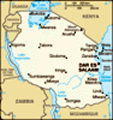
Blogs from Babati, North, Tanzania, Africa

Advertisement

A Few Cultural Differences

Published: July 12th 2012Africa » Tanzania » North » Babati
Mama Linda icon
Mama Linda
July 12th 2012

Market Shopping in the Big Cities Going market shopping requires preparation, stamina and determination as well knowledge of local customs, language and prices. First of all, you must take only small notes and coins and have them readily available in zipped pockets. Tanzanians don’t carry change. They will always get it for you but it make take an hour until they find someone who can break your 500 shilling bill. Paper notes in Tanzania require delicate handling. Besides being tattered, torn, taped and glued, notes may carry note-born germs. Hint: check that you aren’t being passed a note so tattered that no one else will take it. Secondly, you need a basket large enough to carry your purchases. Tanzanians hire lads at the markets to do this for them. Give it a try! Thirdly, you will ... read more


Mama Linda icon
Mama Linda
July 12th 2012

Some Background on CHES Back in 1991, as CUSO cooperants, we were assigned to work in Hanang District, Tanzania, as an attempt on the Canadian government’s part to help rectify some of the economic and human rights abuses perpetrated by workers of the Tanzanian Canadian Wheat Farm Project (TCWP) upon the nomadic cattle herders of the area-the Barbaig. A British anthropologist, Charles Lane, had made public through Human rights organizations and Indigenous Survival groups the lost Barbaig economy and the alienation of their land. Ethnic tensions and conflict with the state were particularly horrendous during the late 1960s and late 1980s. Barbaig households in many areas lost thousands of cattle to raids, houses were burned, crops were destroyed, women raped and people killed. Barbaig children were forced to attend schools with limited resources far from their ... read more


Restaurant etiquette in Katesh

Published: July 11th 2012Africa » Tanzania » North » Babati
Mama Linda icon
Mama Linda
July 11th 2012

Restaurant Etiquette Reading menus in Swahili you might think is difficult. Hamna shida. Don’t worry. If you are like mum you will patiently wait for a waiter to bring one for you. If you are like me, you will know the only menu is written on a blackboard behind the glass counter often holding donuts freshi or other unknowns and simply wait and see how your mother figures things. Either way, there are usually only one or two options. The choices will either be ugali (maize flour stiff porridge like glue) rice with bean, rosti, fish or chicken. Lunch for most people is at 2 and dinner at 7 so if you arrive around 4 or 5 you may be lucky and get bananas with rice. There will not be any chicken, fish or rosti. If ... read more


Driving in Tanzania

Published: June 21st 2012Africa » Tanzania » North » Babati
Mama Linda icon
Mama Linda
June 21st 2012

Driving in Tanzania In the 1990s few people had their own cars. Drivers were professional drivers who were hired by government officials or other salaried people. Five minutes on Tanzanian roads would have explained the need for professional drivers. Now, however, the rising middle class have changed the roadways. Cars abound. Driving schools don’t. It is thought if you can drive a cart and oxen, you inherently can drive a car. If you insist on driving, a few fundamental facts and suggestions are hereby provided. Driving on the left People drive on the left in England, drive on the right in Canada, and drive on both sides in Tanzania. You must maneuver to drive to avoid pot holes, pedestrians, goats, cows, piki pikis, bicycles, buses, dala dalas and other road users. When you are not ... read more


Telling Time in Tanzania

Published: June 7th 2012Africa » Tanzania » North » Babati
Mama Linda icon
Mama Linda
June 7th 2012

Telling Time Ni saa ngapi sasa? Ni saa kumi. Telling time in Tanzania is just a wee bit confusing. Once you figure out that the Swahili day (siku) has 12 daylight hours followed by 12(usiku) hours, you’ll be fine as long as you learned your numbers 1 to 12 and remember to look at the hour exactly opposite the Swahili hour mentioned. The new day begins at sunrise, or 6:00 in the morning. The night cycle begins at sunset, or 6:00 in the evening. So just to show you how easy this is, here are a few examples. Remember that 12 is 6, 1 is 7, 2 is 8, 3 is 9, 4 is 10, 5 is 11, 6 is 12, 7 is 1, 8 is 2, 9 is 3, 10 is 4 and 11 is ... read more




Advertisement


The Lion King rock

Published: December 11th 2011Africa » Tanzania » North » Babati
International backpackers icon
International backpackers
December 11th 2011

Don’t you just love those amazing places not in the Lonely Planet or on the Internet. A place where you can easily spend a week, not mentioned in the Lonely Planet book and not another tourist in sight. Do these places exist in tourist mekka Tanzania? Well we ended up in just the place and it is as spectacular and surrounded in history as many of the famous landmarks. This place is called Dareda, not Babati as it mentions up the top, and it is off the beaten track but well worth the visit. Arriving here in the town we were surrounded on one side a rising cliff face, the other flattens out to be a platue and on the other are the typical savanna landscape reaching as far as the eye can see. For us, ... read more


3Peaks3WeeksHeather icon
3Peaks3WeeksHeather
January 3rd 2010

Peak Issue in East Africa - HIV/AIDS Support for International Change Tanzania A few short weeks ago, the 3 Peaks Team receievd an email from Erica Mackey, Executive Director of Support for International Change (SIC) asking the team which of their 3 current funding priorities our team would like to support. This was a very interesting opportunity. But man, was making the decision tough. From my time in development, I really have learned that projects need to be sustainable, holistic, and focus on long-term solutions. But everyone needs our help! SIC believes that the HIV/AIDS crisis creates both an imperative to act and an opportunity to learn. We envision a world where HIV/AIDS no longer limits length or quality of life or reduces the social or economic development of communities, and where young people learn the ... read more


Tot: 0.105s; Tpl: 0.002s; cc: 7; qc: 57; dbt: 0.0269s; 1; s:apollo w:www (50.28.60.10); sld: 2; ; mem: 6.3mb