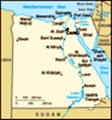
Background: The regularity and richness of the annual Nile River flood, coupled with semi-isolation provided by deserts to the east and west, allowed for the development of one of the world's great civilizations. A unified kingdom arose circa 3200 B.C. and a series of dynasties ruled in Egypt for the next three millennia. The last native dynasty fell to the Persians in 341 B.C., who in turn were replaced by the Greeks, Romans, and Byzantines. It was the Arabs who introduced Islam and the Arabic language in the 7th century and who ruled for the next six centuries. A local military caste, the Mamluks took control about 1250 and continued to govern after the conquest of Egypt by the Ottoman Turks in 1517. Following the completion of the Suez Canal in 1869, Egypt became an important world transportation hub, but also fell heavily into debt. Ostensibly to protect its investments, Britain seized control of Egypt's government in 1882, but nominal allegiance to the Ottoman Empire continued until 1914. Partially independent from the UK in 1922, Egypt acquired full sovereignty following World War II. The completion of the Aswan High Dam in 1971 and the resultant Lake Nasser have altered the time-honored place of the Nile River in the agriculture and ecology of Egypt. A rapidly growing population (the largest in the Arab world), limited arable land, and dependence on the Nile all continue to overtax resources and stress society. The government has struggled to ready the economy for the new millennium through economic reform and massive investment in communications and physical infrastructure.
July 3rd 2009Africa » Egypt » Lower Egypt » Cairo Friday lunchtime we took a trip to Al Azhar Park. The streets of Cairo were almost empty of cars and we took a quick ride in a white taxi for 9LE. The Park lies on a hill between the ring road and I ... 11 photos[full story]
July 3rd 2009Africa » Egypt Those of you who followed my blog last summer, heard about the baptism that we attended of a little boy named Mina.
As I shared last summer, Mina was born with a hole in his heart and is in need o ... [full story]
July 1st 2009Africa » Egypt » Lower Egypt » Cairo Today we found ourselves halfway through the day with some free time, so we decided to take the public ferry to the Nile Barrages at Qanatir. We weren't quite sure what to expect, apart from a relaxi ... 8 photos[full story]
July 1st 2009Africa » Egypt » Lower Egypt » Cairo Left only pen, not for distribution, with check-in desk...good thing we had a boxful of useless others packed underneath the plane! First trip expenditure included new pen at Hudson Book's for $4.5 ... 15 photos[full story]
June 16th 2009Africa » Egypt » Lower Egypt » Cairo Just a couple weeks late in posting this...
News cameras and journalists flooded the hostel to interview the residents trapped inside the morning the quarantine was finished. They were definitely t ... 17 photos[full story]
June 29th 2009Africa » Egypt » Lower Egypt » Cairo Another hidden gem of Cairo is the "cave churches" cut into the Muqattam Hills limestone. On the outskirts of Cairo beyond the Salah Salem Ring Road, is where much of the city's rubbish is collected ... 23 photos[full story]
June 17th 2009Africa » Egypt » Lower Egypt » Cairo Cairo is one of the megacities of the world. Not only does it have 20 million inhabitants, it is also one of most densely populated cities in the world, around 10,000 people per square kilometer.
... 29 photos[full story]
June 23rd 2009Africa » Egypt » Red Sea » Hurghada
This was our last full day in Hurghada so we thought we better get out and not spend the entire time by the pool. We went on a jeep safari. We were piled into land cruisers and off into the desert ... 6 photos[full story]
June 19th 2009Africa » Egypt » Sinai » Dahab For my 2009 birthday my mother and I went to Egypt.
We arrived on the 6th June in Luxor, where we spent 2 days exploring.
We then took a flight via Ciro to Sharam El-Shaykh where we took a taxi ... 119 photos[full story]