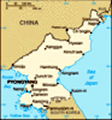
Pyongyang
Advertisement
Advertisement
Background: An independent kingdom under Chinese suzerainty for most of the past millennium, Korea was occupied by Japan in 1905 following the Russo-Japanese War; five years later, Japan formally annexed the entire peninsula. Following World War II, Korea was split with the northern half coming under Soviet-sponsored Communist domination. After failing in the Korean War (1950-53) to conquer the US-backed republic in the southern portion by force, North Korea, under its founder President KIM Il Sung, adopted a policy of ostensible diplomatic and economic "self-reliance" as a check against excessive Soviet or Communist Chinese influence. It molded political, economic, and military policies around the core ideological objective of eventual unification of Korea under Pyongyang's control. KIM's son, the current ruler KIM Jong Il, was officially designated as KIM's successor in 1980 and assumed a growing political and managerial role until his father's death in 1994. He assumed full power without opposition. After decades of economic mismanagement and resource misallocation, the North since the mid-1990s has relied heavily on international aid to feed its population while continuing to expend resources to maintain an army of about 1 million. North Korea's long-range missile development and research into nuclear, chemical, and biological weapons and massive conventional armed forces are of major concern to the international community. In December 2002, following revelations it was pursuing a nuclear weapons program based on enriched uranium in violation of a 1994 agreement with the United States to freeze and ultimately dismantle its existing plutonium-based program, North Korea expelled monitors from the International Atomic Energy Agency (IAEA). In January 2003, it declared its withdrawal from the international Non-Proliferation Treaty. In mid-2003 Pyongyang announced it had completed the reprocessing of spent nuclear fuel rods (to extract weapons-grade plutonium) and was developing a "nuclear deterrent." From August 2003, North Korea has participated on and off in six-party talks with the China, Japan, Russia, South Korea, and the United States to resolve the stalemate over its nuclear programs.
<Missing Content: tb_location_highlights_11399>
<Missing Content: tb_location_hintsntips_11399>