...and Places of Syria

Middle East

Advertisement
Published: October 11th 2009Middle East
October 11th 2009

Aleppo Ancient CitadelAleppo Ancient Citadel
Aleppo Ancient Citadel

Oldest living city in the world with an 8000 year old continuous culture
For more of my photos, or to buy my book, please visit www.nickkembel.com

At the time that the events of the New Testament were taking place, the earliest written records of Damascus and Aleppo were already 2500 years old. Evidence suggests that these two cities have been continuously inhabited for as long as 8000 years, making them the oldest living cities in the world. Over time they have been incorporated into the Egyptian, Assyrian, Persian, Roman, Ottoman, and French empires.


I am baffled by this thought as I peer from my 10$ Aleppo hotel room balcony, observing a group of street cats eating garbage, men smoking nargileh (shisha), and little boys shining shoes. I sometimes have trouble associating these romantic histories with the modern day scenes I observe on the streets, though there is no denying that the crumbling walls of this city’s alleyways exude ancient vibes.


Modern day Aleppo in a conservative Muslim city, and as I travel with a Korinn, a Canadian female companion, I witness firsthand the uncomfortable stares that female travelers have to deal with constantly in this region of the world.


Alcohol is not totally banned like in
Street of Fruit StallsStreet of Fruit Stalls
Street of Fruit Stalls

My favorite street in Aleppo. It also happened to be the beer street.
some neighboring countries, but it is not easy to find either. We locate one hole-in-the-wall shop that sells beers, many of them 10% alcohol; it seems in these parts if people chose to drink, they don’t want to waste any time. As we down a few with fellow travelers on cushions on the rooftop of our hotel, which also acts as a bedroom for those most budget minded travelers, I get the impression that our little gathering is probably the craziest, if only ‘party’ going down in the entire city on this humble Saturday night.


I passed my days in Aleppo photographing the people, and the place to photograph people was in the Old City. One continuous souq (covered market) runs for over a kilometer, terminating at the ancient Citadel, which dominates the cityscape. The souq is overflowing with people, fabric stalls, butchers, shoppers, donkey carts, motorcycles, espresso machines, and pretty much anything you could hope to buy.


I particularly enjoy the cuisine of the Arab states, as I am a huge fan of falafel, hummus, baba ganouj (eggplant dip), and fuul (bean dip), particularly when an entire meal of any of the above only sets you back 50 cents. I was also enthralled by the fruit stalls, where your fruits of choice are blended with fresh pomegranate syrup, honey and ice, to be consumed out of giant glass mugs while standing on the street as you observe the surrounding excitement.


While visiting the ancient Citadel I had an encounter with a female Syrian student named Maleam who, eager to practice her already excellent English, invited my friend and I to sit and chat with them. I was taken aback by how blunt and forward she was with me in conversation; in a city where it is difficult to even make eye contact with women I never expected to be able to converse so openly with them, and so I accepted her invitation to meet again the next day and visit her University. I was able to spend the entire day talking with her and learned a lot about Syrian culture, particularly from the female and Muslim perspective, and I was able to meet many of her friends, including a group of Palestinian girls who were equally forward with me and, I must add, strikingly beautiful.


After Aleppo I journeyed to the desert to take in the ruins of Palmyra, the oasis trading post that once linked the ancient routes from the Mediterranean and Mesopotamia to Arabia, as well as the famous Silk Road to India and China. Today it is a typical tourist town, where the tout hassle is thick and camels ready to pose for pictures abound.


Then it was on to Damascus, which struck me as a slightly larger and slightly less conservative version of Aleppo and, like in Aleppo, I passed most of my time photographing people in the ancient souqs, which in Damascus fill much of the Old City in an enormous network of labyrinthine alleyways.


After a bout of early Christmas shopping, I also took the time to visit a hamaam, or Tukish Bath, where one is violently undressed, scrubbed, rubbed, and massaged by large, half naked, very hairy men on hot slabs of marble while breathing in water vapor and enjoying the ancient interior domed architecture. Clearly a ‘unique’ and must-do Middle Eastern experience.


Finally, I ventured west into Lebanon, and returned again to Syria to visit coastal Lattakia en route to Turkey. Lattakia is the most liberal city in Syria, where café and nargileh culture thrives, and like Lebanon, headscarves are not the norm, style is everything, and even the odd cleavage can be spotted.

For more of my photos, or to buy my book, please visit www.nickkembel.com


There are more photos below
Photos: 18
Displayed: 18


Advertisement

Nick Kembel
www.nickkembel.com I an a nomad of Canadian origin that has been exploring the various corners of the world for over 10 years. My education is in Anthropology and Religious Studies, and in my travels, I have focused on visiting and photographing the spiritual centers of the world. I have been to 44 countries, with highlighting include Burma, Iran, Iraq, Pakistan, India, Bangladesh, and China. I have taught English in Thailand, Korea, China, and for the last 4 years, Taiwan. I'm not backpacking as much as I used to, but my daily life in Taiwan is still a travel... full info
JoinedDecember 16th 2008 Trips0
Last LoginMay 1st 2013 Followers34
StatusBLOGGER Follows9
Blogs62 Guestbook259
Photos1,614 Forum Posts13
Blog Options
Middle East
Middle East
BahrainCyprusIranIraqIsraelJordanKuwaitLebanonOmanQatarSaudi+ArabiaSyriaTurkeyUnited+Arab+EmiratesYemen
Advertisement

44 Countries and Counting!

SvalbardSpainUnited States of AmericaAntarcticaSouth GeorgiaFalkland IslandsBoliviaPeruEcuadorColombiaVenezuelaGuyanaSurinameFrench GuianaBrazilParaguayUruguayArgentinaChileGreenlandCanadaUnited States of AmericaUnited States of AmericaIsraelJordanCyprusQatarUnited Arab EmiratesOmanYemenSaudia ArabiaIraqAfghanistanTurkmenistanIranSyriaSingaporeChinaMongoliaPapua New GuineaBruneiIndonesiaMalaysiaMalaysiaTiawanPhilippinesVietnamCambodiaLaosThailandBurmaBangladeshSri LankaIndiaBhutanNepalPakistanAfghanistanTurkmenistanTajikistanKyrgyzstanUzbekistanJapanNorth KoreaSouth KoreaRussiaKazakhstanRussiaMontenegroPortugalAzerbaijanArmeniaGeorgiaUkraineMoldovaBelarusRomaniaBulgariaMacedoniaSerbiaBosonia & HerzegovinaTurkeyGreeceAlbaniaCroatiaHungarySlovakiaSloveniaMaltaSpainPortugalSpainFranceItalyItalyAustriaSwitzerlandBelgiumFranceIrelandUnited KingdomNorwaySwedenFinlandEstoniaLatviaLithuaniaRussiaPolandCzech RepublicGermanyDenmarkThe NetherlandsIcelandEl SalvadorGuatemalaPanamaCosta RicaNicaraguaHondurasBelizeMexicoTrinidad & TobagoPuerto RicoDominican RepublicHaitiJamaicaThe BahamasCubaVanuatuAustraliaSolomon IslandsFijiNew CaledoniaNew ZealandEritreaEthiopiaDjiboutiSomaliaKenyaUgandaTanzaniaRwandaBurundiMadagascarNamibiaBotswanaSouth AfricaLesothoSwazilandZimbabweMozambiqueMalawiZambiaAngolaDemocratic Repbulic of CongoRepublic of CongoGabonEquatorial GuineaCentral African RepublicCameroonNigeriaTogoGhanaBurkina FassuCote d'IvoireLiberiaSierra LeoneGuineaGuinea BissauThe GambiaSenegalMaliMauritaniaNigerWestern SaharaSudanChadEgyptLibyaTunisiaMoroccoAlgeria
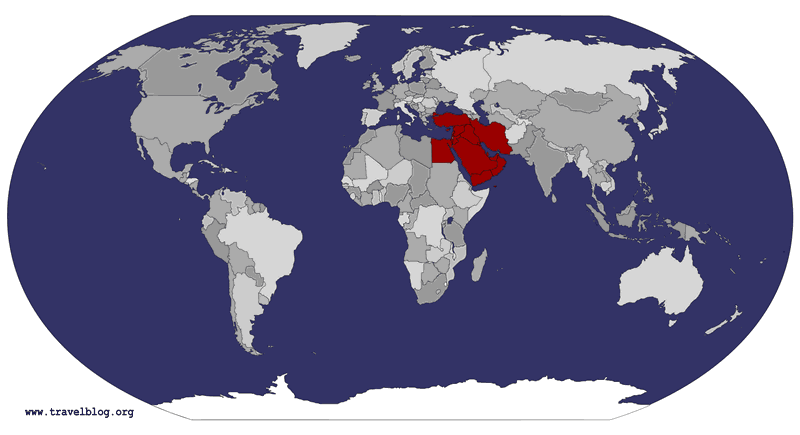
Map Legend: 16%, 44 of 263 Territories
 Maroon 


AustraliaBelgiumBangladeshBelizeBurmaCanadaCambodiaSri LankaChinaDominican RepublicEgyptEthiopiaGreeceGuatemalaHondurasIndonesiaIndiaIranIsraelItalyIraqJapanJordanKorea, SouthLaosLebanonMexicoMalaysiaNepalNew ZealandPakistanQatarPhilippinesSingaporeSyriaUnited Arab EmiratesThailandTurkeyTaiwanUnited KingdomUnited StatesVietnamHoly See (Vatican City)West Bank

Blogged From
Visited Countries
TravelBlog Awards


Typical Syrian Bus StopTypical Syrian Bus Stop
Typical Syrian Bus Stop

And this is a really small one...
I am a Bongo ManI am a Bongo Man
I am a Bongo Man

In the Middle East you can often sleep on these rooftop matresses for half the price of a room


Comments
Date: 11th October 2009

Amazing
As usual, you amaze me. I am always inspired by your wonderful travels, great photos and good journalism. You write very well, I hope someday you will take on an LP project. I am off to Beijing soon and will lead a trek with 7 clients in Nepal in March. Perhaps you will join me in Nepal some day? I hope you have continued great travels and thanks for sending your super great blog. Neil Haggard, Edmonton

From Blog: ...and Places of Syria
Date: 11th October 2009

Excellent
Keep posting Nick! This is an excellent article. It would be nice to see more photographs that you have taken also. -BR

From Blog: ...and Places of Syria
Date: 20th December 2009

request
could you write more about the people (locals you meet) like what you talked about, what they were like, what was surprising about them. and try to meet more locals, and talk about them. its not rude, they wouldnt know

From Blog: ...and Places of Syria
Date: 21st December 2009

reply to only i exist
You read the wrong blog my friend. I wrote a whole blog about the people in Syria, just before this one. Also see my blogs on Iran for this subject matter.

From Blog: ...and Places of Syria
Date: 27th April 2011


greatttttttttttttttttttttttttttt poem at alllllllllllllllllllllllllllll

From Blog: ...and Places of Syria
Date: 20th August 2012

misleading shots..
with all respect,but you captured a certain part of Syrian life and ignored the other more modern part,women in Syria may wear headscarfe or may not,you can find both ,and not all men wear that head cloth,it's not a tradition in the cities,it's more like a traditional outfit of small towns..bus stops are more organised when you go a bit further from the city towards suburbs..and We have Big garbage trucks in Syria!! this one you photographed was a small one obviously for some a freelancer cleaning poor man in a poor suburb..

From Blog: ...and Places of Syria
Date: 21st August 2012

re_misleading shots
I understand your comment, but I also did not think so much about what to photograph. I just arrived in Syria, visited the famous old markets of Damascus and Aleppo, and took pictures of what I thought was beautiful. Of course people who are dressed more traditionally stand out more to me (just like all travel photographers), so I am more likely to take pictures of them. As for the garbage, well, as a photographer I think that something 'ugly' can actually be beautiful! Once again, I think it would be boring to take a picture of boring, modern looking garbage trucks or bus stops!

From Blog: ...and Places of Syria


Tot: 0.953s; Tpl: 0.016s; cc: 9; qc: 43; dbt: 0.3203s; 1; s:apollo w:www (50.28.60.10); sld: 1; ; mem: 6.7mb