Travel Blog | About TravelBlog | World Facts | Travel Wallpaper | Travel Forum | Backpackers Travel Insurance | Services | Cameras

Antarctica Travel Blogs


Links: Antarctica Travel Blogs (all) | Antarctica Travel Photos | Antarctica Travel Forum | Antarctica Facts | Map of Antarctica

Areas in Antarctica: Amundsen-Scott South Pole Station | Belgrano II Station | Casey Station | Davis Station | Dumont d'Urville Station | Halley Station | Hope Station | Maitri Station | Mawson Station | McMurdo Station | Mirnyy Station | Molodezhnaya Station | Neumayer Station | Novolazarevskaya Station | Progress Station | Ross Sea | SANAE Station | South Orkney Islands | South Shetland Islands | Syowa Station | Terra Nova Station | Vostok Station | Zhong Shan Station

Antarctica

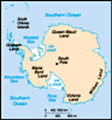
Antarctica Location

Antarcticas map
Map of Antarctica


« back 1 10 20 30 40 50 60 70 80 ... 140 next »
South Orkney Islands / Islas Orcadas del Sur
Province of Tierra del Fuego, Antarctic Territory and South Atlantic Islands (Argentina)
The Argentine presence in the section began during the first decade of the 19th century; though some even affirm that it took place by the end of the previous century. However, navigators from other countries claimed the discovery of Antarctica for themselves. By the end of the 19th century the aid lent by Argentina to foreign expeditions, in particular that of Nordensjöld, Gerlache and Charcot, was properly appreciated. This included the assignment of Argentine place names to Antarctic geographic features, such as the Argentine Islands, Uruguay Islands, General Roca, Quintana, and others. In 1904 the permanent occupation began with the opening [View Full Entry]

skaboii - skaboii | Read The Full Entry | Subscribe | 0 Comment(s) | 54 Photo(s) | 0 Video(s) | 229 words | [diary=286036] | 2008-06-11 06:42:55

Base Esperanza / Hope Base
South Orkneyt Islands / Islas Orcadas del Sur
Base Esperanza / Hope Base

2.1 The Beagle Channel
Taken from above Ushuaia looking east.
Since we commenced our voyage to the Antarctic Peninsular in 2002 from the Beagle Channel, I re-read an edited version of Charles Darwin's 'The Voyage of the Beagle' when I returned home. As I now understand it, Captain Fitzroy and Darwin approached the Beagle Channel through the Murray Channel in whale boats after they had landed the three Fuegians that they had on board at Wulaia just to the south of the Murray Channel. They returned to the Fuegian camp about a week later and again a year later in the Beagle in 1834. They then appear to have sailed [View Full Entry]

AndrewGeorgeNetting - Andrew George Netting | Read The Full Entry | Subscribe | 0 Comment(s) | 5 Photo(s) | 0 Video(s) | 369 words | [diary=286719] | 2008-06-13 03:22:13

2.2 The Northern Shore
2.3 The Beagle Channel
2.4 The Beagle Channel

3.1 Snow Island
3.1 Snow Island
A basaltic outcrop with cloud streaming from its top. Livingston Island is in the background.
One of the things that I had been really looking forward to when setting off for Antarctica in 2002 was to experience its grandeur. The snow-covered mountains disappearing into a blue vault; the enormous tabular icebergs floating past with some twenty stories above the waterline; glacier faces crumbling into the sea and the black of volcanic outcrops against a white backdrop of snow. As it turned out we did not quite get to see all of these things, partly because we were not in the right place for all of them and partly because, on that first visit, we had [View Full Entry]

AndrewGeorgeNetting - Andrew George Netting | Read The Full Entry | Subscribe | 0 Comment(s) | 7 Photo(s) | 0 Video(s) | 353 words | [diary=286720] | 2008-06-14 04:13:38

3.2 A snow-covered island
3.3 An enclosed bay on the Antarctic Peninsular
3.4 Paradise Bay

4.1 A Glacial Foot
4.1 A Glacial Foot
The end of this glacier was at least 30 metres high and contained a deep blue grotto.
The title is from the 2002 voyage and was one of the Naturalist, Jane's, favourite 'silly questions'. The other is, while seated in a zodiac: "How high above sea level are we?" The only response to this is: "Put your head in the water so you can taste it, and then follow it in"! Anyway, back to the glaciers. A much better question would, of course, be: "When do we not see a glacier?", because they are indeed almost everywhere. The hills and valleys slope down to the sea and there are snow-covered cliffs of one to one hundred meters [View Full Entry]

AndrewGeorgeNetting - Andrew George Netting | Read The Full Entry | Subscribe | 0 Comment(s) | 5 Photo(s) | 0 Video(s) | 585 words | [diary=286721] | 2008-06-15 08:03:13

4.2 An Iceberg with a Chasm
4.3 At the edge of newly formed pack ice
4.4 The Foot of another Glacier

5.01 A Cliff Face on Seymour Island
The cretaceous-tertiary (KT) boundary slopes from left to right just above the large U-shaped scree accumulation.
One morning on the 2008 voyage we awoke to find ourselves anchored within a zodiac's ride of Seymour Island on the east coast of the Antarctic Peninsular. I had long been awaiting this moment because Seymour Island is unique in that the cretaceous/tertiary (KT) boundary, the boundary at 65 million years ago between the end of the age of the dinosaurs and the present age of the mammals, is clearly evident. And not only evident but exposed because it is too cold for plant growth and yet snow- and ice-free, being in the lee of James Ross Island. So our [View Full Entry]

AndrewGeorgeNetting - Andrew George Netting | Read The Full Entry | Subscribe | 0 Comment(s) | 10 Photo(s) | 0 Video(s) | 944 words | [diary=286722] | 2008-06-15 09:25:33

5.02 Fossils from Seymour Island
5.03 Another Fossil from Seymour Island
5.04 Some Fossilised Logs

6.1 Deception Island
The entrance, know as Neptune's Bellows, to the caldera where Whaler's Harbour is situated.
In 2002 we approached Whaler's Harbour in the early evening in driving sleet and this only added to my somewhat sombre thoughts about whaling. I'd always been depressed by the thought of whaling: such magnificent animals being killed and boiled down so that, initially, Europeans and then Americans could see in the dark. If you want to know what darkness really means, come to Whaler’s Harbour, Deception Island. Here, one lands on a beach of black volcanic ash with muddy water trickling across it: to the right is a line of rusty cylindrical tanks which held the whale oil - [View Full Entry]

AndrewGeorgeNetting - Andrew George Netting | Read The Full Entry | Subscribe | 0 Comment(s) | 6 Photo(s) | 0 Video(s) | 374 words | [diary=286723] | 2008-06-15 13:29:33

6.2 The whale oil storage tanks
6.3 The whale oil storage tanks
6.4 Hans A. Gulliksen

7.1 A humpback whale
Photographed from the Polar Pioneer.
One afternoon in 2002 some of the zodiacs took a short tour from Neko Harbour but noticed that others were hovering around close to the ship. What was encouraging them to circle around in that somewhat erratic manner? It soon became apparent as we approached that there was a minke whale there flirting with the zodiacs. We had already experienced some social interaction with humpback whales when we were on board ship, but this was clearly something new. It would surface and blow and then show us its dorsal fin. Then it would slowly roll so you could see its [View Full Entry]

AndrewGeorgeNetting - Andrew George Netting | Read The Full Entry | Subscribe | 0 Comment(s) | 8 Photo(s) | 0 Video(s) | 330 words | [diary=286724] | 2008-06-17 14:19:46

7.2 A minke whale
7.3 The underbelly of the minke whale
7.4 The stain in the underbelly of the minke whale canjust be discerned

8.1 A gentoo penguin rookery
There is a pink algal growth on the snow in the background.
I had a laminated poster in my lab of emperor, I think, penguins crossing a small ice shelf in the half light towards their rookery. I had sub-titled it 'When the going gets tough the tough get going'. I had hoped that this would provide some inspiration to those slothful students that passed through from time to time! So, it was with some anticipation that I came down to Antarctica to, among other things, see the real thing. The first penguins we saw in any numbers were gentoos and I think that Bernard Stonehouse may have had them in mind [View Full Entry]

AndrewGeorgeNetting - Andrew George Netting | Read The Full Entry | Subscribe | 0 Comment(s) | 8 Photo(s) | 0 Video(s) | 399 words | [diary=286729] | 2008-06-17 14:38:06

8.2 A gentoo penguin heading for the water
8.3 A gentoo at Port Lockroy in 2008
8.4 A chinstrap rookery

9.1 A leopard seal resting on an iceberg
These leopard seals were photographed near Asrtolabe Island.
Hydrurga is the Latin generic name for the leopard seal and there were certainly leopard seals in the water at Hydrurga Rocks. In fact, they seemed to be interested in the zodiacs and followed us into the bay and swam about off-shore for perhaps half an hour. They were no doubt there because there was a chinstrap penguin colony a few hundred metres from where we landed and the chinstraps were well aware of their presence. There were also several dozen fur seals, their external ears being evident, which mostly lay around doing nothing unless they felt that one had [View Full Entry]

AndrewGeorgeNetting - Andrew George Netting | Read The Full Entry | Subscribe | 0 Comment(s) | 7 Photo(s) | 0 Video(s) | 390 words | [diary=286725] | 2008-06-17 14:54:17

9.2 Another leopard seal on an iceberg
9.3 Another leopard seal on an iceberg
9.4 A fur seal at Melchior Islands

The wildlife on the land around the Antarctic Peninsular is dominated by penguins and, to a lesser extent, resting seals. However, one is certainly aware of skuas because they can be seen in all of the penguin rookeries where they attack and devour disabled and abandoned chicks. Cormorants are also quite common and we did see a rookery near the Almirante Brown Station in Paradise Bay. These birds are remarkable in that they can dive tens of metres below the surface of the sea to catch fish for food. But what really brought it home to us that the centre [View Full Entry]

AndrewGeorgeNetting - Andrew George Netting | Read The Full Entry | Subscribe | 0 Comment(s) | 4 Photo(s) | 0 Video(s) | 145 words | [diary=286726] | 2008-06-17 15:04:00

10.2 A skua bathing pool and
10.3 A blue-eyed cormorant rookery at Paradise Bay near Almirante Brown Station
10.4 A stranded giant jelly fish on a beach on Snow Hill Island


« back 1 10 20 30 40 50 60 70 80 ... 140 next »