Cook Islander Economy, Cook Islands Economy
Advertisement
Economy - overview: Like many other South Pacific island nations, the Cook Islands' economic development is hindered by the isolation of the country from foreign markets, the limited size of domestic markets, lack of natural resources, periodic devastation from natural disasters, and inadequate infrastructure. Agriculture provides the economic base with major exports made up of copra and citrus fruit. Manufacturing activities are limited to fruit processing, clothing, and handicrafts. Trade deficits are offset by remittances from emigrants and by foreign aid, overwhelmingly from New Zealand. In the 1980s and 1990s, the country lived beyond its means, maintaining a bloated public service and accumulating a large foreign debt. Subsequent reforms, including the sale of state assets, the strengthening of economic management, the encouragement of tourism, and a debt restructuring agreement, have rekindled investment and growth.
GDP:
GDP - real growth rate: 7.1% (2001 est.)
GDP - per capita: Purchasing power parity - $5,000 (2001 est.)
GDP - composition by sector: Agriculture: 17% industry: 7.8% services: 75.2% (2000 est.)
Population below poverty line: NA
Household income or consumption by percentage share: Lowest 10%: NA highest 10%: NA
Distribution of family income - Gini index:
Inflation rate (consumer prices):
Labor force: 8,000 (1996)
Labor force - by occupation: Agriculture 29%, industry 15%, services 56% note: shortage of skilled labor (1995)
Unemployment rate: 13% (1996)
Budget: Revenues: $28 million expenditures: $27 million, including capital expenditures of $3.3 million (FY00/01 est.)
Industries: Fruit processing, tourism, fishing, clothing, handicrafts
Industrial production growth rate: 1% (2002)
Electricity - production: 27 million kWh (2002)
Electricity - production by source:
Electricity - consumption: 25.11 million kWh (2002)
Electricity - exports: 0 kWh (2002)
Electricity - imports: 0 kWh (2002)
Oil - production: 0 bbl/day (2001 est.)
Oil - consumption: 450 bbl/day (2001 est.)
Oil - exports: NA
Oil - imports: NA
Oil - proved reserves:
Natural gas - production:
Natural gas - consumption:
Natural gas - exports:
Natural gas - imports:
Natural gas - proved reserves:
Agriculture - products: Copra, citrus, pineapples, tomatoes, beans, pawpaws, bananas, yams, taro, coffee; pigs, poultry
Exports: $9.1 million (2000)
Exports - commodities: Copra, papayas, fresh and canned citrus fruit, coffee; fish; pearls and pearl shells; clothing
Exports - partners: Australia 34%, Japan 27%, New Zealand 25%, US 8% (2000)
Imports: $50.7 million (2000)
Imports - commodities: Foodstuffs, textiles, fuels, timber, capital goods
Imports - partners: New Zealand 61%, Fiji 19%, US 9%, Australia 6%, Japan 2% (2000)
Debt - external: $141 million (1996 est.)
Economic aid - recipient: $13.1 million; note - New Zealand continues to furnish the greater part (1995)
Currency:
Currency code:
Exchange rates: New Zealand dollars per US dollar - 1.5087 (2004), 1.7221 (2003), 2.1622 (2002), 2.3788 (2001), 2.2012 (2000)
Fiscal year: 1 April - 31 March
Advertisement
The information here has been derived from Public Domain Sources such as the CIA World Factbook. No liability can be taken for any inaccuracies.
Tot: 0.045s; Tpl: 0.008s; cc: 6; qc: 6; dbt: 0.0134s; 1; m:domysql w:travelblog (10.17.0.13); sld: 1;
; mem: 1.1mb


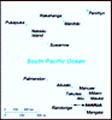
 Named after Captain COOK, who sighted them in 1770, the islands became a British protectorate in 1888. By 1900, administrative control was transferred to New Zealand; in 1965 residents chose self-government in free association with New Zealand. The e...