Advertisement
Published: February 29th 2012
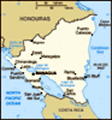
I first met Paulette last year. She is, without doubt, one of the most “good” people I have ever been privileged to meet. A retired social worker from England, she now runs La Mariposa Escuela de Español, a language school in central Nicaragua which is devoted to supporting, and putting every possible córdoba back into, the local community through a wide range of methods, from an extensive home-stay programme whereby students live with local families, to purchasing only locally-grown fruit and vegetables for consumption at the school, to funding all sorts of projects – including village wells, market gardens and local schools – in which her students often volunteer. She also does all she can to operate the school and the projects in which she is involved in as eco-friendly manner as possible. I was hugely taken when she told me that, during her working life in Sheffield, her ambition for her retirement had been to have “a tree in the garden”. Now she lives in the middle of a large plot of land where bananas, coconuts, papaya, mangos, avocados, tangerines and oranges all flourish: no lack of trees here. Some time back, she teamed up with the delightful Bergman, a
lively Nicaraguan, who has compiled a detailed teaching programme used exclusively by La Mariposa.
Feeling handicapped by my total lack of Spanish at the outset of my travels in Central America last year, I signed up for four days’ intensive tuition… and my brain soon complained vigorously at the effort it was being asked to undertake. This year, contemplating a lengthy overland trip around South America with my gap-year niece, Jo, I thought a return visit would be in order. Besides, coming back to Nicaragua would give me the chance to see the friends I’d made last year, and Jo a nice soft introduction to our Big Trip. This time I made sure we booked ourselves a full week at La Mariposa, with classes only in the morning: just a little kinder on our grey cells. After a couple of days at Eskew’s place in Managua to adjust our body-clocks and to recover from the chill that had gripped England the previous week (we’d driven to Heathrow through a magically snowy south London), we packed our holdalls and caught the crowded “microbus” up the hill to La Concepción, one of the towns of Nicaragua’s picturesque Pueblos Blancos region.
Jo was already doing very well in her first brush with the Tropics and the Third World. Within 48 hours, she had taken a night-time cab, a crowded bus and two “microbuses” – minivans which, in the UK might seat a dozen at a push, but which here (as in East Africa’s matatus, and countless other close relations around the world) are invariably carrying nearly twice that number – and seemed no worse for the experience. She was taking great delight in everything around her, from the variety of transport on Managua’s main roads to the glorious colours of the vegetation and birds, and would have very happily befriended every stray dog, cat and small child we encountered. (I have visions of needing to hire an ocean liner in June at the end of what will have been nearly five months on the road to take home everything that takes her fancy.)
At La Mariposa, Jo was in seventh heaven. Not only does Paulette support the local people, she takes in all sorts of strays and unwanted animals and birds, from the expanding canine population to a quartet of white-faced capuchin monkeys, a dozen or more parrots, a trio
of toucans and even a double-banded thick-knee (think: lapwing on steroids), and that’s not forgetting the cats, ducks and hens. The latest toucan was in a large enclosure next to our room. I returned from lunch one day to find Jo inside the enclosure with Manuel, one of the ground staff, feeding the toucan and her duck companion. I raced to get my camera and joined them. Toucans are much like parrots in their curiosity, and this one attempted a good peck at my camera and then, deciding I had exceeded my photo quota, promptly pooped on my shorts. If it is lucky to have a pigeon poop on you, how much luckier – given the rarity value – to have a toucan do so… or so I consoled myself as I went off to change.
The monkeys were at least as inquisitive as their species’ reputation. One would come up around my hip level to ferret around in a proffered pocket (it was wise to clear out a pocket for inspection beforehand, otherwise your room key might be away and dropped on the far side of the enclosure before you could even think up an expletive), while its
partner-in-mischief would tackle me from above, reaching out for clips, ponytails, or simply a handful of hair. Their old-man wise faces and their chittering enchanted us. At night, they would crowd together on the open-sided wooden ledge at the back of the cage, no longer teasing and fighting each other, but cosied up for reassurance.
I had wondered what it would be like coming back to La Mariposa and finding a new collection of students in residence. No more Anne from western Virginia with her sweet-natured home-schooled kids; no more Jeremy with his flirtatious sense of humour; no more Quebecois couple chatting to me in French and scaring away my beginner’s Spanish. But I need not have worried. One of the great joys of La Mariposa is the number of simpaticos it attracts. Paulette’s website bravely includes sections entitled “Do Not Come If…” and “Do Come If…”. I don’t know how many people actually stop and read them, but the effect – at least in my experience – is that she attracts a wonderful range of people but who are yet very like-minded. This year, North America dominated. Of the US states, at least Tennessee, Ohio, Texas, West Virginia,
New Hampshire, Massachusetts, Washington and even Alaska featured, and that’s without my straining the memory too much. North of the border also got a name-check with the wonderful, motherly Chris from Toronto who took Jo under her wing one afternoon when I opted for a little shut-eye rather than that day’s outing, and perma-student Sharon from Vancouver. We were the lone British representatives, although Europe was further represented by a small Dutch contingent, and the Rest-Of-The-World by Kang from South Korea (via London and Missouri). We included several lawyers, teachers, university lecturers, health-care professionals, sociologists, students and businessmen. Sebastian even had the chutzpah to say offhandedly that he was in “import/export”; sadly, for the more romantically-inclined of us, it later appeared that he was no James Bond or undercover CIA agent, simply a businessman and ex-lawyer to boot. Instead of Anne’s kids, we had Allie, Sebastian’s delightful ten-year-old daughter. Not a morning person (I could sympathise), she would become incredibly lively with her story-telling at dinnertime, clearly relishing the time away from her teenage brothers.
In my enthusiasm to cram in as many lessons as possible last year, I had missed out on the afternoon activities. Staying at La
Mariposa is an extraordinarily good deal. Approximately US$350/week gets you full board and accommodation in the lodge itself, four hours of one-on-one Spanish lessons five days a week, and a variety of outings, from visiting local farmers and artisans, to cultural visits around local towns, and more energetic trips to hike local volcanoes and go horse-riding. On the Sunday, we arrived in time to join the evening’s trip to Granada for dinner and the opening concert for the start of “Poetas Del Mundo”, a week-long international poetry festival. Katia Cardenal – of whom I had heard, mainly in connection with the tragic early death of her brother and co-star – sang with the voice of an angel outside Granada’s town hall, enchanting old and young, Nica and gringo alike. It really was a family event, with even the smallest kids out with their parents to mill around and soak up the atmosphere.
The party looked set to continue all week – I wondered, idly, if anyone actually did any work that week in Granada – but we didn’t dip into it again until Wednesday afternoon, when we clubbed together to fund a trip to the festival’s carnival for a
bus-ful of kids from one of the local schools that Paulette supports, and went along ourselves. This was my third Nica carnival/parade, and, like the others, it was happily incomprehensible to the gringo (maybe only slightly less so to the Nica tourists?), but nevertheless very lively, noisy and colourful with groups of dancers and actors from various parts of the country, each in different outfits and partying to different music. From our ringside seat at Eskew’s favourite bar with a glass of one of Nicaragua’s finest beverages in hand, we could watch the action, both intended and otherwise: the heavily made-up young girl stifling a yawn, the drummer-lads getting the giggles, and an effete dancer interrupting his steps for a quick drag on his cigarette.
On the Thursday we arranged a breakaway activity. Paulette is happy to organise alternatives to the scheduled activities if logistics permit, though she charges for doing so. “Let’s take the kids to the seaside tomorrow,” was the gist of the idea part-way through the second Toña (one of Nicaragua’s local beers) on Wednesday evening, and we soon found other takers. Seven of us, including the three “kids” (though Jo, and Paulette’s daughter, Guillermina, might
complain about my putting them in this category with Allie), piled into a camioneta and took off for La Boquita on Nicaragua’s Pacific coast. I had been there once before, but on a crowded Saturday afternoon. Mid-week we had the place to ourselves, except for a few locals tending their boats and fishing nets, and those running the open-sided, thatch-roofed restaurant in which we set ourselves up for the next few hours. Jo and I had diligently brought our “homework” – I had an essay to do for the next day, and she was trying to persuade a few verb conjugations to take hold in her head – to the incredulity of the others, but we soon rewarded ourselves with the first Toña of the afternoon, a bare-footed walk along the beach, and a paddle in the ocean.
On Monday’s activity had been of a totally different nature: to an impoverished local village with a poisonous view. Panama sits in the fall-out zone of Volcán Masaya, one of Nicaragua’s more or less permanently smoking volcanoes. The land is poor, the people beset by respiration problems, and metal corrodes in a matter of months. Paulette has been involved with the
village for several years and, through donations from her students and guests, has been instrumental in improving and extending the school’s premises and teaching facilities. A particularly popular part of the school is the reading room now managed by a fulltime member of staff paid for by La Mariposa.
Just beyond this is the local pink elephant. A worthy group of diplomatic wives collected funding for new toilets to replace the single shallow-dug and very public latrine. Despite emphatic and repeated advice to the contrary, they installed a trio of Western-style flush toilets. Panama does not have its own water source. Instead the villagers have to spend several days a week trailing down and back up the hill to the nearest public well simply to cater for their most basic water needs. Yes, the toilets worked beautifully at the “opening” ceremony, but they never flushed again. Instead, Paulette’s team did what should have been done in the first place: dug 18 metre-deep latrines into the underlying volcanic rock, sufficient to ensure human waste disposal for the foreseeable future, given the bio-degrading properties of this kind of rock. Yet this is not a village wasting time feeling sorry for itself.
For a start, living is too time-consuming for that, but the smiles on the faces of the children and adults as we meandered around the school and a women’s handicrafts co-operative would shame far better-off people in the West. Jo didn’t say much on the way back to La Mariposa that lunchtime; I could only guess what might be going through her head.
In between outings and Toñas, we even did a little studying. Kinema patiently corrected each of my “por’s” and “para’s” (I swear there’s little logic to distinguish the different uses for these two prepositions), and managed not to get too upset when, time and again, I massacred the “pretérito” tense of her language. Sweet-smiling Jamil took me through two more tenses, but fortunately the imperfect and future tense have infinitely fewer “irregulares” so I fared better with them. My Spanish “nature” vocabulary improved when Elizabeth took me out for a walk in the grounds during our conversation lesson, and even further when Kinema brought a children’s book on the rainforest for me to read in my lesson with her. Hopefully some of it would stick until our walk in southern Nicaragua’s Reserva Biológica Indio-Maíz the next
week; maybe I’d even find the odd word or two still there by the time we get to the Ecuadorean Amazon in June. A few adjective constructions found their way into my head when I wasn’t looking, and the confusing reflexives and panoply of personal pronouns were finally explained to me, though I’ll have to work on them a bit harder before they sink in properly.
La Mariposa is a tranquil haven. Many guests stay there for several weeks or even months, and I’ve met some who use it as their sole base for exploring this wonderful corner of Central America. However, a week was enough for us. Furnished with a tiny bit more of the language than we had had eight days’ earlier, we were ready to take off and Explore.
But I’ll be back…
Advertisement
Tot: 0.11s; Tpl: 0.02s; cc: 12; qc: 20; dbt: 0.08s; 1; m:domysql w:travelblog (10.17.0.13); sld: 1;
; mem: 1.2mb







Nicky
non-member comment
The school sounds fantastic, it's firmly on my todo list for the future, especially as I could never figure out para/por either. Great to hear from you and looking forward to the next installment.