Swazi Economy, Swaziland Economy
Advertisement
Economy - overview: In this small, landlocked economy, subsistence agriculture occupies more than 80% of the population. The manufacturing sector has diversified since the mid-1980s. Sugar and wood pulp remain important foreign exchange earners. Mining has declined in importance in recent years with only coal and quarry stone mines remaining active. Surrounded by South Africa, except for a short border with Mozambique, Swaziland is heavily dependent on South Africa from which it receives about nine-tenths of its imports and to which it sends nearly three-quarters of its exports. Customs duties from the Southern African Customs Union and worker remittances from South Africa substantially supplement domestically earned income. The government is trying to improve the atmosphere for foreign investment. Overgrazing, soil depletion, drought, and sometimes floods persist as problems for the future. More than one-fourth of the population needed emergency food aid in 2004 because of drought, and more than one-third of the adult population was infected by HIV/AIDS.
GDP: 1.4% (2004)
GDP - real growth rate: 2.5% (2004 est.)
GDP - per capita: Purchasing power parity - $5,100 (2004 est.)
GDP - composition by sector: Agriculture: 16.1% industry: 43.4% services: 40.5% (2004 est.)
Population below poverty line: 40% (1995)
Household income or consumption by percentage share: Lowest 10%: 1% highest 10%: 50.2% (1995)
Distribution of family income - Gini index:
Inflation rate (consumer prices):
Labor force: 383,200 (2000)
Labor force - by occupation: NA
Unemployment rate: 34% (2000 est.)
Budget: Revenues: $494.6 million expenditures: $552.7 million, including capital expenditures of $147 million (2004 est.)
Industries: Mining (coal, raw asbestos), wood pulp, sugar, soft drink concentrates, textile and apparel
Industrial production growth rate: 3.7% (FY95/96)
Electricity - production: 402 million kWh (2002)
Electricity - production by source:
Electricity - consumption: 1.173 billion kWh (2002)
Electricity - exports: 0 kWh (2002)
Electricity - imports: 799 million kWh; note - electricity supplied by South Africa (2002)
Oil - production: 0 bbl/day (2001 est.)
Oil - consumption: 3,500 bbl/day (2001 est.)
Oil - exports: NA
Oil - imports: NA
Oil - proved reserves:
Natural gas - production:
Natural gas - consumption:
Natural gas - exports:
Natural gas - imports:
Natural gas - proved reserves:
Agriculture - products: Sugarcane, cotton, corn, tobacco, rice, citrus, pineapples, sorghum, peanuts; cattle, goats, sheep
Exports: $900.1 million f.o.b. (2004 est.)
Exports - commodities: Soft drink concentrates, sugar, wood pulp, cotton yarn, refrigerators, citrus and canned fruit
Exports - partners: South Africa 59.7%, EU 8.8%, US 8.8%, Mozambique 6.2% (2004)
Imports: $1.14 billion f.o.b. (2004 est.)
Imports - commodities: Motor vehicles, machinery, transport equipment, foodstuffs, petroleum products, chemicals
Imports - partners: South Africa 95.6%, EU 0.9%, Japan 0.9%, Singapore 0.3% (2004)
Debt - external: $320 million (2002 est.)
Economic aid - recipient: $104 million (2001)
Currency:
Currency code:
Exchange rates: Emalangeni per US dollar - 6.4597 (2004), 7.5648 (2003), 10.5407 (2002), 8.6092 (2001), 6.9398 (2000)
Fiscal year: 1 April - 31 March
Advertisement
The information here has been derived from Public Domain Sources such as the CIA World Factbook. No liability can be taken for any inaccuracies.
Tot: 0.028s; Tpl: 0.015s; cc: 3; qc: 2; dbt: 0.0045s; 1; m:domysql w:travelblog (10.17.0.13); sld: 1;
; mem: 1.1mb


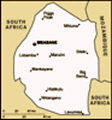
 Autonomy for the Swazis of southern Africa was guaranteed by the British in the late 19th century; independence was granted in 1968. Student and labor unrest during the 1990s pressured the monarchy (one of the oldest on the continent) to grudgingly a...