Burundian Government, Burundi Government
Advertisement
Country name: Conventional long form: Republic of Burundi conventional short form: Burundi local long form: Republika y'u Burundi local short form: Burundi former: Urundi
Government type: Republic
Capital: Bujumbura
Administrative divisions: 16 provinces; Bubanza, Bujumbura, Bururi, Cankuzo, Cibitoke, Gitega, Karuzi, Kayanza, Kirundo, Makamba, Muramvya, Muyinga, Mwaro, Ngozi, Rutana, Ruyigi
Independence: 1 July 1962 (from UN trusteeship under Belgian administration)
National holiday: Independence Day, 1 July (1962)
Constitution: 13 March 1992; provided for establishment of a plural political system; supplanted on 20 October 2004 by a provisional constitution approved by the parliament which extended the transition; a 28 February 2005 popular referendum ratified the new constitution which set ethnic quotas for government positions, and tentatively scheduled general elections for April 2005
Legal system: Based on German and Belgian civil codes and customary law; has not accepted compulsory ICJ jurisdiction
Suffrage: NA years of age; universal adult
Executive branch: Chief of state: President Domitien NDAYIZEYE (since 30 April 2003); note - NDAYIZEYE, a Hutu, was sworn in as president for the second half of the three-year transitional government inaugurated on 1 November 2001; Vice President Frederic NGENZEBUHORO (since 11 November 2004) head of government: President Domitien NDAYIZEYE (since 30 April 2003); note - NDAYIZEYE, a Hutu, was sworn in as president for the second half of the three-year transitional government inaugurated on 1 November 2001; Vice President Frederic NGENZEBUHORO (since 11 November 2004) cabinet: Council of Ministers appointed by president elections: NA; current president assumed power on 30 April 2003 as part of the transitional government established by the 2000 Arusha Accord; note - next presidential election is scheduled for 22 April 2005
Legislative branch: Bicameral, consists of a National Assembly or Assemblee Nationale (expanded from 121 to approximately 140 seats under the transitional government inaugurated 1 November 2001; members are elected by popular vote to serve five-year terms) and a Senate (54 seats; term length is undefined, the current senators will likely serve out the three-year transition period) elections: last held 29 June 1993 (next was scheduled to be held in 1998, but was suspended by presidential decree in 1996; elections are currently planned to be held by April 2005) election results: percent of vote by party - FRODEBU 71.04%, UPRONA 21.4%, other 7.56%; seats by party - FRODEBU 65, UPRONA 16, civilians 27, other parties 13
Judicial branch: Supreme Court or Cour Supreme; Constitutional Court; Courts of Appeal (there are three in separate locations); Tribunals of First Instance (17 at the province level and 123 small local tribunals)
Political parties and leaders: The three national, mainstream, governing parties are: Unity for National Progress or UPRONA [Jean-Baptiste MANWANGARI, secretary general]; Burundi Democratic Front or FRODEBU [Jean MINANI, president]; National Council for the Defense of Democracy, Front for the Defense of Democracy of CNDD-FDD [Pierre NKURUNZIZA, president] note: a multiparty system was introduced after 1998, included are: National Resistance Movement for the Rehabilitation of the Citizen or MRC-Rurenzangemero [Epitace BANYAGANAKANDI]; Party for National Redress or PARENA [Jean-Baptiste BAGAZA]
Political pressure groups and leaders: Loosely organized Hutu and Tutsi militias, often affiliated with Hutu and Tutsi extremist parties or subordinate to government security forces
International organization participation: ACCT, ACP, AfDB, AU, CEPGL, FAO, G-77, IBRD, ICAO, ICCt, ICFTU, ICRM, IDA, IFAD, IFC, IFRCS, ILO, IMF, Interpol, IOC, IOM (observer), ISO (subscriber), ITU, MIGA, NAM, OPCW, UN, UNCTAD, UNESCO, UNIDO, UPU, WCO, WHO, WIPO, WMO, WToO, WTO
Diplomatic representation in the US: Chief of mission: Ambassador Antoine NTAMOBWA chancery: Suite 212, 2233 Wisconsin Avenue NW, Washington, DC 20007 telephone: [1] (202) 342-2574 FAX: [1] (202) 342-2578
Diplomatic representation from the US: Chief of mission: Ambassador James Howard YELLIN embassy: Avenue des Etats-Unis, Bujumbura mailing address: B. P. 1720, Bujumbura telephone: [257] 223454 FAX: [257] 222926
Flag description: Divided by a white diagonal cross into red panels (top and bottom) and green panels (hoist side and outer side) with a white disk superimposed at the center bearing three red six-pointed stars outlined in green arranged in a triangular design (one star above, two stars below)
Advertisement
The information here has been derived from Public Domain Sources such as the CIA World Factbook. No liability can be taken for any inaccuracies.
Tot: 0.042s; Tpl: 0.01s; cc: 3; qc: 8; dbt: 0.0137s; 1; m:domysql w:travelblog (10.17.0.13); sld: 1;
; mem: 1.1mb


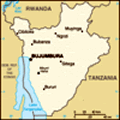
 Burundi's first democratically elected president was assassinated in October 1993 after only one hundred days in office. Since then, some 200,000 Burundians have perished in widespread, often intense ethnic violence between Hutu and Tutsi factions. H...