Advertisement
Published: July 10th 2010
Hi all,
Our Galapagos adventure came to its end, together with Ecuadorian experience. We are about to return to Peru, only this time we are about to explore the Northern part. After a week of endless wildlife and beautiful scenery, we are changing “atmosphere” into desert like views, and shifting to a bit more emphasis on cultures & archeology, abundant in this part of Peru. True, the ancient pre-colombian cultures prevailed in the northern part of Peru are less famous than the world-wide glorious Inca culture. Nevertheless, we learnt that these cultures -
Chimu. Moche and Lambayeque, to name a few, were not less sophisticated, organized or creative than the Inca culture. I believe the reason that these cultures are less “famous” is due to the fact that the Spaniards who conquered the continent in the 16th century, encountered only the Incas - that by that time had already ruled enormous parts of the continent, hence, only their culture was documented in detail by the Spaniards, but not these of their predecessors.
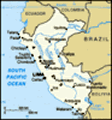
After crossing the Ecuadorian border, we arrived early morning at a big city
Chiclayo, located a few kilometers inland from the Pacific coast and 770 kilometers
from the nation's capital, Lima. We had a nice welcome by a thief, trying to steal our books and schooling bag, but thanks to our alert taxi driver, the bag is safe now... Anyhow, the main reason for our visit in this city was it is located in part of the 'Moche civilization, existed from years A.D. 100 to A.D. 800.This culture had a high understanding of hydraulic engineering as manifested by their canal system which allowed them to use rivers to irrigate their land. This allowed them to have a surplus of crops and a solid economy allowing their society to develop. The Mochicans also used copper in the fabrication of weapons, tools, and ornamental objects. The Mochicans are considered the producers of the best ceramic artifacts because of the elaborate designs of the pottery. These designs represent religious themes, humans, animals, and scenes of ceremonies and myths reflecting their perception of the world. They are noted for their expressiveness, perfection, and realism. Most of the findings are beautifully displayed in the Bruning Museum near Chiclayo, and visiting that Museum was a good way to learn a bit about that culture.
To make our visit complete we also
visited the
Royal Tombs of Sipán museum, opened in 2003. This museum exhibits the most important archaeological remains of the Mochica Culture, in an exceptional exhibition that with maximum scientific accuracy, shows the jewels, emblems and ornaments found in 1987 in the tomb of a Mochica government leader called the Lord of Sipán, considered to be the most important governor of ancient Peru, some 1700 years ago. The Museum is formed in a pyramid shape, inspired by the Mochica sanctuaries; All of the exhibits are original and each has been carefully cleaned and restored. What is so special about this tomb is the significant quantity of well-preserved (and displayed) gold and silver objects, jewels, ceramics and carved wood of incredible value that were found in it. The Lord of Sipan, was found in a sarcophagus made of wood (first found in America), next to his head were the skeletons of two young women, and at his sides a skeleton of a dog and two lamas. Also found in the tomb skeletons of young males; the skeletons found intact but without the bottom part of their legs, hence believed to be the Lord's vigilantes, and a symbol for their constant remain
at their Lord's service, unable to leave him for eternity. The Lord was all covered with gold, silver and copper, chest protector with jewels and gold necklaces. His skull rested on a big golden plate. Although very intense and dense with displays and findings, the kids were eager to learn and understand all about this incredible exhibition, and since there were no explanations in English, we had to practice our Spanish skills, once again...
In Chiclayo we also paid a visit to one of the liveliest markets in Peru, a concert of colors, smells, noises and bizarre items found in the witchcraft section (herbs, skulls, fertility pastes, mummified snakes, staffed condor, lama fetuses and more...).
Time to leave Chiclayo. We continue on to
Trujillo, the third largest city in Peru, only 3 hours south of Chiclayo. Again, our main reason for visiting this city is it's proximity to important sites where the Moche and Chimu pre-Inca civilizations evolved. We accommodate ourselves in a cozy hospedaje (hostel) in a fishing village called
Huanchaco, also known for its great surfing beach and facilities for surfers who flock here from all over.
Fresh and sound, after a pancake breakfast (I
 Fixing the Net
Fisherman in Huanchaco Bay, Perufinally had all ingredients at hand...) - we start our “archeological day” with a visit to
Chimu mud city of Chan Chan. Chan Chan is considered to be the
largest Pre-Columbian city in South America, and it is the world's largest city built out of adobe (burnt clay, used until today to construct most of Peruvian rural houses). Chan-Chan, has been compared with Teotihuacan in Mexico, and the ancient cities of Egypt. The city was built by the Chimu (a late intermediate period civilization which grew out of the remnants of the Moche civilization), around AD 850 and lasted until its conquest by the Inca Empire in AD 1470. It is estimated that around 30,000 people lived in this great city. We were impressed especially with the central palace, its surrounding mud walls, all adorned with sky, earth and under-earth accurate and delicate motifs, in some places well-preserved, although the whole site is in a constant danger of fluids, looting and earthquakes. We wandered through the chambers, burial sites, an interior lagoon (not dry!), and were struck by the enormous measures and complex construction of this unusual city, all made from MUD!
In a very stressed day, we continued
Purple Sunset
Huanchaco Bay, Peru on to a 2nd important site called
Huaca del Arco Iris (Temple of the Rainbow), another mud-construction formed in a pyramid shape (20m*20m*10m high), decorated with strange reliefs of ancient warriors and animals.
We covered this site in half an hour and continued on with our taxi driver (attached to us for the rest of the day..) to the 3rd and last site of the day -
Huaca de la Luna ("Temple of the Moon"). This is a large adobe brick structure built mainly by the Moche people. This shrine and the nearby Huaca del Sol ("Temple of the Sun"), are part of the remains of an ancient Moche capital city. The Huaca del Sol was partially destroyed and looted by Spanish conquistadors in the 17th century, while the Huaca de la Luna was left relatively untouched. It is believed today that the Huaca de la Luna served as a large ceremonial and religious site. Though today the Huaca de la Luna is mostly soft brown due to its adobe brickwork, just after its construction it would have been an impressive colorful site - We could still notice decorations on murals painted in black, bright red, sky blue, white,
Central Plaza
Mud City of Chan Chan, Peru and yellow. Naturally, the sun and weather has since faded these murals away, but with just a little bit of imagination one could imagine how this palace once looked like. The Huaca de la Luna itself is a large complex of three main platforms, each one serving a different function. One platform was destroyed by looters and so the central and southern platforms have been the focus of most excavations. One platform has yielded with a variety of fine ceramics, suggesting that it was used as a burial ground for the Moche religious elite, and the other platform, was the site of human sacrifice rituals which are depicted in a variety of Moche visual arts, most notably painted ceramics. After their sacrifice, bodies of victims would be hurled over the side of the Huaca and left exposed in the patios. This finding is supported by the discovery of multiple skeletons of adult males found at the foot of the rock, all of whom show signs of a tremendous trauma, usually a severe blow to the head, as the cause of death. All in all, it is a magnificent site, showing the power of these ancient cultures and sophisticated life style,
though long ago extinct, its remnants still standing still hundreds of years later. We return to the taxi driver, patiently waiting for us and we return to Huanchaco. On the way to our hostel, we make our daily stop at the bakery and ice-cream shop - 3 cones for the kids, and cakes for the adults... But the day is not over yet - we are urging to the near by shore, just before a terrific sunset is right above the horizon. We watch the fisherman at their routine work - fixing their torn fishing nets, collecting the catch of the day, drying their “
Caballitos de Totora” (“Little horses made of reed” - actually, these are traditional surfing boards made from local reeds, using the fisherman to 'surf' into open see and fish while 'surfing'!!). We are chatting with one of the locals, trying to understand his earnings of the day, and whereabouts of his crab sales, while I am taking photos of surfers with the scarlet and crimson sunset at the background. The long day is over. We are back in our hostel, and not much later we visit once again Senyora Clara, ordering her divine Royal Hamburgers (home-made
hams with bacon and fried eggs). Yummmmm....
Tomorrow morning, we are leaving Huanchaco towards Chachapoyas, to visit some extra great archeological sites (hope my family don't kill me for dragging them again to such sites...).
Until the next entry,
Miss you all,
Tal
** To view our Chiclayo & Trujillo Galleries, Just click on the following links:
Chiclayo & Trujillo Photos
Advertisement
Tot: 0.375s; Tpl: 0.05s; cc: 10; qc: 19; dbt: 0.0493s; 1; m:domysql w:travelblog (10.17.0.13); sld: 1;
; mem: 1.1mb







Itzhak
non-member comment
hello from Cusco
Very nice for you. so we were very close to each other For the last 10 days I just made Lima, Huaraz + Santa Cruz treck, Paracas and today arrived to Cusco! see you