Colombian Government, Colombia Government
Advertisement
Country name: Conventional long form: Republic of Colombia conventional short form: Colombia local long form: Republica de Colombia local short form: Colombia
Government type: Republic; executive branch dominates government structure
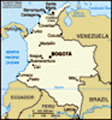
Capital: Bogota
Administrative divisions: 32 departments (departamentos, singular - departamento) and 1 capital district* (distrito capital); Amazonas, Antioquia, Arauca, Atlantico, Distrito Capital de Bogota*, Bolivar, Boyaca, Caldas, Caqueta, Casanare, Cauca, Cesar, Choco, Cordoba, Cundinamarca, Guainia, Guaviare, Huila, La Guajira, Magdalena, Meta, Narino, Norte de Santander, Putumayo, Quindio, Risaralda, San Andres y Providencia, Santander, Sucre, Tolima, Valle del Cauca, Vaupes, Vichada
Independence: 20 July 1810 (from Spain)
National holiday: Independence Day, 20 July (1810)
Constitution: 5 July 1991
Legal system: Based on Spanish law; a new criminal code modeled after US procedures was enacted into law in 2004; judicial review of executive and legislative acts; accepts compulsory ICJ jurisdiction, with reservations
Suffrage: 18 years of age; universal
Executive branch: Chief of state: President Alvaro URIBE Velez (since 7 August 2002); Vice President Francisco SANTOS (since 7 August 2002); note - the president is both the chief of state and head of government head of government: President Alvaro URIBE Velez (since 7 August 2002); Vice President Francisco SANTOS (since 7 August 2002); note - the president is both the chief of state and head of government cabinet: Cabinet consists of a coalition of the two dominant parties - the PL and PSC - and independents elections: president and vice president elected by popular vote for a four-year term; election last held 26 May 2002 (next to be held May 2006) election results: President Alvaro URIBE Velez received 53% of the vote; Vice President Francisco SANTOS was elected on the same ticket
Legislative branch: Bicameral Congress or Congreso consists of the Senate or Senado (102 seats; members are elected by popular vote to serve four-year terms) and the House of Representatives or Camara de Representantes (166 seats; members are elected by popular vote to serve four-year terms) elections: Senate - last held 10 March 2002 (next to be held March 2006); House of Representatives - last held 10 March 2002 (next to be held March 2006) election results: Senate - percent of vote by party - NA%; seats by party - PL 28, PSC 13, independents and smaller parties (many aligned with conservatives) 61; House of Representatives - percent of vote by party - NA%; seats by party - PL 54, PSC 21, independents and other parties 91
Judicial branch: Four roughly coequal, supreme judicial organs; Supreme Court of Justice or Corte Suprema de Justicia (highest court of criminal law; judges are selected by their peers from the nominees of the Superior Judicial Council for eight-year terms); Council of State (highest court of administrative law; judges are selected from the nominees of the Superior Judicial Council for eight-year terms); Constitutional Court (guards integrity and supremacy of the constitution; rules on constitutionality of laws, amendments to the constitution, and international treaties); Superior Judicial Council (administers and disciplines the civilian judiciary; resolves jurisdictional conflicts arising between other courts; members are elected by three sister courts and Congress for eight-year terms)
Political parties and leaders: Colombian Communist Party or PCC [Jaime CAICEDO]; Conservative Party or PSC [Carlos HOLGUIN Sardi]; Democratic Pole or PDI [Samuel MORENO Rojas]; Liberal Party or PL [Juan Fernando CRISTO] note: Colombia has about 60 formally recognized political parties, most of which do not have a presence in either house of Congress
Political pressure groups and leaders: Two largest insurgent groups active in Colombia - Revolutionary Armed Forces of Colombia or FARC and National Liberation Army or ELN; largest anti-insurgent paramilitary group is United Self-Defense Groups of Colombia or AUC
International organization participation: BCIE, CAN, CDB, CSN, FAO, G-3, G-24, G-77, IADB, IAEA, IBRD, ICAO, ICC, ICCt, ICFTU, ICRM, IDA, IFAD, IFC, IFRCS, IHO, ILO, IMF, IMO, Interpol, IOC, IOM, ISO, ITU, LAES, LAIA, Mercosur (associate), MIGA, NAM, OAS, OPANAL, OPCW, PCA, RG, UN, UNCTAD, UNESCO, UNHCR, UNIDO, UPU, WCL, WCO, WFTU, WHO, WIPO, WMO, WToO, WTO
Diplomatic representation in the US: Chief of mission: Ambassador Luis Alberto MORENO Mejia chancery: 2118 Leroy Place NW, Washington, DC 20008 telephone: [1] (202) 387-8338 FAX: [1] (202) 232-8643 consulate(s) general: Atlanta, Beverly Hills, Boston, Chicago, Houston, Miami, New Orleans, New York, San Francisco, San Juan (Puerto Rico), and Washington, DC
Diplomatic representation from the US: Chief of mission: Ambassador William B. WOOD embassy: Calle 22D-BIS, numbers 47-51, Apartado Aereo 3831 mailing address: Carrera 45 #22D-45, Bogota, D.C., APO AA 34038 telephone: [57] (1) 315-0811 FAX: [57] (1) 315-2197
Flag description: Three horizontal bands of yellow (top, double-width), blue, and red; similar to the flag of Ecuador, which is longer and bears the Ecuadorian coat of arms superimposed in the center
Advertisement
The information here has been derived from Public Domain Sources such as the CIA World Factbook. No liability can be taken for any inaccuracies.
Tot: 0.019s; Tpl: 0.008s; cc: 3; qc: 2; dbt: 0.0028s; 1; m:domysql w:travelblog (10.17.0.13); sld: 1;
; mem: 1.1mb


 Colombia was one of the three countries that emerged from the collapse of Gran Colombia in 1830 (the others are Ecuador and Venezuela). A 40-year insurgent campaign to overthrow the Colombian Government escalated during the 1990s, undergirded in part...