Samoan Government, Samoa Government
Advertisement
Country name: Conventional long form: Independent State of Samoa conventional short form: Samoa former: Western Samoa
Government type: Mix of parliamentary democracy and constitutional monarchy
Capital: Apia
Administrative divisions: 11 districts; A'ana, Aiga-i-le-Tai, Atua, Fa'asaleleaga, Gaga'emauga, Gagaifomauga, Palauli, Satupa'itea, Tuamasaga, Va'a-o-Fonoti, Vaisigano
Independence: 1 January 1962 (from New Zealand-administered UN trusteeship)
National holiday: Independence Day Celebration, 1 June (1962); note - 1 January 1962 is the date of independence from the New Zealand-administered UN trusteeship, 1 June 1962 is the date that independence is celebrated
Constitution: 1 January 1962
Legal system: Based on English common law and local customs; judicial review of legislative acts with respect to fundamental rights of the citizen; has not accepted compulsory ICJ jurisdiction
Suffrage: 21 years of age; universal
Executive branch: Chief of state: Chief Tanumafili II MALIETOA (cochief of state from 1 January 1962 until becoming sole chief of state 5 April 1963) head of government: Prime Minister Sailele Malielegaoi TUILA'EPA (since 1996); note - TUILA'EPA served as deputy prime minister from 1992 and assumed the duties of acting prime minister in 1996, when former Prime Minister TOFILAU Eti Alesana resigned in poor health; TUILA'EPA was confirmed as prime minister (November 1998) after TOFILAU died; Deputy Prime Minister MISA Telefoni (since 2001) cabinet: Cabinet consists of 12 members, appointed by the chief of state on the prime minister's advice elections: upon the death of Chief Tanumafili II MALIETOA, a new chief of state will be elected by the Legislative Assembly to serve a five-year term; following legislative elections, the leader of the majority party is usually appointed prime minister by the chief of state with the approval of the Legislative Assembly
Legislative branch: Unicameral Legislative Assembly or Fono (49 seats - 47 elected by voters affiliated with traditional village-based electoral districts, 2 elected by independent, mostly non-Samoan or part-Samoan, voters who cannot, (or choose not to) establish a village affiliation; only chiefs (matai) may stand for election to the Fono from the 47 village-based electorates; members serve five-year terms) elections: election last held 3 March 2001 (next election to be held not later than March 2006) election results: percent of vote by party - NA%; seats by party - HRPP 30, SNDP 13, independents 6
Judicial branch: Court of Appeal; Supreme Court; District Court; Land and Titles Court
Political parties and leaders: Christian Democratic Party [leader NA]; Human Rights Protection Party or HRPP [Sailele Malielegaoi TUILA'EPA, chairman]; Samoan Democratic United Party or SDUP [LE MAMEA Ropati, chairman] (opposition)
Political pressure groups and leaders: NA
International organization participation: ACP, AsDB, C, FAO, G-77, IBRD, ICAO, ICCt, ICFTU, ICRM, IDA, IFAD, IFC, IFRCS, IMF, IMO, IOC, ITU, MIGA, OPCW, PIF, Sparteca, UN, UNCTAD, UNESCO, UPU, WCO, WHO, WIPO, WMO, WTO (observer)
Diplomatic representation in the US: Chief of mission: Ambassador Aliioaiga Feturi ELISAIA chancery: 800 Second Avenue, Suite 400D, New York, NY 10017 telephone: [1] (212) 599-6196, 6197 FAX: [1] (212) 599-0797
Diplomatic representation from the US: Chief of mission: US Ambassador to New Zealand is accredited to Samoa embassy: Accident Compensation Board (ACB) Building, 5th Floor, Apia mailing address: P. O. Box 3430, Apia telephone: [685] 21631/22696 FAX: [685] 22030
Flag description: Red with a blue rectangle in the upper hoist-side quadrant bearing five white five-pointed stars representing the Southern Cross constellation
Advertisement
The information here has been derived from Public Domain Sources such as the CIA World Factbook. No liability can be taken for any inaccuracies.
Tot: 0.021s; Tpl: 0.008s; cc: 3; qc: 2; dbt: 0.0039s; 1; m:domysql w:travelblog (10.17.0.13); sld: 1;
; mem: 1mb


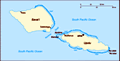
 New Zealand occupied the German protectorate of Western Samoa at the outbreak of World War I in 1914. It continued to administer the islands as a mandate and then as a trust territory until 1962, when the islands became the first Polynesian nation to...