I-Kiribati Economy, Kiribati Economy
Advertisement
Economy - overview: A remote country of 33 scattered coral atolls, Kiribati has few natural resources. Commercially viable phosphate deposits were exhausted at the time of independence from the UK in 1979. Copra and fish now represent the bulk of production and exports. The economy has fluctuated widely in recent years. Economic development is constrained by a shortage of skilled workers, weak infrastructure, and remoteness from international markets. Tourism provides more than one-fifth of GDP. The financial sector is at an early stage of development as is the expansion of private sector initiatives. Foreign financial aid from UK, Japan, Australia, New Zealand, and China equals 25%-50% of GDP. Remittances from workers abroad account for more than $5 million each year.
GDP: NA
GDP - real growth rate: 1.5% (2001 est.)
GDP - per capita: Purchasing power parity - $800 (2001 est.)
GDP - composition by sector: Agriculture: 30% industry: 7% services: 63% (1998 est.)
Population below poverty line: NA
Household income or consumption by percentage share: Lowest 10%: NA highest 10%: NA
Distribution of family income - Gini index:
Inflation rate (consumer prices):
Labor force: 7,870 economically active, not including subsistence farmers (2001 est.)
Labor force - by occupation:
Unemployment rate: 2%; underemployment 70% (1992 est.)
Budget: Revenues: $28.4 million expenditures: $37.2 million, including capital expenditures of NA (2000 est.)
Industries: Fishing, handicrafts
Industrial production growth rate: 0.7% (1991 est.)
Electricity - production: 7 million kWh (2002)
Electricity - production by source:
Electricity - consumption: 6.51 million kWh (2002)
Electricity - exports: 0 kWh (2002)
Electricity - imports: 0 kWh (2002)
Oil - production: 0 bbl/day (2001 est.)
Oil - consumption: 190 bbl/day (2001 est.)
Oil - exports: NA
Oil - imports: NA
Oil - proved reserves:
Natural gas - production:
Natural gas - consumption:
Natural gas - exports:
Natural gas - imports:
Natural gas - proved reserves:
Agriculture - products: Copra, taro, breadfruit, sweet potatoes, vegetables; fish
Exports: $35 million f.o.b. (2002)
Exports - commodities: Copra 62%, coconuts, seaweed, fish
Exports - partners: France 45.7%, Japan 29.2%, US 9.1%, Thailand 5.4% (2004)
Imports: $83 million c.i.f. (2002)
Imports - commodities: Foodstuffs, machinery and equipment, miscellaneous manufactured goods, fuel
Imports - partners: Australia 33.6%, Fiji 29.8%, Japan 10.3%, New Zealand 6.9%, France 4.1% (2004)
Debt - external: $10 million (1999 est.)
Economic aid - recipient: $15.5 million largely from UK and Japan (2001 est.)
Currency:
Currency code:
Exchange rates: Australian dollars per US dollar - 1.3598 (2004), 1.5419 (2003), 1.8406 (2002), 1.9334 (2001), 1.7248 (2000)
Fiscal year: NA
Advertisement
The information here has been derived from Public Domain Sources such as the CIA World Factbook. No liability can be taken for any inaccuracies.
Tot: 0.03s; Tpl: 0.008s; cc: 6; qc: 6; dbt: 0.0063s; 1; m:domysql w:travelblog (10.17.0.13); sld: 1;
; mem: 1.1mb


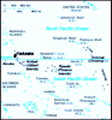
 The Gilbert Islands were granted self-rule by the UK in 1971 and complete independence in 1979 under the new name of Kiribati. The US relinquished all claims to the sparsely inhabited Phoenix and Line Island groups in a 1979 treaty of friendship with...