Mexican Geography, Mexico Geography
Advertisement
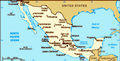
Location: Middle America, bordering the Caribbean Sea and the Gulf of Mexico, between Belize and the US and bordering the North Pacific Ocean, between Guatemala and the US
Geographic coordinates: 23 00 N, 102 00 W
Map references: North America
Area: Total: 1,972,550 sq km land: 1,923,040 sq km water: 49,510 sq km
Area - comparative: Slightly less than three times the size of Texas
Land boundaries: Total: 4,353 km border countries: Belize 250 km, Guatemala 962 km, US 3,141 km
Coastline: 9,330 km
Maritime claims: Territorial sea: 12 nm contiguous zone: 24 nm exclusive economic zone: 200 nm continental shelf: 200 nm or to the edge of the continental margin
Climate: Varies from tropical to desert
Terrain: High, rugged mountains; low coastal plains; high plateaus; desert
Elevation extremes: Lowest point: Laguna Salada -10 m highest point: Volcan Pico de Orizaba 5,700 m
Natural resources: Petroleum, silver, copper, gold, lead, zinc, natural gas, timber
Land use: Arable land: 12.99% permanent crops: 1.31% other: 85.7% (2001)
Irrigated land: 65,000 sq km (1998 est.)
Natural hazards: Tsunamis along the Pacific coast, volcanoes and destructive earthquakes in the center and south, and hurricanes on the Pacific, Gulf of Mexico, and Caribbean coasts
Environment - current issues: Scarcity of hazardous waste disposal facilities; rural to urban migration; natural fresh water resources scarce and polluted in north, inaccessible and poor quality in center and extreme southeast; raw sewage and industrial effluents polluting rivers in urban areas; deforestation; widespread erosion; desertification; deteriorating agricultural lands; serious air and water pollution in the national capital and urban centers along US-Mexico border; land subsidence in Valley of Mexico caused by groundwater depletion note: the government considers the lack of clean water and deforestation national security issues
Environment - international agreements: Party to: Biodiversity, Climate Change, Climate Change-Kyoto Protocol, Desertification, Endangered Species, Hazardous Wastes, Law of the Sea, Marine Dumping, Marine Life Conservation, Ozone Layer Protection, Ship Pollution, Wetlands, Whaling signed, but not ratified: none of the selected agreements
Geography - note: Strategic location on southern border of US; corn (maize), one of the world's major grain crops, is thought to have originated in Mexico
Advertisement
The information here has been derived from Public Domain Sources such as the CIA World Factbook. No liability can be taken for any inaccuracies.
Tot: 0.017s; Tpl: 0.007s; cc: 3; qc: 2; dbt: 0.0022s; 1; m:domysql w:travelblog (10.17.0.13); sld: 1;
; mem: 1mb


 The site of advanced Amerindian civilizations, Mexico came under Spanish rule for three centuries before achieving independence early in the 19th century. A devaluation of the peso in late 1994 threw Mexico into economic turmoil, triggering the worst...