Panamanian Geography, Panama Geography
Advertisement
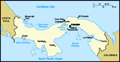
Location: Central America, bordering both the Caribbean Sea and the North Pacific Ocean, between Colombia and Costa Rica
Geographic coordinates: 9 00 N, 80 00 W
Map references: Central America and the Caribbean
Area: Total: 78,200 sq km land: 75,990 sq km water: 2,210 sq km
Area - comparative: Slightly smaller than South Carolina
Land boundaries: Total: 555 km border countries: Colombia 225 km, Costa Rica 330 km
Coastline: 2,490 km
Maritime claims: Territorial sea: 12 nm contiguous zone: 24 nm exclusive economic zone: 200 nm
Climate: Tropical maritime; hot, humid, cloudy; prolonged rainy season (May to January), short dry season (January to May)
Terrain: Interior mostly steep, rugged mountains and dissected, upland plains; coastal areas largely plains and rolling hills
Elevation extremes: Lowest point: Pacific Ocean 0 m highest point: Volcan de Chiriqui 3,475 m
Natural resources: Copper, mahogany forests, shrimp, hydropower
Land use: Arable land: 7.36% permanent crops: 1.98% other: 90.66% (2001)
Irrigated land: 320 sq km (1998 est.)
Natural hazards: Occasional severe storms and forest fires in the Darien area
Environment - current issues: Water pollution from agricultural runoff threatens fishery resources; deforestation of tropical rain forest; land degradation and soil erosion threatens siltation of Panama Canal; air pollution in urban areas; mining threatens natural resources
Environment - international agreements: Party to: Biodiversity, Climate Change, Climate Change-Kyoto Protocol, Desertification, Endangered Species, Hazardous Wastes, Law of the Sea, Marine Dumping, Ozone Layer Protection, Ship Pollution, Tropical Timber 83, Tropical Timber 94, Wetlands, Whaling signed, but not ratified: Marine Life Conservation
Geography - note: Strategic location on eastern end of isthmus forming land bridge connecting North and South America; controls Panama Canal that links North Atlantic Ocean via Caribbean Sea with North Pacific Ocean
Advertisement
The information here has been derived from Public Domain Sources such as the CIA World Factbook. No liability can be taken for any inaccuracies.
Tot: 0.027s; Tpl: 0.007s; cc: 3; qc: 2; dbt: 0.0065s; 1; m:domysql w:travelblog (10.17.0.13); sld: 1;
; mem: 1.1mb


 With US backing, Panama seceded from Colombia in 1903 and promptly signed a treaty with the US allowing for the construction of a canal and US sovereignty over a strip of land on either side of the structure (the Panama Canal Zone). The Panama Canal ...