Dominican Geography, Dominican Republic Geography
Advertisement
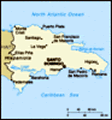
Location: Caribbean, eastern two-thirds of the island of Hispaniola, between the Caribbean Sea and the North Atlantic Ocean, east of Haiti
Geographic coordinates: 19 00 N, 70 40 W
Map references: Central America and the Caribbean
Area: Total: 48,730 sq km land: 48,380 sq km water: 350 sq km
Area - comparative: Slightly more than twice the size of New Hampshire
Land boundaries: Total: 360 km border countries: Haiti 360 km
Coastline: 1,288 km
Maritime claims: Territorial sea: 6 nm contiguous zone: 24 nm exclusive economic zone: 200 nm continental shelf: 200 nm or to the edge of the continental margin
Climate: Tropical maritime; little seasonal temperature variation; seasonal variation in rainfall
Terrain: Rugged highlands and mountains with fertile valleys interspersed
Elevation extremes: Lowest point: Lago Enriquillo -46 m highest point: Pico Duarte 3,175 m
Natural resources: Nickel, bauxite, gold, silver
Land use: Arable land: 22.65% permanent crops: 10.33% other: 67.02% (2001)
Irrigated land: 2,590 sq km (1998 est.)
Natural hazards: Lies in the middle of the hurricane belt and subject to severe storms from June to October; occasional flooding; periodic droughts
Environment - current issues: Water shortages; soil eroding into the sea damages coral reefs; deforestation
Environment - international agreements: Party to: Biodiversity, Climate Change, Climate Change-Kyoto Protocol, Desertification, Endangered Species, Hazardous Wastes, Marine Dumping, Marine Life Conservation, Ozone Layer Protection, Ship Pollution signed, but not ratified: Law of the Sea
Geography - note: Shares island of Hispaniola with Haiti
Advertisement
The information here has been derived from Public Domain Sources such as the CIA World Factbook. No liability can be taken for any inaccuracies.
Tot: 0.026s; Tpl: 0.013s; cc: 3; qc: 2; dbt: 0.003s; 1; m:domysql w:travelblog (10.17.0.13); sld: 1;
; mem: 1.1mb


 Explored and claimed by Columbus on his first voyage in 1492, the island of Hispaniola became a springboard for Spanish conquest of the Caribbean and the American mainland. In 1697, Spain recognized French dominion over the western third of the islan...