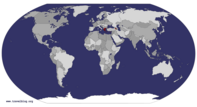
There is a land called Crete, in the midst of the wine-dark sea, a fair, rich land, begirt with water, and therein are many men, past counting, and ninety cities. They have not all the same speech, but their tongues are mixed. There dwell Achaeans, there great-hearted native Cretans, there Cydonians, and Dorians of waving plumes, and goodly Pelasgians.
-Homer, The Odyssey, Bk. 19
The land of Armenia, then, is situated largely on an extensive plateau, surrounded by high mountains, well watered by rivers which perpetuate its natural fertility.... The rulers of Armenia from its earliest Urartian period (c. 1400 BC) down to the fifteenth century AD had to be powerful enough in battle to withstand the hostile pressures on their borders; also, they had to possess above-average organising skill and considerable aptitude in the art of diplomacy to control the petty chiefs and princes in the many valleys and inaccessible mountain strongholds of their country, and to bring them and their warrior peoples within the hegemony of the kingdom. They were greatly assisted in this task by the east-west aspect of the Armenian Alps and the Taurus Range, which prevented an easy penetration of enemies from the south and the north. However, the same geographical features offered convenient routes not only to traders and their caravans, but also to invaders, particularly from the east and west.
- The Kingdom of Armenia, A History. by M. Chain, p. 43-44
Such then is Cyprus in point of position. But in excellence it falls behind no one of the
islands : for it is rich in wine and oil, and uses home-grown wheat. There are mines of
copper in plenty at Tamassos, in which are produced sulphate of copper and copper-rust
useful in the healing art. Eratosthenes talks of the plains as being formerly full of wood run
to riot, choked in fact Avith undergrowth and uncultivated. The mines were here of some
little service, the trees being cut down for the melting of copper and silver ; and of further
help was shipbuilding, when men sailed over the sea without fear and with large fleets. But
when even so they were not got under leave was given to those who would and could cut
them down to keep the land they had cleared in full possession and free of taxes.
- Strabo, P. Mela 3

Clearly I've had a busy summer so far (it's often difficult to find time to sit down and write a blog entry when database entries need to be written, remote sesning data needs to be processed or hilltop sunsets need to be enjoyed with a cold beer in hand), and nearly every day I remember the myriad of promises I made to continue the Travel Blog this summer, and how I’ve simply failed to do so, and then I promise myself that today I will finally sit down and crank out a few entries to get back on track…next thing I know I’m waking up again, kicking myself for not writing and promising myself again—needless to say, I have no credibility with myself anymore. All that said I've discovered a rare hour (!) of uninterrupted peace
... read moreHi all, I wanted to post this before I left Armenia, but ended up being unable to, so, here are my last thoughts while in country-- written with less than 6 hours left. I never got around to posting it this past year, so I'm posting it now as a review of what went on in T27 last year, and as a primer for my next post about my time in Armenia so far. Apologies for the lack of pictures. More coming soon. I'm up early on my last day in Armenia for two reasons: to take a shower (check) and to write a brief blog entry before we dismantle the internet (which, with a bunch of 21st century archaeologists and scientists, is the last thing to get broken down, a truism I am thankful for).
... read moreWell into Week 5, I'm finally getting around to writing about Week 4-- life on Project ArAGATS is growing hectic because we have less than a week left in the field, and so much left to do-- not to mention final trench reports to write, artifacts to catalog, C14, and dendrochronology samples and ceramics to pack so they can be shipped back stateside for analysis... but all is good-- for archaeological excavations (and academics in general...) this last minute cramming is nothing unusual. In any case, I'm getting ahead of myself, and details about Week 5 will have to wait until my next entry. After a wild week 4 in T27; with the final count at forty-four complete (though some fragmented) ceramics removed, two bronze arrowheads, two obsidian arrowheads, and over twenty grinding stones and mortars,
... read moreThanks to a thunderstorm, we've returned from the field a bit early today, and, since the power is out in the house, and the local network database that we use to keep track of the excavation won't work without the router, I'm finally finding time to write the entry I promised last week but never got around to doing. The reason for this is simple: the intact jar I discussed in last week's post was only the first of forty four complete (though, in many cases, fragmented) ceramics: everything from small medicine jars, drinking cups and bowls, to large grain or wine storage vessels. Because of this, I've spent most of the last week excavating and removing these ceramics during the day, and entering data about them into the database at night. It really is a
... read moreAfter a busy , but fantastic week, I'm squeezing in a few minutes to write this blog entry before dinner, data processing, email checking, and last, but certainly not least, bed. I'm also not holding up to my promise to write once a week -- but I hope to post twice this week to make up for it. (One final caveat: I didn't get around to posting this on Sunday (7/18) when I wrote it, and I'm finally posting it on Tuesday (7/20), that's why dates may seem a bit off.) After finishing the week up in the field, last Saturday (we work Monday through Saturday, and have Sunday off, which is reserved for field trips, and general mental well-being), we ventured off to visit three sites north west of Aparan and the Tsaghkahovit plain where
... read moreBarev from Armenia! I arrived over a week ago, but I haven't been able to post to this blog due to technical difficulties. We were supposed to have wireless internet available in the dig house, but it turns out the the cheaper option was to get a wireless modem that attaches to the USB port of a computer and share that between all of us. The problem is, we can't get it to work on a number of computers. Anyway, I've figure out a system that should allow me to post once a week-- but it took a while to iron out the glitches. In any case, I'm glad that many of you appreciated last year's blog from Crete, and I'm happy to write again-- this time from Armenia. Please feel free to pass the blog
... read moreIt took a few days to get rolling, but taking over as supervisor (or, Pitt-Boss, as the undergrads I have been working with prefer to call me), of trench 4400 has been entirely worth it. At first, however, I was totally and completely lost. Last Monday morning, at 6:45 AM, I found myself flipping through the trench notebook, and being completely baffled as to what was going on-- elevation measurements were off, loci recordings were all out of wack, and no one was really sure what they were supposed to be doing. About fifteen minutes later, when the previous "trench supervisor" arrived on site he made the assuring comment "I'm glad you're taking over the trench today Jeff, because I'm afraid I might've 'fallen asleep at the wheel' a bit in terms of keeping the notebook..."
... read moreAs I write tonight, I'm sitting out on the back porch of Georgou's (pronounced Your-go) taverna, enjoying a cold Mythos (the local Greek beer) and watching the sun set over Mirabello bay. It's hard to believe I've been in Mochlos for over a week now. I arrived in Mochlos last Monday after my spelunking adventure at Skoteino, and I was on a boat out to Mochlos island and the archaeological site at 6:30 AM on Tuesday morning. To recap from an earlier post, the archaeological site of Mochlos is located on a small island about two hundred meters off the north Cretan coast. It was occupied during the entire Bronze Age (that is, from the Early Bronze Age, approximately 3500 BC-2200 BC through the Middle Bronze Age, 2200BC-1600 BC, with the Bronze Age occupation ending at
... read moreIn rather characteristic fashion, this week started off slow (sensing a pattern here?). Last Monday I was slated to help Kroni, the Center's professional photographer, take pictures of the Minoan site of Petras (Pe-trahs). Petras is a major Bronze Age site, with evidence for human occupation from the Neolithic through Late Bronze Age-- and it features a Late Bronze Age administrative complex, as well as a number of caves and rock shelters that are believed to have been used as ceremonial or ritual sites. But, it was the Minoan and Late Bronze Age graveyard that had been excavated this season, and which we were supposed to photograph. Unfortunately, because the winds had picked up for the day, we were unable to. (See the photo from my last blog entry which shows the 5 meter boom-arm that
... read moreThis week started off rather slowly. Monday and Tuesday featured me sitting at the center checking my email 4,000 times, reading up on the world news, and doing some research in the library here at INSTAP. I shouldn't complain really, since I've had time to catch up on some work. Then, I spent my evenings making friends with a local taverna owner named Manoles and by default practicing my Greek. My reliable dinner companions were a beer, a book, and the sun setting over the western part of the Pacheia Amos bay-- not terribly exciting, but serene and relaxing. Wednesday morning brought a welcomed end to my lazy and rather boring days-- that's when Tom Brogan, the director here at INSTAP realized that I actually could be put to work, and he wasted little time doing
... read more