Advertisement
Published: February 23rd 2008
THE SILK ROAD, UZBEKISTAN - (August 2007)
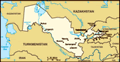
- (Friday 3rd to Friday 10th August) - Fri 3rd Aug It was with some relief that after spending nine days in Tashkent, I was now able to leave the city and head out and begin exploring the rest of Uzbekistan. In particular, I was looking forward to visiting the old Silk Road cities of Samarkand and Bukhara.
There is still some dispute as to which country Samarkand and Bukhara belong to. Due to Stalin and his gerrymandering of the old Soviet Central Asian borders, the cities are in what is currently known as Uzbekistan. However, up until the late 1980’s, the Soviet Republic of Tajikistan was still claiming Samarkand for itself as the city is very close to its border. To back up this claim, the predominant language in Samarkand is not Uzbek, but is a form of Farsi which is spoken in Tajikistan.
Nevertheless, the city is located in present day Uzbekistan and I booked a ticket on the train from Tashkent to Samarkand for Friday morning. By the time I was eventually in a position to purchase my train ticket after managing to collect all
 Outside the Registan
Camels across the desertmy visas in Tashkent for onward travel after Uzbekistan (i.e. my Russian visa and my Kazakhstan transit visa), the only tickets that were left for the train were third or first class. As the tickets were not particularly expensive, the journey from Tashkent to Samarkand being only about 4 hours long, I decided to get a first class ticket.
The train departed at 8am and we soon left the city and its urban surroundings behind and were soon travelling through the desert and passing a string of small desert towns/ settlements along the way.
The old Soviet trains in Uzbekistan are much like the Chinese trains with two beds per compartment in first class and four beds per compartment in second class. Being in first class, I had the luxury of only one other person being in the compartment with me. However, there was little conversation as his English was as non-existent as my Russian and Uzbek is, and consequently we were only able to communicate via a few grunts and finger pointing.
I’ve never travelled first class in China so I don’t know whether they have the same set up on their trains, but on this
Sharhr-i-Zindah
The Avenue of tombs particular train there was a TV screen in each first class compartment and DVD films were piped in. As a result, the first 3 ½ hours of the train journey was spent watching ‘The Last Samurai’ and some Russian action film about Chechnya, both of which were in Russian and with no subtitles - I never knew that Tom Cruise could speak such good Russian and with such a deep voice as well!
In the space of four hours, I was fed twice, with what for Uzbekistan was quite good food (probably some of the best food I had in all my time in Uzbekistan), which together with the ‘enjoyment’ of watching two films in Russian resulted in the journey soon passing and the next thing I knew, I was being told that this was my stop. After 10 days in Uzbekistan, I’d finally arrived in Samarkand!
Fri 3rd - Tues 7th Aug - (Samarkand) The first thing I did on arrival in Samarkand was to find somewhere to stay. I’d been recommended the same hostel by several people, the Bahodir B&B, mainly because it was about the only backpacker hostel in town. Nevertheless it proved to
be a good choice and lived up to its reputation. Whilst not being the cleanest hostel I’ve ever stayed in, especially the bathroom area, the owners were very friendly and helpful and they provided plenty of free melons, tea and biscuits which were always laid out on the communal table in the courtyard. There were always lots of people milling around and the hostel was located just a stones throw away from the Registan, the centre piece and Architectural wonder of Samarkand.
There didn’t seem to be much to do around Samarkand at night, certainly not in the part of town where the hostel was located, but the hostel offered cheap evening meals and as a consequence most people seemed to stay around the hostel during the evening which made it a good place to hang out.
Talking to people at the hostel made me realise that my six month trip overland from Thailand to England palled into insignificance compared to some of the trips other people were doing. Quite a few people at the hostel had just come through Afghanistan and all of them were saying that the situation in the country seemed to be deteriorating all
the time. I was also amazed at how many people seemed to be cycling their way around the world, something which seemed to me to be a bit too much like hard work.
One particular night during my stay at the hostel, the hostel was all but invaded by lots of clapped out small 1 litre cars - The London to Ulaanbaatar rally had hit town! The hostel wasn't really big enough for everyone but nevertheless, the owner tried to put everyone up and people ended up sleeping all over the place - in the court yard and in the hall way, and even on the roof, with the owner running around all night trying to make sure everyone was catered for.
The London to Ulaanbaatar rally involves getting from London to Ulaanbaatar in Mongolia in a 1 litre or less car in the shortest possible time, although I don’t think that getting to Ulaanbaatar first is the prime motivation for most people. There is no set route although many drivers seem to end up in Uzbekistan as part of the trip. Although he didn’t turn up whilst I was there, apparently Jack Osborne of MTV’s ‘The Osborne’s’
fame was competing in the race but was apparently a couple of days behind the group that descended on Bahodir's when I was staying there.
As for Samarkand itself, Samarkand is apparently one of Central Asia’s oldest settlements being founded in the 5th Century. In 1220 it was raised to the ground by Genghis Khan but by 1370 Timur Lane had made the city into his capital and over the next 35years it became Central Asia’s economic and cultural epicentre until the 16th Century when the Uzbek ‘Shaybands’ moved the capital to Bukhara.
The Uzbek cities of Samarkand, Bukhara and Kiva were at one time all on the Silk Road and were famous amongst other things for their slave markets. The centre of medieval Samarkand was the Registan, which encompasses several buildings within its complex which date from around 1420. As with a lot of the medieval buildings around Uzbekistan, a lot of restoration work was undertaken during Soviet times and consequently the Registan no doubt looks a lot different now to what it did a number of decades ago.
For some reason, which I never found out, September 2007 was a special event for Samarkand and
at the time of my visit some sort of event at the Registan was being prepared. The event seemed to involve hundreds of children and dancers waving their arms about and dancing within the complex's courtyards and balconies. Rehearsals went on every morning and late afternoon when the complex was closed, and from what you could see, it all looked like it was going to be very impressive.
The Registan itself is a very impressive complex and I spent several hours on two separate occasions wandering around the buildings admiring the intricate restored tile work and just generally soaking up the atmosphere. The Registan’s tile work is apparently something of a rarity for the Muslim world as it contains the faces of two tigers which are located either side of the main archway, something which flaunts the Muslim prohibition against the depiction of living beings.
One thing that surprised me was how touristy Samarkand is. I’m sure most people from the UK have never heard of Samarkand, never mind ever thought of visiting the city. However, the place seemed to be full of French and Italian tour groups. As a consequence of the tourist trade, large parts of
the Registan's complex have been given over to tourist shops most of which sold the usual tourist pap, although some others did have some good stuff for sale.
Just around the corner from the Registan is the ‘Bibi-Khanym Mosov’, which is one of the world’s largest mosques and which is so big that when it was built, it reportedly nearly fell down due to the weight of the roof structure.
Samarkand has a lot of very impressive buildings all of which have been, or are in the process of being restored and you can just imagine the splendour of the place in its heyday when it was one of the main cities along the Silk Road. The highlight of Samarkand for me was the Shahr-i-Zindah ('Tomb of the Living King'😉 which is set just outside the main centre of Samarkand on a small hill alongside a modern grave yard. The Shahr-i-Zindah consists of an avenue of tombs and shrines which are beautifully decorated both inside and out.
The holiest shrine in the complex is said to be that of Qusam ibn-Abbas, a cousin of the Prophet Mohammed who is said to have brought Islam to this area.
The majority of the other shrines/ tombs are said to belong to Timur's and Ulughbek's family and their favourite associates. The complex is just beautiful and it was just wonderful wandering in and out of the peaceful mausoleums soaking up the ambience and admiring the intricate decoration of the tombs.
As well as Samarkand itself, there are a few things that are worth seeing just outside the city. 20km north of Samarkand is the village of Hoja Ismail which is said to be one of Islam’s holier spots. The village is famous for being home to the mausoleum of Ismail al-Bukhari who is apparently regarded as one of the greatest Muslim scholars ever and who during his lifetime collected many acts and sayings of the prophet Mohammed. Ismail al-Bukhari’s work is generally regarded by Sunni Muslims as second only to the Quran’s as a source of religious law. While the Mausoleum is relatively new, it was a nice place to spend a couple of hours along with the pilgrims who were visiting the mausoleum.
About 90km outside of Samarkand is Timur’s home town, a town called Shakhrisabz. Again, some of the Architecture is quite spectacular although there is
not much left to see of the Ak-Saray palace (White Palace) which was apparently used by Timur as his summer palace, apart from two 40m high entrance columns. In what was the centre of the palace, a new statue of Amur Timur has been built which has become a favourite place for wedding photographs - as I found out when I was visiting when there were plenty of wedding parties taking place.
There are also plenty of Mosques and Mausoleum’s around Shakhrisabz which all made for a pleasant half day trip from Samarkand. Whilst getting a taxi out to the town was reasonably straight forward and reasonably priced, (except for having to wait around for about an hour for the taxi to fill up), getting back wasn’t quite as straight forward.
At first I couldn’t find any transport out of Shakhrisabz but eventually managed to get a lift to a place out of town where taxis waited to fill up before going on to Samarkand. After a while I managed to find a shared taxi which would take me back to Samarkand and agreed a price which was the same price as the taxi ride out to Shakhrisabz.
But how stupid of me…………, when we got back to Samarkand and I gave the money to the driver, he gave it back to me and said that the price we agreed was not in Som (the local currency) but in Euro’s - a form of money that I’d never heard mentioned as a currency of choice in Uzbekistan before! After a bit of a heated discussion, the money was thrown back at him and the door slammed shut with a few choice words exchanged between us.
Wed 8th - Fri 10th Aug - (Bukhara) After a couple of days in Samarkand it was time to move on to Bukhara, the next Silk Road city in Uzbekistan, which is located around 250km north of Samarkand. Instead of the train, this time I decided to try and catch a shared taxi which I had been told would not be much more expensive than the bus and which would get me to Bukhara quicker. Whilst in theory catching a shared taxi is a good idea, especially as the cars and roads in Uzbekistan are in a reasonably good state, when travelling alone it sometimes proves very difficult to get
one for a reasonable price. Unfortunately, this proved to be the case on this particularly journey. The journey from Samarkand to Bukhara takes around half a day and unfortunately no taxi was prepared to take me for a reasonable price or to wait around for other passengers to share the costs with me. So unfortunatley it had to be the bus on this occasion!
Fortunately though, the place where the shared taxi’s tended to hang out was more or less right next to where the buses departed from. Although full, I managed to get on a bus which was ready to depart and a seat was found for me next to the driver and his mate at the expense of someone else who was just shoved to the back. Although I got a seat and the bus was departing more or less straight away, I’m not sure that it was a wise decision to accept the seat offered to me as for most of the next 3 to 4 hours I seemed to become the butt of all the jokes that were going on between the driver and his ‘mates’ at the front of the bus with all of
them taking advantage of my non-existent Russian. Whilst I’m sure they were only being friendly, there is only so long that you can pretend to be asleep when you are being poked in the ribs every five minutes and when it’s about 45 - 50c outside and the bus doesn’t have any air conditioning! While the cars and taxis in Uzbekistan all seem to be in a pretty good state of repair, some of the buses certainly weren’t.
It was with some relief then that 3 to 4 hours later the bus arrived in Bukhara. I’d been given a recommendation of somewhere to stay in the centre of Bukhara from someone so I jumped in a taxi and told him the address. Although it was only a five minute drive from the bus station to the centre of the old town, after 30minutes we still hadn’t managed to find the place even though I had the address. Throughout my time in Uzbekistan it seemed to be a constant theme that taxi drivers didn't have a clue where anything was!
Although we had the telephone number of the place where I wanted to stay and the taxi driver had
rung the owner up and asked for directions, we still couldn’t find the place. We eventually had to get the owner to come out and meet us and walk me to the accommodation.
Unknown to me the accommodation, whilst ok, was a home stay and not a hostel/ hotel. The accommodation was part of a shop which had a court yard and several sleeping places behind. Whilst I had a room to myself and a quite comfortable mattress and blankets Central Asian style to sleep on/under, no one else was staying at the homestay and I always felt a bit awkward coming and going through the front of the shop.
However, fortunately after one day I bumped into an English guy called Rich who I'd met a few weeks before in Osh, Kyrgyzstan, and also very briefly in Samarkand a couple of days earlier. It turned out that he was staying in a place called Mubinjons’ Bukhara House hostel with an American girl called Min. Whilst Mubinjon's didn't have any air conditioning in the rooms, which is a factor to consider when its 40c outside, I decided to move across to Mubinjons.
Mubinjons’ building apparently dated back
Sharhr-i-Zindah
Inside one of the mausoleums to 1766 and was supposedly one of the first hotels/ hostels to open in Bukhara after the collapse of the old Soviet Union. The rooms were all set around a central court yard and whilst being a bit dilapidated and with no air conditioning, the place was quite nice and quaint. At the time I staying there, the owner was renovating the hostel including restoring the original murals that were painted on the walls of all the rooms. Once complete, the hostel will no doubt look absolutely fantasic.
Capital of the Samanid state in the 9th and 10th Century’s, Bukhara apparently became the centre of an intellectual, religious and commercial renaissance of Central Asia until the city succumbed in 1220 to Genghis Khan. Timur then conquered the city in 1370, after which Samarkand became the region’s most important city. Bukhara had a second lease of life in the 16th century when it became the capital of what became known as the Bukhara Khanate. During this time, the city apparently had more than 300 mosques and 100 madrassas which had over 10,000 students. In 1868, the city became the protectorate of the Tsar and later became incorporated into the Russian
Sharhr-i-Zindah
One of the tombs along the 'Avenue of tombs' and then Soviet empires.
Unlike Samarkand, the medieval centre of Bukhara retains a ‘lived-in’ feel to it even though parts have been heavily restored during Soviet times. The old town is a warren of small lanes with lots of mini bazaars and small shops lining the small lanes and with old mosques and madrassas seemingly around every corner. Bukhara is said to house Central Asia’s oldest surviving mosque which dates back to 1417.
The Kalon Minaret which is 47m tall, when built in 1127 was said to be the tallest building in Central Asia. It is also said that Genghis Khan was so dumfounded by it that he ordered it to be spared when he was raising the city on his way through Central Asia in the 13th Century. The 14 ornamental bands around the minaret apparently include the first use of the glazed blue tiles that became the whole mark of Central Asian architecture under Timur.
Bukhara has also had a long Jewish history with the first Jews arriving in the city in the 12th and 13th Century. Whilst the numbers have significantly declined, there is still a working synagogue within the old city.
Bukhara’s
oldest structure, the Ark, has apparently had people living in its complex since the 5th Century up until it was bombed by the Red army in 1920. Now mostly in ruins, the Ark was home to the Emir of Bukhara until the Red Army’s onslaught. The last coronation of a ‘Khan of Bukhara’ took place within the Ark complex in 1910.
As with Samarkand, the town seemed to be full of French and Italian tour groups but all these seemed to disappear after dark which made the old city very quiet after around 7pm. As in Samarkand, there didn’t seem to be much to do at night and also not many of the restaurants appeared to be open after dark. However, there was a local Uzbek guy who wondered around the city during the day inviting foreigners back to his house where for a small price he would provide a meal.
I would have been a bit suspect about just being approached in the street by someone offering to take me back to his place to cook a meal, but Min bumped into him one afternoon and arranged for the three of us to go around one night.
Shakhrisabz
Birthplace of Timur Outside of Tashkent, the food in Uzbekistan got a bit boring after a while. There are basically just three dishes that you can order from a standard restaurant. These three dishes consist of Plov, which is a kind of risotto/ fried rice with a lump of gristly meat on top (which was probably my favourite), Shashlyk and Naan bread, which is meat roasted on skewers over hot coals, and a dish called Lagman which is basically a poor version of Spaghetti Bolognese. Whilst the food was no different at the place we went to, we had a very relaxing meal in the house court yard around a traditional Central Asian low table while sitting/ lying on cushions.
As in Samarkand, there are some fantastic buildings in and around Bukhara which made for a pleasant couple of days. In addition to the buildings within Bukhara, 12km out of the city is the ‘Bakhautdin Naqshband Mausoleum’ which is apparently one of Sufi Islam’s most important shrines and which is located in the Saint's village of birth. Bakhautdin Naqshband is the 14th century founder of the most influential of the many Central Asian Sufi orders. Sufi Islam is a mystic form
of Islam which has many followers in Central Asia including Pakistan and Afghanistan although the Sufis in Afghanistan have been severely persecuted by the Taliban in recent times.
I couldn't let the opportunity of visiting a Sufi shrine go whilst I was in Central Asia, so Min and myself caught a shared taxi out to the village and joined the rest of the pilgrims at the shrine. Whilst the mausoleum wasn’t as nice as some of the ones I had seen, there were lots of pilgrims about which made it a worthwhile trip out of Bukhara. In addition to the main Mausoleum, there was also another shine/ mausoleum dedicated to the Saints mother within the complex.
After a few very enjoyable days in Bukhara, it was time to move on further up the old Silk Road to the next stop, a place called Kiva. Kiva is located in the middle of the desert in northern Uzbekistan close to the border with Turkmenistan. Min, Rich and myself were all heading in the same direction so we decided to travel together and we left Bukhara early one morning with the intention of getting a shared taxi to Kiva.
Advertisement
Tot: 0.178s; Tpl: 0.017s; cc: 15; qc: 80; dbt: 0.0867s; 1; m:domysql w:travelblog (10.17.0.13); sld: 1;
; mem: 1.3mb








Franco
Franklin H
Great photos and commentary. Unfortunately was not able to rate photos or would have given you many 5 stars.