Philippine Geography, Philippines Geography
Advertisement
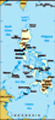
Location: Southeastern Asia, archipelago between the Philippine Sea and the South China Sea, east of Vietnam
Geographic coordinates: 13 00 N, 122 00 E
Map references: Southeast Asia
Area: Total: 300,000 sq km land: 298,170 sq km water: 1,830 sq km
Area - comparative: Slightly larger than Arizona
Land boundaries: 0 km
Coastline: 36,289 km
Maritime claims: Territorial sea: irregular polygon extending up to 100 nm from coastline as defined by 1898 treaty; since late 1970s has also claimed polygonal-shaped area in South China Sea up to 285 nm in breadth exclusive economic zone: 200 nm continental shelf: to depth of exploitation
Climate: Tropical marine; northeast monsoon (November to April); southwest monsoon (May to October)
Terrain: Mostly mountains with narrow to extensive coastal lowlands
Elevation extremes: Lowest point: Philippine Sea 0 m highest point: Mount Apo 2,954 m
Natural resources: Timber, petroleum, nickel, cobalt, silver, gold, salt, copper
Land use: Arable land: 18.95% permanent crops: 16.77% other: 64.28% (2001)
Irrigated land: 15,500 sq km (1998 est.)
Natural hazards: Astride typhoon belt, usually affected by 15 and struck by five to six cyclonic storms per year; landslides; active volcanoes; destructive earthquakes; tsunamis
Environment - current issues: Uncontrolled deforestation especially in watershed areas; soil erosion; air and water pollution in major urban centers; coral reef degradation; increasing pollution of coastal mangrove swamps that are important fish breeding grounds
Environment - international agreements: Party to: Biodiversity, Climate Change, Climate Change-Kyoto Protocol, Desertification, Endangered Species, Hazardous Wastes, Law of the Sea, Marine Dumping, Ozone Layer Protection, Ship Pollution, Tropical Timber 83, Tropical Timber 94, Wetlands, Whaling signed, but not ratified: Air Pollution-Persistent Organic Pollutants
Geography - note: The Philippine archipelago is made up of 7,107 islands; favorably located in relation to many of Southeast Asia's main water bodies: the South China Sea, Philippine Sea, Sulu Sea, Celebes Sea, and Luzon Strait
Advertisement
The information here has been derived from Public Domain Sources such as the CIA World Factbook. No liability can be taken for any inaccuracies.
Tot: 0.114s; Tpl: 0.007s; cc: 6; qc: 6; dbt: 0.0082s; 1; m:domysql w:travelblog (10.17.0.13); sld: 1;
; mem: 1.1mb


 The Philippine Islands became a Spanish colony during the 16th century; they were ceded to the US in 1898 following the Spanish-American War. In 1935 the Philippines became a self-governing commonwealth. Manuel QUEZON was elected President and was ta...