Advertisement
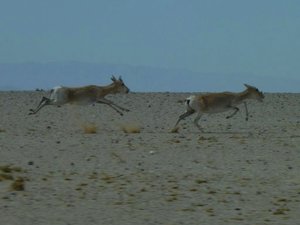
 Gazelles
Racing with gazelles across the GobiA brown-black wall of sand and rain towered threateningly above Guchin Us. Most of the year this Gobi settlement is dry, so rain is welcomed as it starts the pasture growing so that the herders’ animals can survive and grow fat. The rain started slowly in strong winds but then lashed down for an hour. But as we watched the rain through the door of our lodgings we realised that a torrent of water was also falling in our room where the roof leaked. Luckily the water was over the cooking area and not our beds so a baby bath was borrowed from the hotel owner. It was too late for a repair so twice during the night we heard the rain showering in. Coincidently the next day we tried out the hot shower in the village centre. This is a small enterprise by one of the cafes who heat water in a 40 litre tank with a small plastic shower hose attached. It was great to wash my hair under running water rather than in a bowl and I would have paid more than 1500 togrog (75p) for such a treat.
Guchin Us is the second of our research areas.
It is further into the Gobi and much drier than Bogd. One of the bags (sub areas) has only 50 out of 150 households left in the area as the rest have moved out ‘by otor’ to find grass for their animals in surrounding areas.
On our first day back in Guchin Us we accompanied the soum officials and representatives of the Asian Development Bank who have sponsored a number of new deep wells in this aimag. However the herder groups for whom the wells have been built did not attend as there is currently no grass surrounding the wells and the herders were far away. As we drove between wells we suddenly saw swift movement in this barren area and four Gobi gazelles raced away from us. Enkhee accelerated in pursuit and, as we bumped across the rocky desert, I managed to take some action photos. Later the other car said they had also spotted a wolf ahead of the gazelles.
Later that evening I was buying a loaf of bread in the shop adjoining our room when an American voice said “You’re English!” Standing next to me was a dark haired American girl who introduced herself as Erin,
Well
Several new deep wells have been built in the area but as there is no grass they are not yet being used the Peace Corps English teacher in the soum. We soon started chatting and she came back to our room for tea and to exchange news. She has been working here for nearly a year, with another year to go and was glad to speak English to a native speaker for a change. Most of her time in Mongolia she had spent in the soum centre and had not experienced the life of her pupils in their rural homes. So, as the school had just broken up and we were off to visit households in the countryside, we invited her along. It is tough to be away from home for three months, so to live here alone for two years must be hard.
Our first homestay in Guchin Us was with one of the members of a herder group, all relatives, that includes several influential connections in the soum such as the bag governor, the parliamentary speaker and the owner of the shop and hotel where we were staying. Profits from the shop and bakery are distributed between members of the group. The oldest brother lent Enkhee and myself horses whilst Nyamaa rode behind Batjargal on a motorbike. Nyamaa was unable
Camels
Camels have character to ride due to a dislocated thumb from playing basket ball the previous evening. A Mongolian remedy of immersion of the affected area in warm tea and salt had reduced the swelling but she still felt unable to ride horses with us. Batjagal took us to see the springs that had been fenced by the group to protect the water supply from livestock. As we sat by on the only grassy area for miles around he described how the grass used to be high years ago but through climate change was now low. He talked about the younger generations who were giving up herding for more prosperous livelihoods in the cities and UB. Erin and I stayed with the household on our own that night as the ger was too small for four and, although it was difficult to communicate at times, the people in the household made us welcome. Early the next morning we earned our keep by collecting a large basketful of dried dung from the surrounding countryside to use as fuel in the ger stove.
A few days later we visited another household in the southern part of the soum which is further into the Gobi, an
tow
Enkhee goes to the rescue. Normally the river is totally dry. area of stony semi-desert, almost flat with few landmarks for navigation. It became a regular activity for Enkhee to stop and get out his binoculars to look for the road or signs of the household we were seeking. We had been invited to visit three neighbouring households that were holding a children’s hair-cutting ceremony that day. Mongolians believe that when a baby is born its head is pure. So as a child grows that purity is lost. When a boy is one or three years old and a girl two or four their hair is ceremonially cut. The head is shaved apart from a single strand on a boy’s head and two on a girl’s which are plaited and tied with coins or beads. Relatives and friends participate in the hair cutting and give gifts of money, food or toys to the child. During the morning we moved from ger to ger taking part in the ceremonies, eating and talking. The first two children patiently allowed their hair to be cut and shaved and happily accepted their gifts. However, the last girl was a little older and emotional because of all the attention cried as her hair was cut.
In
Hoola hoop
Some games are popular everywhere the afternoon, after the ceremonies, Yunden, the grandfather of the children came with us as we drove across the landscape. He showed us several wells that his family used in different seasons including the oldest deep well in the soum built in 1957 and still operating with a new generator. We stopped at some small dunes for him to dig a medicinal plant, the Gobi Goyo, used for animal medicine. This plant has deep red rods between 15 and 20 cm high growing out of the sand but the part that is used is the creamy white root. This is pulled out but the base of the tap root is left to grow again in the future.
Because the families were using their small otor gers, Nyamaa, Enkhee, Erin and myself camped out nearby. The evening was warm and we sat out playing cards with the children until they were called to move the goats in from the pasture. Then we sat back and watched the sky as it got dark and the stars came out over the Gobi. I slept well, despite the wind increasing towards morning. But as we took down the tents a gust caught mine and
Camp
Camping by the river in Guchin Us sent it bowling over the gravel, frightening the local horses. Enkhee had to quickly jump in the vehicle and chase it before it ended up in China.
Our final homestay in Guchin Us was with Baatar, who I had met last year. I remembered him as laughing and knowledgeable and the day after the rain we set of in sunshine to his ger, accompanied by two of his grandchildren. His wife also welcomed us and it was lovely to pass the time with them in their summer place set just above the river, which was now flowing. In the afternoon, Erin and I rode with his son, Chokha, to explore the area. The wide brown stony steppe surrounded us with just a splash of green along the river valley and mountains in the distance. The family were hoping that they would get one more day of rain that would bring enough grass for their livestock allowing them to erect a larger ger and stay in the area for the whole summer. More rain would also see the return of other households who had migrated out of the soum because of the drought. Although the rain was welcome it had caused
tent
Nyamaa's pop up tent was easy to erect but caused problems folding it up again problems for vehicles that had to cross the now fast flowing river and Enkhee had already helped to pull two vehicles that had got stuck. Late in the evening the rain started again and Enkhee was called out again. Nyamaa, Erin and I played cards in one of our tents but as it got darker and the rain heavier and Enkhee did not return we started to worry. Eventually he turned up, having helped to restart the flooded engine of the other vehicle. I slept well listening to the rain on the tent and the river flowing by.
Our main concern at the moment is getting diesel for the Isuzu as Russia has stopped providing fuel to Mongolia. We have been stockpiling fuel over the last couple of weeks with the help of our local friends. This means our room has several blue canisters stored under our beds and Nyamaa and Enkhee are banned from smoking inside! Mongolia relies on its neighbours for supplies but exports most of its raw materials such as minerals and cashmere. Many Mongolians would like to develop greater capacity for manufacturing and processing but without capital resources this is difficult for this large country with a small population. Instead their mineral wealth in particular is exploited by international companies and local livelihoods are barely improved. The withdrawal of Russian fuel supply is having a large effect on the economy and putting limits on how much travelling we can do for the remainder of the project.
Advertisement
Tot: 0.629s; Tpl: 0.015s; cc: 14; qc: 128; dbt: 0.3222s; 1; m:domysql w:travelblog (10.17.0.13); sld: 1;
; mem: 1.5mb