Advertisement
Published: September 6th 2008

 Battambang
My journey by boat begins.Water is the basis of life all over the planet and in Cambodia this is more apparent than in many other countries.
It played an important role in the ancient Angkor kingdom, which maintained its economy with the complex system of irrigation tanks and canals that played such a an important role in the ritual life of the community. Thanks to this we see so many beautiful photographs of the reflection of Angkor Wat.
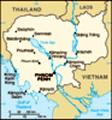
In the centre of Cambodia is the largest lake in SE Asia. The Tongle Sap Lake controls ecosystems across the whole of SE Asia and Southern China, Many rivers drain into it, including the Battambang and the Siem Reap Rivers at the top end, and the Tongle Sap at the bottom. This river drains water out of the lake for six months and surprisingly pours water back in for the other six months of the year. At Phnom Pengh the Tongle Sap meets the Mekong, which spreads out across S Vietnam before entering the South China Sea.
In Battambang I inally escaped from bus travel! I bought a boat ticket from Battambang to Siem Reap. The boat was an old, open sided,
Battambang
Fellow passengers boarding our boat. flat bottomed, wooden one and many of the passengers chose to sit on the roof; there were more tourists than locals. At first we made progress downstream between riverbanks scattered with villages, temple and mosques. Then the river spread out into mini delta. We puttered slowly along, sometimes using a stick to punt, sometimes nosing for a channel. The padi fields around us were absolutely flat and we had to stand up to see the people working in them. We crossed the narrow top part of the lake, and it seemed like we were on an inland sea, it was so vast. Then we nosed into a mass of thick water hyacinth and somehow found a channel into the mini delta of the Siem Reap river, and started bashing through fields of fresh-water mangrove trees. There is an annual variation in water level of about 30 metres, so building on stilts is impractical: houses, fuel stations, restaurants are all constructed on rafts. There are no fixed jetties, small rowing boats deliver passengers and take goods off the boat.
When Ray and I left Siem Reap, it was to head down the length of the lake in a bullet boat,
Battambang
More fellow passengers take their seat. the type that is used on the Sarawak rivers. It had upholstered seats for one hundred passengers and a large luggage hold. As most of the passengers preferred to enjoy the view from the roof there was room for the rest of us to stretch out across three seats, imagine we were in an areoplane, and snooze.
There are various options for water travel from Phnom Penh to Vietnam and we choose to take a small tourist boat. This was a small launch with eighteen comfortable seats; the shell was like the flying coffins that run around the Brueni waterways, except it was a little bigger and had an open deck at the back. I had heard many tales about the rigours of the land border on the riverbank between the two countries, but we escaped the worst. The water level was high so there was no scrambling up steep banks; we steped straight from the boat to grass. The boat company supplied two guides to take us through the checks; both were called Mohammad and I was glad we had their help. Everyone that looked at my passport found fault with it: it was too full, it was
Battambang District
Houseboats on the Battambang River. too shabby, it was too damp. Without Mohammads’ presence it might have taken me longer to get through.
Travel Notes
In Siem Reap we stayed at the Angkor Discover Inn. 0126, Phum Slorkrame, Siem Rea. . This simple, but quite charmingly presented guesthouse is on the edge of town, in the direction of the ruins. US$45 for a twin room, with breakfast. There is a good restaurant right opposite and cyber-cafes close by. There are many cheaper, and many much more expensive, options available in this tourist-dominated town.
In Phnom Penh we stayed in some personalized accommodation. Sok Souen offers “exclusive tours and boutique accommodation in a self contained flat beneath his home. Use of the flat with one bedroom is US$60.00 a night, and there is a second one. This Cambodian-Australian run business is called Cambodia Uncovered. Souen organises car or boat tours to suit different interests, offers classes in Cambodian cuisine, and will entertain to specific requirements. . How I've Been
I found it hard to post to Travel Blog from Vietnam, due to our overly-hectic schedule, first with a bus tour of the Mekong Delta and then with a
Battambang District
Another houseboat on the Battambang River. mad dash to Hanoi and on to the Chinese Border (upcoming posts). Then in China we went into the countryside (another upcoming post). But cheapish-middling Chinese hotels seem to have free adsl connections in the rooms, so I'm all set to catch up.
I've added the pictures to
Sixteen Observations on Cambodia now.
Mary: I hope you like them now they're here.
khmerlander: Thanks for visiting and for the input.
Di: Cambodia is such an overwhelming experience I simply didn't know how to write about it discursively.
Dick and Debbie: Sorry there are no action shots of these boats for your grandsons.
Advertisement
Tot: 0.326s; Tpl: 0.02s; cc: 12; qc: 27; dbt: 0.1532s; 1; m:domysql w:travelblog (10.17.0.13); sld: 2;
; mem: 1.1mb






Wen S
non-member comment
Living where our rivers only flow in one direction, I was amazed to find out the Tongle Sap actually flows both at different times of the year, I just now finished looking it up and researching it; quite fascinating, as with the rest of your travels and experiences you have been sharing from there.