Bruneian Economy, Brunei Economy
Advertisement
Economy - overview: This small, well-to-do economy encompasses a mixture of foreign and domestic entrepreneurship, government regulation, welfare measures, and village tradition. Crude oil and natural gas production account for nearly half of GDP. Per capita GDP is far above most other Third World countries, and substantial income from overseas investment supplements income from domestic production. The government provides for all medical services and free education through the university level and subsidizes rice and housing. Brunei's leaders are concerned that steadily increased integration in the world economy will undermine internal social cohesion, although it became a more prominent player by serving as chairman for the 2000 APEC (Asian Pacific Economic Cooperation) forum. Plans for the future include upgrading the labor force, reducing unemployment, strengthening the banking and tourist sectors, and, in general, further widening the economic base beyond oil and gas.
GDP: 5.1% (2004)
GDP - real growth rate: 3.2% (2003 est.)
GDP - per capita: Purchasing power parity - $23,600 (2003 est.)
GDP - composition by sector: Agriculture: 5% industry: 45% services: 50% (2001 est.)
Population below poverty line: NA
Household income or consumption by percentage share: Lowest 10%: NA highest 10%: NA
Distribution of family income - Gini index:
Inflation rate (consumer prices):
Labor force: 158,000 note: includes foreign workers and military personnel; temporary residents make up about 40% of labor force (2002 est.)
Labor force - by occupation: Agriculture, forestry, and fishing 10%, production of oil, natural gas, services, and construction 42%, government 48% (1999 est.)
Unemployment rate: 3.2% (2002 est.)
Budget: Revenues: $4.9 billion expenditures: $4.2 billion, including capital expenditures of $1.35 billion (2003 est.)
Industries: Petroleum, petroleum refining, liquefied natural gas, construction
Industrial production growth rate: 5% (2002 est.)
Electricity - production: 2.458 billion kWh (2002)
Electricity - production by source:
Electricity - consumption: 2.286 billion kWh (2002)
Electricity - exports: 0 kWh (2002)
Electricity - imports: 0 kWh (2002)
Oil - production: 204,000 bbl/day (2003 est.)
Oil - consumption: 13,000 bbl/day (2001 est.)
Oil - exports: 199,000 bbl/day (2003)
Oil - imports: NA
Oil - proved reserves: 1.255 billion bbl (1 January 2002)
Natural gas - production: 10.35 billion cu m (2001 est.)
Natural gas - consumption: 1.35 billion cu m (2001 est.)
Natural gas - exports: 9 billion cu m (2001 est.)
Natural gas - imports: 0 cu m (2001 est.)
Natural gas - proved reserves: 315 billion cu m (1 January 2002)
Agriculture - products: Rice, vegetables, fruits, chickens, water buffalo
Exports: $7.7 billion f.o.b. (2003 est.)
Exports - commodities: Crude oil, natural gas, refined products
Exports - partners: Japan 38.1%, South Korea 14%, Australia 11.2%, US 8.6%, Thailand 7.9%, Indonesia 5.9%, China 4.5% (2004)
Imports: $5.2 billion c.i.f. (2003)
Imports - commodities: Machinery and transport equipment, manufactured goods, food, chemicals
Imports - partners: Singapore 32.7%, Malaysia 21.2%, UK 8.3%, Japan 7.2% (2004)
Debt - external: $0
Economic aid - recipient: NA
Currency:
Currency code:
Exchange rates: Bruneian dollars per US dollar - 1.6902 (2004), 1.7422 (2003), 1.7906 (2002), 1.7917 (2001), 1.724 (2000)
Fiscal year: Calendar year
Advertisement
The information here has been derived from Public Domain Sources such as the CIA World Factbook. No liability can be taken for any inaccuracies.
Tot: 0.023s; Tpl: 0.007s; cc: 3; qc: 2; dbt: 0.0062s; 1; m:domysql w:travelblog (10.17.0.13); sld: 1;
; mem: 1.1mb


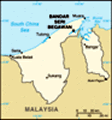
 The Sultanate of Brunei's influence peaked between the 15th and 17th centuries when its control extended over coastal areas of northwest Borneo and the southern Philippines. Brunei subsequently entered a period of decline brought on by internal strif...