Senegalese Geography, Senegal Geography
Advertisement
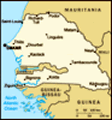
Location: Western Africa, bordering the North Atlantic Ocean, between Guinea-Bissau and Mauritania
Geographic coordinates: 14 00 N, 14 00 W
Map references: Africa
Area: Total: 196,190 sq km land: 192,000 sq km water: 4,190 sq km
Area - comparative: Slightly smaller than South Dakota
Land boundaries: Total: 2,640 km border countries: The Gambia 740 km, Guinea 330 km, Guinea-Bissau 338 km, Mali 419 km, Mauritania 813 km
Coastline: 531 km
Maritime claims: Territorial sea: 12 nm contiguous zone: 24 nm exclusive economic zone: 200 nm continental shelf: 200 nm or to the edge of the continental margin
Climate: Tropical; hot, humid; rainy season (May to November) has strong southeast winds; dry season (December to April) dominated by hot, dry, harmattan wind
Terrain: Generally low, rolling, plains rising to foothills in southeast
Elevation extremes: Lowest point: Atlantic Ocean 0 m highest point: unnamed feature near Nepen Diakha 581 m
Natural resources: Fish, phosphates, iron ore
Land use: Arable land: 12.78% permanent crops: 0.21% other: 87.01% (2001)
Irrigated land: 710 sq km (1998 est.)
Natural hazards: Lowlands seasonally flooded; periodic droughts
Environment - current issues: Wildlife populations threatened by poaching; deforestation; overgrazing; soil erosion; desertification; overfishing
Environment - international agreements: Party to: Biodiversity, Climate Change, Climate Change-Kyoto Protocol, Desertification, Endangered Species, Hazardous Wastes, Law of the Sea, Marine Life Conservation, Ozone Layer Protection, Ship Pollution, Wetlands, Whaling
Geography - note: Westernmost country on the African continent; The Gambia is almost an enclave within Senegal
Advertisement
The information here has been derived from Public Domain Sources such as the CIA World Factbook. No liability can be taken for any inaccuracies.
Tot: 0.066s; Tpl: 0.008s; cc: 5; qc: 6; dbt: 0.0266s; 1; m:domysql w:travelblog (10.17.0.13); sld: 2;
; mem: 1.1mb


 Independent from France in 1960, Senegal joined with The Gambia to form the nominal confederation of Senegambia in 1982. However, the envisaged integration of the two countries was never carried out, and the union was dissolved in 1989. Despite peace...