Advertisement
Published: April 5th 2010

 Stairway to hell
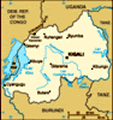
Window at the Kigali Genocide Memorial CentreI arrive in Kigali mid-afternoon and have mixed feelings. Its outskirts are fairly pretty, rolling up the steep hills that characterise Rwanda's landscape like a provincial Spanish hill-town. However, the centre is rather bland and the only thing I find of interest here is the Genocide Memorial Centre. Kigali has the most expensive accommodation I've had to take so far, without much in the way of options. I feel no compulsion to hang around for a second $24 night so get packing the next morning. Before departing I do take a couple of hours to check out the Genocide Memorial. There's no denying that it makes for a macabre spectacle, particularly the horrifically graphic photos of victims and the morbid personal testimonies. I do think the modernity of the building detracts a little from the impact however. I'm no connoisseur of such memorials, but my one point of comparison, S21 Prison in Cambodia, felt much more impactful due to its drab, grey appearance, bare rooms and walls, and the chilling nature of its setting. Kigali's offering is almost a little too polished. It is not my place to pontificate about the Genocide, but one thing I will comment on is just
how recent it was. Most of the beggars I see are limbless, undoubtedly the victims of the genocide and the subsequent regional wars. Every so often it hits me that many of the people passing me on the streets lived through the events of 1994 and most were either victims or, more frighteningly, perpetrators of the horrendous atrocities that were committed. From my brief experience, Rwandans are not a very friendly people – understandably - and perhaps the least welcoming of the countries I've seen so far. Throughout my time in Rwanda I cannot shake the atmosphere of repressed tension as if the all the country's political and ethnic troubles have been swept under a very small carpet.
Rain batters the ground, making the hot tarmac road steam, as I wind upwards and outwards from Kigali. Despite this the weather in Rwanda overall is a great improvement on perpetually soggy Uganda. The skies are blue, and the clouds bright white and billowing, in which you can make out almost any cloud sculpture your mind cares to conjure up. The country is also maddeningly beautiful. I would like nothing more than to inhale it all, gulping down this sensory
overload like a cold glass of water on a hot day. My bus ride out of Kigali takes me up towards the epic Virunga Volcanoes, each of which rises like the classical image of Mt. Olympus with their rings of cloud. After these comes the descent to the searing turquoise of Lake Kivu and the imposing form of Mt. Nyragongo in the distance.
I stop at the northern tip of Lake Kivu in Gisenyi from which I hop across into the Democratic Republic of Congo for a day (see previous blog). Then I follow the atrocious road south - I am yet to be convinced by Rwanda's reputation for excellent infrastructure - that hugs the lake from top to bottom. I do this two day journey purely for the sake of travel and because of its reputation for scenic beauty. It does not disappoint me; even by Rwandan standards this is a sensational ride. Up and down, left and right we weave along a track that must become a river during the rainy season so deep are the water-worn channels and pot-holes. To the right far below is the bejewelled expanse of Lake Kivu and the steamy mountains
of the DRC beyond. To the left are countless hills encircling deep valleys which disappear out of sight into the depths below. The vigorously undulating terrain is awash with resplendent green tea plantations and thick, brooding forest.
I break the journey up in Kibuye, a little under halfway down the lake. On the approach I see a trial taking place on the grass outside a church. Justice has been slow in Rwanda; perversely many of the worst criminals during the Genocide were tried first due to their high profile and thus avoided languishing in prison for many uncertain years. As part of the reconciliation process (and to deal with the weight of numbers) the government also designated responsibility to local government and the traditional system of village tribunals. In the area around Kibuye 90% of the Tutsi population was wiped out so it is perhaps not surprising that the necessary legal rigmarole is still going on. All the boda drivers seem to be on a lunch break when I arrive so I follow suit, dropping into the only eatery I can find for the usual matoke, pasta, rice, chips and beans buffet that typifies Rwandan cuisine. Apart from
a few idle and unhelpful young men lounging about, the streets are still deserted when I re-emerge so I trudge up to the Home of St. Jean, a fantastic hotel on a hill with great views of the lake. Nearby is another memorial, which, like so many of the sites where the worst massacres took place, is located in a church. It is a little eerie inside due to its high ceiling and emptiness, but the brilliant stained glass adds light and colour to the place, projecting an image of hope for the future.
After Kibuye it is another long and jaw-dropping journey to Cyangugu at the southern end of Lake Kivu, which is inexplicably waterless despite being by a lake. If possible it surpasses even the day before for aesthetic artistry. For the first time I feel welcomed into Rwanda, partly by the woman with Marge Simpson style hair next to me (comparable for its height though not colour) and partly by the energetic kids who bound alongside us. I feel like a bit of a celebrity - who would have thought a simple wave could put such an enormous grin on someone’s face.
Advertisement
Tot: 0.113s; Tpl: 0.012s; cc: 22; qc: 97; dbt: 0.0807s; 1; m:domysql w:travelblog (10.17.0.13); sld: 1;
; mem: 1.3mb