Basotho Economy, Lesotho Economy
Advertisement
Economy - overview: Small, landlocked, and mountainous, Lesotho relies on remittances from miners employed in South Africa and customs duties from the Southern Africa Customs Union for the majority of government revenue, but the government has strengthened its tax system to reduce dependency on customs duties. Completion of a major hydropower facility in January 1998 now permits the sale of water to South Africa, also generating royalties for Lesotho. As the number of mineworkers has declined steadily over the past several years, a small manufacturing base has developed based on farm products that support the milling, canning, leather, and jute industries and a rapidly growing apparel-assembly sector. The garment industry has grown significantly, mainly due to Lesotho qualifying for the trade benefits contained in the Africa Growth and Opportunity Act. The economy is still primarily based on subsistence agriculture, especially livestock, although drought has decreased agricultural activity. The extreme inequality in the distribution of income remains a major drawback. Lesotho has signed an Interim Poverty Reduction and Growth Facility with the IMF.
GDP: 2.3% (2004)
GDP - real growth rate: 3.3% (2004 est.)
GDP - per capita: Purchasing power parity - $3,200 (2004 est.)
GDP - composition by sector: Agriculture: 15.2% industry: 43.9% services: 40.9% (2004 est.)
Population below poverty line: 49% (1999)
Household income or consumption by percentage share: Lowest 10%: 0.9% highest 10%: 43.4%
Distribution of family income - Gini index: 56 (1986-87)
Inflation rate (consumer prices):
Labor force: 838,000 (2000)
Labor force - by occupation: 86% of resident population engaged in subsistence agriculture; roughly 35% of the active male wage earners work in South Africa
Unemployment rate: 45% (2002)
Budget: Revenues: $698.5 million expenditures: $697.6 million, including capital expenditures of $15 million (2004 est.)
Industries: Food, beverages, textiles, apparel assembly, handicrafts; construction; tourism
Industrial production growth rate: 15.5% (1999)
Electricity - production: 314 million kWh; note - electricity supplied by South Africa (2002)
Electricity - production by source:
Electricity - consumption: 308 million kWh (2002)
Electricity - exports: 0 kWh (2002)
Electricity - imports: 16 million kWh; note - electricity supplied by South Africa (2002)
Oil - production: 0 bbl/day (2001 est.)
Oil - consumption: 1,500 bbl/day (2001)
Oil - exports: NA
Oil - imports: NA
Oil - proved reserves:
Natural gas - production:
Natural gas - consumption:
Natural gas - exports:
Natural gas - imports:
Natural gas - proved reserves:
Agriculture - products: Corn, wheat, pulses, sorghum, barley; livestock
Exports: $484.5 million f.o.b. (2004 est.)
Exports - commodities: Manufactures 75% (clothing, footwear, road vehicles), wool and mohair, food and live animals (2000)
Exports - partners: US 97%, Canada 2.1%, UK 0.3% (2004)
Imports: $730.9 million f.o.b. (2004 est.)
Imports - commodities: Food; building materials, vehicles, machinery, medicines, petroleum products (2000)
Imports - partners: Hong Kong 46.8%, China 25.5%, South Korea 5.6%, Germany 4.8% (2004)
Debt - external: $735 million (2002)
Economic aid - recipient: $41.5 million (2000)
Currency:
Currency code:
Exchange rates: Maloti per US dollar - 6.4597 (2004), 7.5648 (2003), 10.5407 (2002), 8.6092 (2001), 6.9398 (2000)
Fiscal year: 1 April - 31 March
Advertisement
The information here has been derived from Public Domain Sources such as the CIA World Factbook. No liability can be taken for any inaccuracies.
Tot: 0.038s; Tpl: 0.016s; cc: 4; qc: 8; dbt: 0.0064s; 1; m:domysql w:travelblog (10.17.0.13); sld: 1;
; mem: 1.1mb


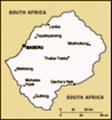
 Basutoland was renamed the Kingdom of Lesotho upon independence from the UK in 1966. King MOSHOESHOE was exiled in 1990, but returned to Lesotho in 1992 and reinstated in 1995. Constitutional government was restored in 1993 after 23 years of military...