Advertisement
Published: September 6th 2009
Confusing?? I’ll Explain…
Egyptian History 101
Egypt’s Pharaonic history dates over 3500 years and is split into three kingdoms,
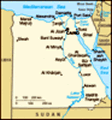
Old, Middle , and New Kingdoms. During this time and even until today, Egypt itself is separated into five regions.
Upper Egypt where the Nile river flows from,
Lower Egypt including Cairo, Alexandria and the Nile Delta,
The Western Desert from the Nile River West,
The Eastern Desert from the Nile River East (obviously) of which both are populated by the
Bedouin Nomads, and
Sinai Peninsula which is part of the Asian continent and not part of Africa. Hence South being Upper Egypt and North being Lower. These two areas were where the great civilisations of Ancient Egypt were concentrated, along the fertile banks of the Nile. This river not only provided sustenance for the people and the land but was also a symbolic representation of their beliefs. The ancient Egyptians believed that the sun was the God
Ra and that because the it rose in the East, this side of the river signified life. The West Bank with it’s setting sun was reserved for the afterlife. Because of this, all the temples and cities were constructed on the East
Bank where as all the tombs and pyramids were kept to the West of the river.
Originally two separate kingdoms, the Upper and Lower parts of Egypt were governed as completely separate entities, each with their own flags and symbols. Upper Egypt had the papyrus and the cobra signifying their lands and Lower Egypt had the lotus and the vulture. Not until the Pharaohs of the
Old Kingdom united the two areas was the Egyptian empire truly underway, with the rulers wearing the dual crown of both Upper and Lower. This period brought in the first real wealth to the country and allowed expansion and increased control. This period lasted for over 800 years and only crumbled due to poor leadership in the later dynasties of that time, fragmenting Egypt into it’s two main regions again.
During the
Middle Kingdom the country was reunited again and all the most famous and impressive temples and tombs were erected, including the Pyramids, Thebes (now known as Luxor and the capital of the time), Valley of the Kings, Valley of the Queens, and Abu Simbal, which goes against the rule and was constructed on the West Bank as a means of
showing power over the people in the extreme of Lower Egypt.
Anyway…
Aswan, although quite a large city, still has that country village kind of feel to it. The markets are full of spices and people intent on getting your attention in any way possible, the buildings are run down and often look unfinished, and the people themselves are a mixture of Arabs and Egypt’s third group of people, the
Nubians. Originally coming from further South in Africa, most are below the poverty line. They exist in local villages along the Nile as they have for hundreds of years, in clay brick houses with no roof (last year it rained for 2 minutes for the whole year so there’s no real need for a roof, it just traps the heat in) and run by the village chief and his council.
Arriving in Aswan in the mid morning from our overnight train, we freshened up and headed straight out to
Philae Temple for a look around. Built during the Greek occupation of Egypt around 300BC by the emperor at the time, it honours a family of gods with the main temple to the goddess
Isus, goddess of magic. With
classic Grecian columns leading up to the main building, each column is adorned with open lotus flowers or papyrus fronds at their top to signify the occupation of all Egypt. Defaced by the Christians who used it during Roman times as a refuge (like so many other temples I was to find out), they had chiselled off the features of the Egyptian gods but the outline and the hieroglyphics still tell the tale. Situated on an island in the middle of the Nile, when the Aswan dam was built in 1960 and water levels began to rise, the temple was actually under water for about seven years before it was moved to a nearby island with firmer foundations and a higher water line. A side trip on the way back to the hotel took us to a perfume factory which the area around Aswan is well known for. An interesting experience… me and all the girls… especially when they tell you that lettuce oil is the natural equivalent to
Viagra. For those interested there was a female equivalent too though.
The next morning was an early start to head out to
Abu Simbal. The reason… police corruption!! Buses can
only make the trip in a police convoy that leaves Aswan at 4.30am. Ten minutes down the highway and we were the only vehicle in sight. Not another bus nor the escort to be seen for miles. Most of the trip is before the sun and when the light does start to creep up on you the vista is one so alien it’s startling. Sand… as far as the eye can see… with the occasional rocky outcropping thrown in to liven things up. Barren doesn’t even begin to describe it. Suddenly though, you’ll pass through a patch of clay huts with a few palms and greenery floating around the edges and realise you’ve just witnessed your first true oasis. Not like the movies at all and buggered if I would want to get out of the air conditioned bus to have a look around when it’s already approaching 40 at 7am. Reaching Abu Simbal at around 8.30am, from the entrance it appears to be nothing of merit. It’s not until you walk around the side of a hill that you really notice the enormous lake created by the new Aswan Dam. Being the largest man made body of water in
the world, it blocks the Nile not only providing water for the millions of inhabitants in Egypt but also controlling the annual flooding that used to take place in the Nile Valley. The problem once again with that is that after the dam was built and the lake began to form, they realised that Abu Simbal (a UNESCO World Heritage Site) would soon be consumed. Applying to UNESCO for emergency help, it took just over a year for it to be granted and just under four years for the temple to be moved with precision. Most cuts made to the monuments were less then 4mm wide and remain almost invisible to the naked eye. An amazing feat in itself!!! The site consists of two temples built by the Pharaoh
Rameses II, the first of which idolises himself as a god amongst three others and is the only temple dedicated to the devotion of more then one deity. The second temple is in honour of his favourite wife,
Queen Nefertari. The outside facades of the temples are so quintessentially Egyptian that they are just as famous as the pyramids or sphinx now days. Just brilliant to behold with their statues and
to think it came so close to being lost.
10am and it was time for another meaningless convoy back to Aswan where that night we took a boat up the Nile to a Nubian village for dinner. Almost totally reliant on tourist dollars, the village is a sharp reminder of the harshness that life can deal out. We met the chief who holds that position for life and is voted in for his wisdom and his wealth. The current chief, Omar, owns all the feluccas from that village including the one we would spend the next three days on as we made our way slowly up the Nile towards the ancient capital.
”We do not need to understand other people and their customs fully to interact with them and learn in the process; it is making the effort to interact without knowing all the rules, improvising certain situations, which allows us to grow." - Mary Catherine Bateson
Advertisement
Tot: 0.075s; Tpl: 0.014s; cc: 9; qc: 23; dbt: 0.0244s; 1; m:domysql w:travelblog (10.17.0.13); sld: 1;
; mem: 1.1mb