Romanian Geography, Romania Geography
Advertisement
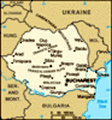
Location: Southeastern Europe, bordering the Black Sea, between Bulgaria and Ukraine
Geographic coordinates: 46 00 N, 25 00 E
Map references: Europe
Area: Total: 237,500 sq km land: 230,340 sq km water: 7,160 sq km
Area - comparative: Slightly smaller than Oregon
Land boundaries: Total: 2,508 km border countries: Bulgaria 608 km, Hungary 443 km, Moldova 450 km, Serbia and Montenegro 476 km, Ukraine (north) 362 km, Ukraine (east) 169 km
Coastline: 225 km
Maritime claims: Territorial sea: 12 nm contiguous zone: 24 nm exclusive economic zone: 200 nm continental shelf: 200-m depth or to the depth of exploitation
Climate: Temperate; cold, cloudy winters with frequent snow and fog; sunny summers with frequent showers and thunderstorms
Terrain: Central Transylvanian Basin is separated from the Plain of Moldavia on the east by the Carpathian Mountains and separated from the Walachian Plain on the south by the Transylvanian Alps
Elevation extremes: Lowest point: Black Sea 0 m highest point: Moldoveanu 2,544 m
Natural resources: Petroleum (reserves declining), timber, natural gas, coal, iron ore, salt, arable land, hydropower
Land use: Arable land: 40.82% permanent crops: 2.25% other: 56.93% (2001)
Irrigated land: 28,800 sq km (1998 est.)
Natural hazards: Earthquakes, most severe in south and southwest; geologic structure and climate promote landslides
Environment - current issues: Soil erosion and degradation; water pollution; air pollution in south from industrial effluents; contamination of Danube delta wetlands
Environment - international agreements: Party to: Air Pollution, Air Pollution-Persistent Organic Pollutants, Antarctic Treaty, Biodiversity, Climate Change, Climate Change-Kyoto Protocol, Desertification, Endangered Species, Environmental Modification, Hazardous Wastes, Law of the Sea, Ozone Layer Protection, Ship Pollution, Wetlands signed, but not ratified: none of the selected agreements
Geography - note: Controls most easily traversable land route between the Balkans, Moldova, and Ukraine
Advertisement
The information here has been derived from Public Domain Sources such as the CIA World Factbook. No liability can be taken for any inaccuracies.
Tot: 0.022s; Tpl: 0.007s; cc: 3; qc: 2; dbt: 0.0051s; 1; m:domysql w:travelblog (10.17.0.13); sld: 1;
; mem: 1.1mb


 The principalities of Wallachia and Moldavia - for centuries under the suzerainty of the Turkish Ottoman Empire - secured their autonomy in 1856; they united in 1859 and a few years later adopted the new name of Romania. The country gained recognitio...