Dutch Economy, Netherlands Economy
Advertisement
Economy - overview: The Netherlands has a prosperous and open economy, which depends heavily on foreign trade. The economy is noted for stable industrial relations, moderate unemployment and inflation, a sizable current account surplus, and an important role as a European transportation hub. Industrial activity is predominantly in food processing, chemicals, petroleum refining, and electrical machinery. A highly mechanized agricultural sector employs no more than 4% of the labor force but provides large surpluses for the food-processing industry and for exports. The Netherlands, along with 11 of its EU partners, began circulating the euro currency on 1 January 2002. The country continues to be one of the leading European nations for attracting foreign direct investment. Economic growth slowed considerably in 2001-04, as part of the global economic slowdown, but for the four years before that, annual growth averaged nearly 4%, well above the EU average.
GDP: 1.6% (2004)
GDP - real growth rate: 1.2% (2004 est.)
GDP - per capita: Purchasing power parity - $29,500 (2004 est.)
GDP - composition by sector: Agriculture: 2.4% industry: 24.5% services: 73.1% (2004 est.)
Population below poverty line: NA
Household income or consumption by percentage share: Lowest 10%: 2.8% highest 10%: 25.1% (1994)
Distribution of family income - Gini index: 32.6 (1994)
Inflation rate (consumer prices):
Labor force: 7.53 million (2004 est.)
Labor force - by occupation: Agriculture 4%, industry 23%, services 73% (1998 est.)
Unemployment rate: 6% (2004 est.)
Budget: Revenues: $256.9 billion expenditures: $274.4 billion, including capital expenditures of NA (2004 est.)
Industries: Agroindustries, metal and engineering products, electrical machinery and equipment, chemicals, petroleum, construction, microelectronics, fishing
Industrial production growth rate: 0.8% (2004 est.)
Electricity - production: 90.61 billion kWh (2002)
Electricity - production by source:
Electricity - consumption: 100.7 billion kWh (2002)
Electricity - exports: 4.5 billion kWh (2002)
Electricity - imports: 20.9 billion kWh (2002)
Oil - production: 46,200 bbl/day (2001 est.)
Oil - consumption: 895,300 bbl/day (2001 est.)
Oil - exports: 1.418 million bbl/day (2001)
Oil - imports: 2.284 million bbl/day (2001)
Oil - proved reserves: 88.06 million bbl (1 January 2002)
Natural gas - production: 77.75 billion cu m (2001 est.)
Natural gas - consumption: 49.72 billion cu m (2001 est.)
Natural gas - exports: 49.28 billion cu m (2001 est.)
Natural gas - imports: 20.78 billion cu m (2001 est.)
Natural gas - proved reserves: 1.693 trillion cu m (1 January 2002)
Agriculture - products: Grains, potatoes, sugar beets, fruits, vegetables; livestock
Exports: $293.1 billion f.o.b. (2004 est.)
Exports - commodities: Machinery and equipment, chemicals, fuels; foodstuffs
Exports - partners: Germany 25%, Belgium 12.4%, UK 10.1%, France 9.9%, Italy 6%, US 4.3% (2004)
Imports: $252.7 billion f.o.b. (2004 est.)
Imports - commodities: Machinery and transport equipment, chemicals, fuels; foodstuffs, clothing
Imports - partners: Germany 17.9%, Belgium 9.9%, US 7.9%, China 7.4%, UK 6.4%, France 4.8% (2004)
Debt - external:
Economic aid - recipient:
Currency:
Currency code:
Exchange rates: Euros per US dollar - 0.8054 (2004), 0.886 (2003), 1.0626 (2002), 1.1175 (2001), 1.0854 (2000)
Fiscal year: Calendar year
Advertisement
The information here has been derived from Public Domain Sources such as the CIA World Factbook. No liability can be taken for any inaccuracies.
Tot: 0.024s; Tpl: 0.008s; cc: 3; qc: 2; dbt: 0.0065s; 1; m:domysql w:travelblog (10.17.0.13); sld: 1;
; mem: 1.1mb


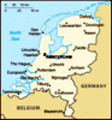
 The Kingdom of the Netherlands was formed in 1815. In 1830 Belgium seceded and formed a separate kingdom. The Netherlands remained neutral in World War I, but suffered invasion and occupation by Germany in World War II. A modern, industrialized natio...