Ni-Vanuatu Geography, Vanuatu Geography
Advertisement
Location: Oceania, group of islands in the South Pacific Ocean, about three-quarters of the way from Hawaii to Australia
Geographic coordinates: 16 00 S, 167 00 E
Map references: Oceania
Area: Total: 12,200 sq km land: 12,200 sq km water: 0 sq km note: includes more than 80 islands, about 65 of which are inhabited
Area - comparative: Slightly larger than Connecticut
Land boundaries: 0 km
Coastline: 2,528 km
Maritime claims: Measured from claimed archipelagic baselines territorial sea: 12 nm contiguous zone: 24 nm exclusive economic zone: 200 nm continental shelf: 200 nm or to the edge of the continental margin
Climate: Tropical; moderated by southeast trade winds from May to October; moderate rainfall from November to April; may be affected by cyclones from December to April
Terrain: Mostly mountainous islands of volcanic origin; narrow coastal plains
Elevation extremes: Lowest point: Pacific Ocean 0 m highest point: Tabwemasana 1,877 m
Natural resources: Manganese, hardwood forests, fish
Land use: Arable land: 2.46% permanent crops: 7.38% other: 90.16% (2001)
Irrigated land: NA sq km
Natural hazards: Tropical cyclones or typhoons (January to April); volcanism causes minor earthquakes; tsunamis
Environment - current issues: A majority of the population does not have access to a potable and reliable supply of water; deforestation
Environment - international agreements: Party to: Antarctic-Marine Living Resources, Biodiversity, Climate Change, Climate Change-Kyoto Protocol, Desertification, Endangered Species, Law of the Sea, Marine Dumping, Ozone Layer Protection, Ship Pollution, Tropical Timber 94 signed, but not ratified: none of the selected agreements
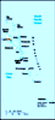
Geography - note: A Y-shaped chain of four main islands and 80 smaller islands; several of the islands have active volcanoes
Advertisement
The information here has been derived from Public Domain Sources such as the CIA World Factbook. No liability can be taken for any inaccuracies.
Tot: 0.033s; Tpl: 0.007s; cc: 6; qc: 6; dbt: 0.0038s; 1; m:domysql w:travelblog (10.17.0.13); sld: 1;
; mem: 1mb


 The British and French, who settled the New Hebrides in the 19th century, agreed in 1906 to an Anglo-French Condominium, which administered the islands until independence in 1980....