Eritrean Geography, Eritrea Geography
Advertisement
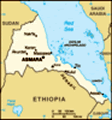
Location: Eastern Africa, bordering the Red Sea, between Djibouti and Sudan
Geographic coordinates: 15 00 N, 39 00 E
Map references: Africa
Area: Total: 121,320 sq km land: 121,320 sq km water: 0 sq km
Area - comparative: Slightly larger than Pennsylvania
Land boundaries: Total: 1,626 km border countries: Djibouti 109 km, Ethiopia 912 km, Sudan 605 km
Coastline: 2,234 km total; mainland on Red Sea 1,151 km, islands in Red Sea 1,083 km
Maritime claims: Territorial sea: 12 nm
Climate: Hot, dry desert strip along Red Sea coast; cooler and wetter in the central highlands (up to 61 cm of rainfall annually); semiarid in western hills and lowlands; rainfall heaviest during June-September except in coastal desert
Terrain: Dominated by extension of Ethiopian north-south trending highlands, descending on the east to a coastal desert plain, on the northwest to hilly terrain and on the southwest to flat-to-rolling plains
Elevation extremes: Lowest point: near Kulul within the Denakil depression -75 m highest point: Soira 3,018 m
Natural resources: Gold, potash, zinc, copper, salt, possibly oil and natural gas, fish
Land use: Arable land: 4.95% permanent crops: 0.03% other: 95.02% (2001)
Irrigated land: 220 sq km (1998 est.)
Natural hazards: Frequent droughts; locust swarms
Environment - current issues: Deforestation; desertification; soil erosion; overgrazing; loss of infrastructure from civil warfare
Environment - international agreements: Party to: Biodiversity, Climate Change, Desertification, Endangered Species signed, but not ratified: none of the selected agreements
Geography - note: Strategic geopolitical position along world's busiest shipping lanes; Eritrea retained the entire coastline of Ethiopia along the Red Sea upon de jure independence from Ethiopia on 24 May 1993
Advertisement
The information here has been derived from Public Domain Sources such as the CIA World Factbook. No liability can be taken for any inaccuracies.
Tot: 0.046s; Tpl: 0.007s; cc: 5; qc: 8; dbt: 0.021s; 1; m:domysql w:travelblog (10.17.0.13); sld: 1;
; mem: 1.1mb


 Eritrea was awarded to Ethiopia in 1952 as part of a federation. Ethiopia's annexation of Eritrea as a province 10 years later sparked a 30-year struggle for independence that ended in 1991 with Eritrean rebels defeating governmental forces; independ...