Chilean Geography, Chile Geography
Advertisement
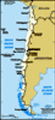
Location: Southern South America, bordering the South Pacific Ocean, between Argentina and Peru
Geographic coordinates: 30 00 S, 71 00 W
Map references: South America
Area: Total: 756,950 sq km land: 748,800 sq km water: 8,150 sq km note: includes Easter Island (Isla de Pascua) and Isla Sala y Gomez
Area - comparative: Slightly smaller than twice the size of Montana
Land boundaries: Total: 6,171 km border countries: Argentina 5,150 km, Bolivia 861 km, Peru 160 km
Coastline: 6,435 km
Maritime claims: Territorial sea: 12 nm contiguous zone: 24 nm exclusive economic zone: 200 nm continental shelf: 200/350 nm
Climate: Temperate; desert in north; Mediterranean in central region; cool and damp in south
Terrain: Low coastal mountains; fertile central valley; rugged Andes in east
Elevation extremes: Lowest point: Pacific Ocean 0 m highest point: Nevado Ojos del Salado 6,880 m
Natural resources: Copper, timber, iron ore, nitrates, precious metals, molybdenum, hydropower
Land use: Arable land: 2.65% permanent crops: 0.42% other: 96.93% (2001)
Irrigated land: 18,000 sq km (1998 est.)
Natural hazards: Severe earthquakes; active volcanism; tsunamis
Environment - current issues: Widespread deforestation and mining threaten natural resources; air pollution from industrial and vehicle emissions; water pollution from raw sewage
Environment - international agreements: Party to: Antarctic-Environmental Protocol, Antarctic-Marine Living Resources, Antarctic Seals, Antarctic Treaty, Biodiversity, Climate Change, Climate Change-Kyoto Protocol, Desertification, Endangered Species, Environmental Modification, Hazardous Wastes, Law of the Sea, Marine Dumping, Ozone Layer Protection, Ship Pollution, Wetlands, Whaling signed, but not ratified: none of the selected agreements
Geography - note: Strategic location relative to sea lanes between Atlantic and Pacific Oceans (Strait of Magellan, Beagle Channel, Drake Passage); Atacama Desert is one of world's driest regions
Advertisement
The information here has been derived from Public Domain Sources such as the CIA World Factbook. No liability can be taken for any inaccuracies.
Tot: 0.031s; Tpl: 0.016s; cc: 3; qc: 2; dbt: 0.0039s; 1; m:domysql w:travelblog (10.17.0.13); sld: 1;
; mem: 1mb


 Prior to the coming of the Spanish in the 16th century, northern Chile was under Inca rule while Araucanian Indians inhabited central and southern Chile; the latter were not completely subjugated until the early 1880s. Although Chile declared its ind...