Bulgarian Geography, Bulgaria Geography
Advertisement
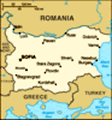
Location: Southeastern Europe, bordering the Black Sea, between Romania and Turkey
Geographic coordinates: 43 00 N, 25 00 E
Map references: Europe
Area: Total: 110,910 sq km land: 110,550 sq km water: 360 sq km
Area - comparative: Slightly larger than Tennessee
Land boundaries: Total: 1,808 km border countries: Greece 494 km, Macedonia 148 km, Romania 608 km, Serbia and Montenegro 318 km, Turkey 240 km
Coastline: 354 km
Maritime claims: Territorial sea: 12 nm contiguous zone: 24 nm exclusive economic zone: 200 nm
Climate: Temperate; cold, damp winters; hot, dry summers
Terrain: Mostly mountains with lowlands in north and southeast
Elevation extremes: Lowest point: Black Sea 0 m highest point: Musala 2,925 m
Natural resources: Bauxite, copper, lead, zinc, coal, timber, arable land
Land use: Arable land: 40.02% permanent crops: 1.92% other: 58.06% (2001)
Irrigated land: 8,000 sq km (1998 est.)
Natural hazards: Earthquakes, landslides
Environment - current issues: Air pollution from industrial emissions; rivers polluted from raw sewage, heavy metals, detergents; deforestation; forest damage from air pollution and resulting acid rain; soil contamination from heavy metals from metallurgical plants and industrial wastes
Environment - international agreements: Party to: Air Pollution, Air Pollution-Nitrogen Oxides, Air Pollution-Persistent Organic Pollutants, Air Pollution-Sulfur 85, Air Pollution-Volatile Organic Compounds, Antarctic-Environmental Protocol, Antarctic-Marine Living Resources, Antarctic Treaty, Biodiversity, Climate Change, Climate Change-Kyoto Protocol, Desertification, Endangered Species, Environmental Modification, Hazardous Wastes, Law of the Sea, Ozone Layer Protection, Ship Pollution, Wetlands signed, but not ratified: Air Pollution-Sulfur 94
Geography - note: Strategic location near Turkish Straits; controls key land routes from Europe to Middle East and Asia
Advertisement
The information here has been derived from Public Domain Sources such as the CIA World Factbook. No liability can be taken for any inaccuracies.
Tot: 0.044s; Tpl: 0.008s; cc: 6; qc: 6; dbt: 0.0069s; 1; m:domysql w:travelblog (10.17.0.13); sld: 1;
; mem: 1.1mb


 The Bulgars, a Central Asian Turkic tribe, merged with the local Slavic inhabitants in the late 7th century to form the first Bulgarian state. In succeeding centuries, Bulgaria struggled with the Byzantine Empire to assert its place in the Balkans, b...