Advertisement
Published: November 25th 2008
The Story of a Fight Over Olive Trees
The sign over the once functioning Golan Hospital reads, “Destructed by Zionists and changed it to firing target.” In 1967 during the Six Day War the Israeli army pushed into the Golan Heights and began an occupation of more than 450 square km of formerly Syrian territory, which included the small village of Al-Quneitra. However, only six years later the during the Yom Kippur War the Syria forces pushed back and negotiated a cease fire with Israel that remains in place today. The cease fire returned 150 square km of territory back to Syria and created a UN monitored buffer zone between the two countries. Within the land returned to Syrian control was Al-Quneitra.
Upon withdrawing from Al-Quneitra, the Israeli army displaced all of the towns’ residents and then systematically took almost everything of value from the city; every piece of metal, every piece of plastic, every religious artifact. With the town stripped bare, the Israelis then dynamited most of the houses in the village and made the remaining structures irreparable including the hospital, the main street buildings, and the sanctuaries of worship.
When the Syrian forces took over, they entered
the town to find it completely destroyed and saw only one option for the town’s revival, to level it and start from scratch. However, just as many of the concentration camps of WWII Europe have been left standing as a solemn memory to the atrocities committed there, the Syrian government left Quneitra’s rumble in place as a memory to the victims of the wars and a reminder of the brutality of the Israeli forces. Instead of erasing Israel’s cruelty into the books of history, they left it for all to see.
Visiting Al-Quneitra
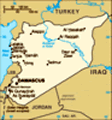
The Syrian government grants access to Quneitra on a limited basis via the Ministry of the Interior. On my second morning in Damascus, I awoke early and traveled to the Ministry to request permission to enter the town. After waiting outside for approximately 25 minutes next to heavily armed guards, I and my two travel companions were granted access and hoped in our newly rented car for an 1.5hr drive towards the Golan Heights, just southwest of Damascus.
On the outskirts of Quneitra, visitors are greeted by two checkpoints, the first of which is simply to verify that you have permission from the Ministry of
the Interior. The second is much more ominous. As your car comes to a stop, well armed security guards approach the car and force you to turnover your passports while informing you that for the remainder of your visit to Al-Quneitra you will be accompanied by a security official dressed in street clothes. Our security official, although polite and cordial, meant business and in some ways reminded us all of a smooth torturer, dressed in a leather jacket and formal slacks with his eyes hidden behind large, dark shades. Once in the car he directed us around the town and told us of the destruction that had taken place. Every so often, he would ask us to stop the car and then lead us through the bullet ridden buildings. He was also flexible enough to take us to the ceasefire line, which gave us a chance to talk to the Syrian troops guarding the border. To all our surprise, the troops were very open and answered all our questions without flinching. However, when we asked if there was any hope for the future, they simply shrugged their shoulders.
Al-Quneitra's Legacy
Visiting Al-Quneitra reminded me of a line from Thomas
Friedman’s now somewhat dated book, The Lexus and the Olive Tree. In the beginning of the book in which he describes the metaphor of the Lexus versus the olive tree, i.e. the struggle between progress and identity in the era of globalization, he writes:
So there I was speeding along at 180 miles an hour on the most modern train in the world, reading this story about the oldest corner of the world. And the thought occurred to me that these Japanese, whose Lexus factory I had visited and whose train I was riding in, were building the greatest luxury car in the world with robots. And over here, on the top of page 3 of the Herald Tribune, the people with whom I had lived for so many years in Beirut and Jerusalem…were still fighting over who owned which olive tree. I cannot stress how unimpressive the Golan Heights actually is. Having heard “Golan Heights” in the news so many times and only knowing that Israel considered the land important in order to take a strategic high point away from Syria, I figured that the Heights would be a huge bluff or mountain that loomed threateningly over
the Israeli landscape. Instead, the Heights are a series of rolling hills that stretch across a parched landscape with a few olive trees, plenty of white calcium rocks, and a few patches of grass. As the world races on, these two countries continue locked in an age-old ethnic/tribal rivalry. They could enter into a modern rivalry based on science, technology, and economics, but instead they continue to waste their precious resources fighting over a few hills on which lonely olive trees grow. Don’t be fooled into believing that this is a conflict about security. If they truly wanted security, they would turn their attention to economic gains and cultural stimulation, which would improve the livelihood of their peoples and help repair their seriously damaged reputations by engendering powerful individual bonds between themselves and the consumers of their cultural exports. Instead, this is a vengeful tribal conflict that is in all honesty becoming less and less geo-politically important by the day; that is to everyone but the regional tribes cloaked in nation-state clothing.
Visiting Al-Quneitra left me with the same horrible sinking feeling in my stomach that had accompanied me out the doors of the Holocaust Museum in Washington, DC
and through the cold hard barracks in Auschwitz, Poland. It was a reminder of the sheer brutality that can be stimulated within human nature. But in the back of my head, I could not help but to wonder how many towns in Iraq now faced the same bleak decision that Al-Quneitra faced some 25 years ago; to start from scratch or simply walk away. At the end of the day, it’s not just those Zionist Israelis or the Nazi Germans that are capable of extraordinary cruelty, but it is also the Americans that supported the use of torture on civilians suspected of causing future harm to the U.S. and the European governments that facilitated the practice of “extraordinary rendition.” Luckily for us Americans, we have awarded ourselves with an extraordinary opportunity over the past month to once again reach for the ethical high ground that our founding father's laid out for us, but to which we still do not measure up. I only hope that in the future the reminders of our own atrocities and those of others, just as human and mistake prone as ourselves, will be fresh in our minds as we, a new generation of American leadership,
take the reigns of power.
Advertisement
Tot: 0.126s; Tpl: 0.03s; cc: 9; qc: 52; dbt: 0.047s; 1; m:domysql w:travelblog (10.17.0.13); sld: 1;
; mem: 1.1mb






Dora
non-member comment
AWESOME
Mike, visiting your blog is always a pleasant and enriching experience. Your words are so vivid that I could smell hat Syrian bread in the oven from miles away. I’d say you have received a beautiful gift: the ability to see beyond and to touch people’s heart with your constructive thoughts and reflections. Be safe, “Dora”