Advertisement
Published: September 18th 2009

 The main portal of the Mogao Grottoes of Dunhuang, Gansu
Within this sandstone mountain, in the middle of a desert oasis, 735 Buddhist shrines have been carved into its bowels. The caves have been excavated since the time a travelling monk, Shamen Lezun, had a vision of light and 1,000 Buddhas appeared. 1,600 years have passed since he created the first of the grottoes. It is another of China's spectacular national treasures. ***** "It is with deep sadness, that I heard of the recent events and tragedy at my former school in Miami. From so far away, in Taizhou, China, I wish to share in your pain and suffering, that must be overwhelming you, my dear friends and collegues and students at Coral Gables H.S. My memories of almost 20 years with you were of great joy and satisfaction, and I wish I could be there with you to offer my love and some comfort in person. We can all hope, that time will become the healer of this painful memory. My heart and my prayers go out to all of you, and I hope you will find comfort in each other's friendship and love. I miss you all very much at this moment of such great suffering." *****
**********************************
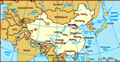
PART 2 of my exciting, "Summer-2009", travels in China take me to the northwestern Chinese Province of Gansu, to the important and ancient Silk Road city of Dunhuang. Dunhuang, an oasis-city with a history of thousands of years, is sandwiched by the "Horse's Mane Mountain" (North Mountain) and the "Qilian Mountain" (South Mountain). The oasis is formed by the constant floods
The mountains holds more than 1,600 years of Buddhist history.
Set in the middle of a small desert oasis, monks, merchants, and travelers along the Silk Road found spiritial and physical relaxation in its shadows. Now, thousands' of tourists marvel not so much at the exterior, but what is treasures are within. of the Dan River, which flows from the South Mountain. Scattered around this oasis are extensive deserts and huge sand dunes.
The ancient Silk Road opened during the Han Dynasty, some 2,000 years ago and had its starting point in the ancient city of Xi'an, well known for the army of Terra Cotta Warriors. Far to the West, along this important trade route from China to Europe, Dunhuang held its strategic position. At Dunhuang, the road split into a South-route leading toward India, and North-route leading to Kasakhstan toward Europe and the Roman Empire.
Surrounded by imposing mountains and dunes, Dunhuang controlled the flow of traffic, being blessed with two mountain-passes, the Yangguan Pass and the Yummenguan Pass (Yumen Pass), directing the north and south split of the Silk Road. From here, the city served as the hub of the the East and West trade.
As part of the Dunhuang defense system, a long wall, which later became part of the Great Wall, was erected to its North. Dunhuang became the doorway to Central China and also served as an important military outpost. The city enjoyed a long period of stability.
The goods traded included silk
Part 1, The Mogao Grottoes. A creation, that came from LOVE!
The main portal of the Mogao Grottoes has invited the faithful and curious to enjoy repose from the desert sun into the cool of its hidden shrines. and porcelain from Central China, precious stones from the West, camels and horses from the North, and the local grain products.
As Dunhuang continued its growth into an important commercial- and trade- center, it also developed as a profitable grain production base along the Silk Road.
Besides being a business center, Dunhuang became a cultural melting pot. The culture of Central China started to take root quickly and the Buddhist culture of India greatly influenced Dunhuang's growth, bringing with it the cultures and customs of Western Asia and Central Asia.
It was here in Dunhuang that the traditions of China and Western countries met, collided, and merged!
A well-known Dunhuang scholar, Mr. Ji Xianlin, once wrote:
"Although the world is large and its history is long, only four countries and regions have established their complete cultural systems which have exerted a far reaching influence in the world: China, India, Greece, and Islam. But there is only one area in the whole world where these four cultures once met: that is Dunhuang and Xinjiang in the West of China."
All travels East to West, and West to East, made their way through Dunhuang, among them a
Buddha in Paronirvana
This is just one of thousands of treasures within the desert mountain near Dunhuang. The Buddha is some 55 feet long, and has been at rest here for a thousand years. large number of Buddhist teachers and monks on their quest to spread their philosophy and find nirvana. The development of the Buddhist culture in Dunhuang was inevitable, as it held such a strategic location along the Silk Road. But completely by accident, the desert terrain and sandstone mountains in the area became the source and material of some of the most fascinating Buddhist architecture anywhere in China, and in the world.
**********************************
A SHORT HISTORY OF THE MOGAO-CAVE-SHRINE HOLY SITE:
While the development of Buddhist culture in the oasis city of Dunhuang was inevitable and flourished, the cave-shrine construction at Mogao in Dunhuang started accidentally and the story is written:
That in the year 366 A.D., during the Qin Dynasty, a travelling monk named Shamen Lezun arrived one day at Mogao Mountain near Dunhuang. Suddenly he saw golden lights appearing from the steep cliffs of the mountain wall, as if there were a thousand Buddhas rushing out of the rays of sunshine. (It is the reason, the Mogao Caves are also known as the "Thousand Buddha Grotto".) With this experience, he felt he must carry forward the power of Buddha from this spot.
He then dug a
The interior of one of 735 cave-shrines
The colors of the murals, covering every inch of wall-space are still vibrant after centuries. The statues take center stage, and are mostly created as painted clay stucco sculptures. cave from the Mogao cliff and built a shrine.
After him came the Zen Master Faliang from the East, who hollowed a second cave next to it, and thus began the trend of cave building in Dunhuang, and the contruction was to last for more than a thousand years. The constructions and excavations were later supported financially by local authorities, pilgrims, and wealthy merchants.
The cave constructions became quite a fad, and though there were many military conflicts and wars and occupations, the cave construction flourished even more during the occupation of the Dunhuang region by the Tibetan nobles around 842 A.D. These were for the most part Buddhist supporters, and so the Buddhist culture and art in Dunhuang was unimpeded under the Tibetan rule.
Around 1227 A.D., the region was conquered and occupied by the Mongols. But since they were also devout believers of Buddhism, they regarded the Mogao Grottoes in Dunhuang as an important Buddhist sanctuary, to be protected and improved.
Then the development tapered off. With the rise of an "Ocean Silk Road" and the expansion of the Mongol Empire, the oasis town of Dunhuang lost its strategic position as a hub of
The original exteriors have survived centuries of desert weather.
The entrances to the cave-shrines can be accessed through stairs and rampways along four tears.
Most of the murals have almost complete faded, in stark contrast to the interiors of the caves. East- and West-transportation and as a gateway of the Chinese West. The Mogao Grottoes fell into decline.
Not until the Qing Dynasty and the emperor Qianlong, around 1760 A.D., did Dunhuang experience a revival, and the Mogao Grottoes began to attract the attention of people again.
But in 1900 A.D., the now world famous Dunhuang Library Cave was discovered, containing thousands of ancient documents, scrolls, books and treasures! That single important discovery lured greedy and ruthless Western Explorers and Adventurers to the site.
With the decline of China's Qing Dynasty by means of the strong-arm tactics of the Western Powers (remember the Opium Wars!), who were dividing China by armed force and conflict among each other, these Western Adventurers and Robbers could now loot anything they wanted in China, at will.
In "shame" should stand the Hungarian, Marc Aurel Stein; Paul Pelliot of France; Zuicho Tachibana of Japan, and Serei Oldenberg of Russia, just to name a few. They looted and carried away whatever they could. What they could not, was often left to destruction.
China's treasures were ferried away by the truckloads and were scattered around the world. They are now in the collections
Part 2 in this Photo Journal offers a visit to the YUMEN PASS.
A desert highway takes us 60 miles from downtown Dunhuang to the remains of a fortress, guarding the Yumen Pass. of private individuals and in museums in England, France, Russia, Japan and many other countries. Only a small part remain in China.
What a tremendous loss and misfortune for China, a loss unprecedented in the history of Chinese culture. It will remain as part of the eternal shame of European Imperialism in the 19th Century, who have looted the history of so many other countries and continents (ex. Greece, Egypt, Africa and South America etc.), only to fill their museums and homes with these stolen treasures, and there they still can be found today!!!
When will they be returned to their rightful owners?? What would we do, if our historical documents such as the Magna Carta and Declaraton of Independence and Constitution had been stolen in similar fashion??
************************
The desert-sandstone-mountains surrounding Dunhuang continued to be used to construct within hundreds of Buddhist temples/cave-shrines for centuries. Now they are now known collectively as the MOGAO CAVES of Dunhuang in the Province of Gansu. They have become one of the great archeological sites and wonder in the world. Now, finally, they are under protection as a "World Heritage Site".
These Mogao Cave constructions started quite accidentally
Part 2, The Yumen Pass
It is a long way to travel under the desert heat. But we made the journey in the comfort of an airconditioned bus, only to find these lone remains of a once thriving defense system, known as the Yumen Pass. some 1,500 years ago, and continued to develop into a shrine complex consisting of 735 caves, beautifully excavated, their interior decorated with thousands of painted sculptures, with tens of thousands of square yards of colorful wall-paintings on four different levels and five wooden porticos.
The Mogao Cave Complex holds an amazing collection of Buddhist treasures, many now only replicas, as the originals sit in the collections of other nations! The caves had been almost lost for centuries, as Dunhuang was in decline due to the receeding importance of the Silk Road, which had been replaced by ocean- and shipping- routes (the Ocean Silk Road).
Most of the caves (492 caves), carved deep into the sandstone, where used as religious shrines for monks and pilgrims and travellers. These are located to the South of the sandstone-mountain.
The North caves (243 caves), housed the monks' living quarters and have earthen beds, hearth pits, smoke ducts, wall shrines, lamp stands, and other practical elements for a rather comfortable and "cool" living arrangement in the heat of the desert.
Since the cave-temples were dug out of a sandstone cliff, fine sculpturing was almost impossible at the site, and painted clay
Part 3, A night's entertainment in Dunhuang.
After an exhauting day of sightseeing we enjoyed a colorful show in the center-city concert-hall of Dunhuang. stucco sculptures and murals became the major artistic media. The artists conveyed skin tone, facial expressions, fluffy hair and beard, and costume texture through painted additions, rather than carvings.
To make a painted clay stucco sculpture, the artist-monks built a dummy first of bound straw, and then they stuccoed it with a mixture of dried reeds and clay on which they applied the colors.
A mural was created on a treated wall, on which two or three layers of reed- and clay-mixture were first applied as a base. Then the artists composed the layout through sketchings, followed by the application of colors.
The details of the temple-caves have been preserved with its original design and colors by a combination of the dry desert and the constant temperatures of the caves for over a thousand years. Now they are carefully guarded and protected from the throngs of visitors, who are asked not to touch any of the paintings or sculptures, but at times with little success. Photos are strictly forbidden.
And so the inner of this desert mountain has become a magnificant work of art, combining and unifying architecture, painted sculptures, and wall paintings.
The architectural
Let me introduce you to my collegues and fellow travelers to Dunhuang, Gansu.
From left to right:
My friend Arthur, Director of International Exchange and Co-operation of Taizhou Teachers College;
Ms. Yang, Director of Personnel of TTC;
Mr. Xu, President of Taizhou Teachers College;,
and to my right, Mr. Huang, Director of Finance of TTC.
shape of a cave is determined by its content and function. Sculptures are a focus of worship, usually found in a niche or on a prominent position on an altar. These are surrounded and co-ordinated in theme and color by the wall paintings.
The wall paintings depict complex narratives and/or decorative visual statements. These colorful paintings occupy the whole cave. They spread across the four walls and into niches, from floor to ceilings, and they compliment the sculptures that sit at focal points.
The art of the Dunhuang cave-shrines, the ones I was so fortunate to visit, is Buddhist with Chinese national- and folk- art characteristics. Its themes not only draw on Chinese customs and traditions from the various dynasties, but also have drawn inspiration from the arts of other lands.
These cave-temples and cave-shrines are one of Chinas greatest treasures, as well as world Buddhist art.
All the caves are known by their number. Visitors will only be able to enter a few shrines through guided tours. The caves visited by tourists will vary with each tour-guide and are carefully secured by locks.
*No photos are permitted, and that edict is strictly enforced! I
Surrounding area of Mogao Grottoes, Photo #1
Many Stupas have been erected over centuries, and grace the grounds leading to the entrance of the Mogao Grottoes. Stupas are typical Buddhist structures that contain holy scriptures or remains of important Buddhist teachers/monks. cannot take credit for the pictures of the inside of the caves in this TravelBlog entry. These are photos I made of post-cards and I can only thank the un-known photographers for their use, and I hope they forgive me. They must not be reproduced again in any form for profit or gain.
I only wish to use them to inform you about the unique treasures within these sandstone mountains in the desert of Dunhuang in the Province of Gansu, and urge you to personally visit this amazing site during your travels in China. It is an experience one is not likely to ever forget.
****Please, one more personal message to so many of you, who wish to add me to your "Facebook" and have left comments. I see the e-mails of invitation and commentary, but I am sad to inform you, that the "Facebook" Website cannot be accessed from China. The government has found it more prudent to block "Facebook" during these times of trouble and turmoil in some of the Western regions of China, which I have just visited. If you wish to communicate with me, please use this site for your comments and messages. I
Surrounding area of Mogao Grottoes, Photo #2
Seen from the distance, it is this sandstone mountain into which the ancient Mogao Grottoes have been excavated. The mountain area is surrounded by a small desert oasis. am always grateful to receive them and I read them eagerly. *****
In this TravelBlog entry, I have shared 73 photos with you.
Again I urge you to enlarge them for greater details, if you find the time.
Your thoughts, questions, and suggestions make me feel, that the many dozens of hours spent on each entry are worth my efforts and I thank you for them.
Advertisement
Tot: 0.119s; Tpl: 0.043s; cc: 10; qc: 29; dbt: 0.0636s; 1; m:domysql w:travelblog (10.17.0.13); sld: 1;
; mem: 1.2mb







Stefanie Kinnamon
non-member comment
Sounds like you had a wonderful trip! Pictures of my adventures would involve five-year-olds with their fingers up their noses. Not quite as picturesque I feel. Its funny, I went to Gansu as well and visited completely different areas. I think two people could have basically the same itinerary and come back with completely different stories. Drop me a line sometime and tell me how you are doing.