Advertisement
Published: August 14th 2008
The last few days have been spent wandering the temples of Angkor and the streets of Siem Reap. On Monday afternoon we went to Angkor Thom, the old Royal City. It is not very far from Angkor Wat, and contains a few temples of its own. We spent most of the afternoon wandering around Bayon, the most famous temple at the complex. Bayon's most famous feature is an array of towers that have faces carved into all four sides. We could climb as high as the third level, and got to see them up close. Even after hundreds of years of weathering, the sculptures are still impressive. The temple also included dozens more bas relief panels to view, although some were closed for restoration. The Japanese and Germans have dozens of restoration projects around Angkor, and almost every place we visited showed some signs of restoration work: scaffolding, measuring equipment, closed areas. From Bayon we moved on to Baphuan, Phimeanakas and the Terrace of the elephants. By that time it was raining so hard that we abandoned our tour and headed back to Marina Villa.
Tuesday's highlight was Ta Prohm, also known as the jungle temple or a Tomb Raider
set piece. This was by far our favorite temple of Angkor. Everything was on the verge of collapse and trees grew into the rocks everywhere, strangling them, knocking down some, and holding others in place. A close second was Banteay Kdei, another temple that has largely been overtaken by jungle. We clearly prefer the less restored look to that of the more repaired temples such as Angkor Wat. The day's final highlight was dinner at the Khmer Kitchen, rapidly becoming our favorite restaurant in town. Their pumpkin and coconut soup convinced me to return for a second try!
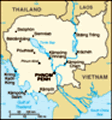
By Wednesday we were a little bit over the idea of visiting temples, so we spent the morning getting a glimpse of life on the banks of Lake Tonle Sap. There, the floating village of Chong Kneas migrates with the waters of the lake, moving inland from June to October when overflow from the Mekong River expands the boundaries of the lake. From October to June the lake level is higher than the Mekong (as the Mekong is no longer overflowing with ice melt from Tibet), and the lake drains back into the river, leaving fertile mudbanks and causing the inhabitants
to move inward to stay on the lake's waters. Right now the lake level is rising, so we could see much of the area inundated with water. There are forests that are now halfway under water and will be nearly completely submerged by October. Some houses were in the process of moving, and we saw trucks carrying some and boats towing others. The lake inhabitants are fishermen, and there are catfish farms up and down the river leading to the lake. There is also a large Vietnamese population making up a high percentage of fisherman and traders in the village. We saw many small boats converted into houses holding an average of 6 people as well as much larger structures that are also built to float. Many people could be seen paddling up and down the waterway to trade or try to sell snacks to tourists.
We also visited the Artisans of Angkor, a project that trains disadvantaged youth from the countryside to become painters, carvers, sculptures, weavers, etc. to acquire skills to support themselves. The company began with banking from the French government and the EU, but now entirely supports itself using sales from their shop. Everything there
is made to look old, and it was funny to see something beautiful and new that was then “antiqued” to look ancient. There was one room full of deaf and mute girls who were trained in painting silk. The girls are selected by non-profits to train in sign language, then are brought to the Artisan school to learn to paint. For all of the students, they must apprentice for 6-8 months (depending on natural talent) before they graduate to become artisans. Some only learn a part of the process, becoming lacquerers or painters. Much of the work is replications of the bas reliefs seen at Angkor, with patterns used in all of the crafts to ensure they will look the same and true to their original design. Some of the paintings take up to a month, while a large bas relief carving can take closer to 3 months. We of course did our part and made sure to buy a few souvenirs.
Our final afternoon was spent wandering through the marvelous Banteay Srei and waiting for the sunset that almost was. At least it wasn't raining!
We're now in Singapore and I hope to have updates from here
soon.
Advertisement
Tot: 0.12s; Tpl: 0.012s; cc: 16; qc: 80; dbt: 0.0803s; 1; m:domysql w:travelblog (10.17.0.13); sld: 1;
; mem: 1.2mb






Jess Kretch
non-member comment
I miss you!
Hey girl!! Wow i am so jealous your photos are amazing!! I hope you are having a great time with Wes! Have enough fun for me too!! Miss you! Jess