Canadian Geography, Canada Geography
Advertisement
Location: Northern North America, bordering the North Atlantic Ocean on the east, North Pacific Ocean on the west, and the Arctic Ocean on the north, north of the conterminous US
Geographic coordinates: 60 00 N, 95 00 W
Map references: North America
Area: Total: 9,984,670 sq km land: 9,093,507 sq km water: 891,163 sq km
Area - comparative: Somewhat larger than the US
Land boundaries: Total: 8,893 km border countries: US 8,893 km (includes 2,477 km with Alaska)
Coastline: 202,080 km
Maritime claims: Territorial sea: 12 nm contiguous zone: 24 nm exclusive economic zone: 200 nm continental shelf: 200 nm or to the edge of the continental margin
Climate: Varies from temperate in south to subarctic and arctic in north
Terrain: Mostly plains with mountains in west and lowlands in southeast
Elevation extremes: Lowest point: Atlantic Ocean 0 m highest point: Mount Logan 5,959 m
Natural resources: Iron ore, nickel, zinc, copper, gold, lead, molybdenum, potash, diamonds, silver, fish, timber, wildlife, coal, petroleum, natural gas, hydropower
Land use: Arable land: 4.96% permanent crops: 0.02% other: 95.02% (2001)
Irrigated land: 7,200 sq km (1998 est.)
Natural hazards: Continuous permafrost in north is a serious obstacle to development; cyclonic storms form east of the Rocky Mountains, a result of the mixing of air masses from the Arctic, Pacific, and North American interior, and produce most of the country's rain and snow east of the mountains
Environment - current issues: Air pollution and resulting acid rain severely affecting lakes and damaging forests; metal smelting, coal-burning utilities, and vehicle emissions impacting on agricultural and forest productivity; ocean waters becoming contaminated due to agricultural, industrial, mining, and forestry activities
Environment - international agreements: Party to: Air Pollution, Air Pollution-Nitrogen Oxides, Air Pollution-Persistent Organic Pollutants, Air Pollution-Sulfur 85, Air Pollution-Sulfur 94, Antarctic-Environmental Protocol, Antarctic-Marine Living Resources, Antarctic Seals, Antarctic Treaty, Biodiversity, Climate Change, Climate Change-Kyoto Protocol, Desertification, Endangered Species, Environmental Modification, Hazardous Wastes, Law of the Sea, Marine Dumping, Ozone Layer Protection, Ship Pollution, Tropical Timber 83, Tropical Timber 94, Wetlands signed, but not ratified: Air Pollution-Volatile Organic Compounds, Marine Life Conservation
Geography - note: Second-largest country in world (after Russia); strategic location between Russia and US via north polar route; approximately 90% of the population is concentrated within 160 km of the US border
Advertisement
The information here has been derived from Public Domain Sources such as the CIA World Factbook. No liability can be taken for any inaccuracies.
Tot: 0.021s; Tpl: 0.008s; cc: 3; qc: 2; dbt: 0.0043s; 1; m:domysql w:travelblog (10.17.0.13); sld: 1;
; mem: 1mb


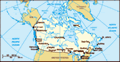
 A land of vast distances and rich natural resources, Canada became a self-governing dominion in 1867 while retaining ties to the British crown. Economically and technologically the nation has developed in parallel with the US, its neighbor to the sou...