Cypriot Background, Cyprus Background
Advertisement
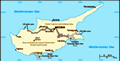
Background: A former British colony, Cyprus received independence in 1960 following years of resistance to British rule. Tensions between the Greek Cypriot majority and Turkish Cypriot minority came to a head in December 1963, when violence broke out in the capital of Nicosia. Despite the deployment of UN peacekeepers in 1964, sporadic intercommunal violence continued forcing most Turkish Cypriots into enclaves throughout the island. In 1974, a Greek-sponsored attempt to seize the government was met by military intervention from Turkey, which soon controlled more than a third of the island. In 1983, the Turkish-held area declared itself the "Turkish Republic of Northern Cyprus," but it is recognized only by Turkey. The latest two-year round of UN-brokered direct talks - between the leaders of the Greek Cypriot and Turkish Cypriot communities to reach an agreement to reunite the divided island - ended when the Greek Cypriots rejected the UN settlement plan in an April 2004 referendum. Although only the internationally recognized Greek Cypriot-controlled Republic of Cyprus joined the EU on 1 May 2004, every Cypriot carrying a Cyprus passport will have the status of a European citizen. EU laws, however, will not apply to north Cyprus. Nicosia continues to oppose EU efforts to establish direct trade and economic links to north Cyprus as a way of encouraging the Turkish Cypriot community to continue to support reunification.
Advertisement
The information here has been derived from Public Domain Sources such as the CIA World Factbook. No liability can be taken for any inaccuracies.
Tot: 0.021s; Tpl: 0.007s; cc: 3; qc: 2; dbt: 0.0029s; 1; m:domysql w:travelblog (10.17.0.13); sld: 1;
; mem: 1mb


 A former British colony, Cyprus received independence in 1960 following years of resistance to British rule. Tensions between the Greek Cypriot majority and Turkish Cypriot minority came to a head in December 1963, when violence broke out in the capi...