Grenadian Government, Grenada Government
Advertisement
Country name: Conventional long form: none conventional short form: Grenada
Government type: Constitutional monarchy with Westminster-style parliament
Capital: Saint George's
Administrative divisions: 6 parishes and 1 dependency*; Carriacou and Petit Martinique*, Saint Andrew, Saint David, Saint George, Saint John, Saint Mark, Saint Patrick
Independence: 7 February 1974 (from UK)
National holiday: Independence Day, 7 February (1974)
Constitution: 19 December 1973
Legal system: Based on English common law
Suffrage: 18 years of age; universal
Executive branch: Chief of state: Queen ELIZABETH II (since 6 February 1952), represented by Governor General Daniel WILLIAMS (since 9 August 1996) head of government: Prime Minister Keith MITCHELL (since 22 June 1995) cabinet: Cabinet appointed by the governor general on the advice of the prime minister elections: none; the monarch is hereditary; governor general appointed by the monarch; following legislative elections, the leader of the majority party or the leader of the majority coalition is usually appointed prime minister by the governor general
Legislative branch: Bicameral Parliament consists of the Senate (a 13-member body, 10 appointed by the government and three by the leader of the opposition) and the House of Representatives (15 seats; members are elected by popular vote to serve five-year terms) elections: last held on 27 November 2003 (next to be held by November 2008) election results: House of Representatives - percent of vote by party - NA%; seats by party - NNP 8, NDC 7
Judicial branch: West Indies Associate States Supreme Court (an associate judge resides in Grenada)
Political parties and leaders: Grenada United Labor Party or GULP [Gloria Payne BANFIELD]; National Democratic Congress or NDC [Tillman THOMAS]; New National Party or NNP [Keith MITCHELL]; People Labor Movement or PLM [Dr. Francis ALEXIS]
Political pressure groups and leaders: NA
International organization participation: ACP, C, Caricom, CDB, FAO, G-77, IBRD, ICAO, ICFTU, ICRM, IDA, IFAD, IFC, IFRCS, ILO, IMF, IMO, Interpol, IOC, ISO (subscriber), ITU, LAES, MIGA, NAM, OAS, OECS, OPANAL, OPCW (signatory), UN, UNCTAD, UNESCO, UNIDO, UPU, WHO, WIPO, WTO
Diplomatic representation in the US: Chief of mission: Ambassador Denis G. ANTOINE chancery: 1701 New Hampshire Avenue NW, Washington, DC 20009 telephone: [1] (202) 265-2561 FAX: [1] (202) 265-2468 consulate(s) general: New York
Diplomatic representation from the US: Chief of mission: the US Ambassador to Barbados is accredited to Grenada embassy: Lance-aux-Epines Stretch, Saint George's mailing address: P. O. Box 54, Saint George's, Grenada, West Indies telephone: [1] (473) 444-1173 through 1176 FAX: [1] (473) 444-4820
Flag description: A rectangle divided diagonally into yellow triangles (top and bottom) and green triangles (hoist side and outer side), with a red border around the flag; there are seven yellow, five-pointed stars with three centered in the top red border, three centered in the bottom red border, and one on a red disk superimposed at the center of the flag; there is also a symbolic nutmeg pod on the hoist-side triangle (Grenada is the world's second-largest producer of nutmeg, after Indonesia); the seven stars represent the seven administrative divisions
Advertisement
The information here has been derived from Public Domain Sources such as the CIA World Factbook. No liability can be taken for any inaccuracies.
Tot: 0.026s; Tpl: 0.009s; cc: 3; qc: 2; dbt: 0.005s; 1; m:domysql w:travelblog (10.17.0.13); sld: 1;
; mem: 1.1mb


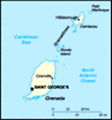
 One of the smallest independent countries in the western hemisphere, Grenada was seized by a Marxist military council on 19 October 1983. Six days later the island was invaded by US forces and those of six other Caribbean nations, which quickly captu...