Aruban; Dutch Economy, Aruba Economy
Advertisement
Economy - overview: Tourism is the mainstay of the small, open Aruban economy, with offshore banking and oil refining and storage also important. The rapid growth of the tourism sector over the last decade has resulted in a substantial expansion of other activities. Construction has boomed, with hotel capacity five times the 1985 level. In addition, the reopening of the country's oil refinery in 1993, a major source of employment and foreign exchange earnings, has further spurred growth. Aruba's small labor force and exceptionally low unemployment rate have led to a large number of unfilled job vacancies, despite sharp rises in wage rates in recent years. Tourist arrivals have declined in the aftermath of the 11 September 2001 terrorist attacks on the US. The government now must deal with a budget deficit and a negative trade balance.
GDP:
GDP - real growth rate: -1.5% (2002 est.)
GDP - per capita: Purchasing power parity - $28,000 (2002 est.)
GDP - composition by sector: Agriculture: NA% industry: NA% services: NA%
Population below poverty line: NA
Household income or consumption by percentage share: Lowest 10%: NA highest 10%: NA
Distribution of family income - Gini index:
Inflation rate (consumer prices):
Labor force: 41,500 (1997 est.)
Labor force - by occupation: Most employment is in wholesale and retail trade and repair, followed by hotels and restaurants; oil refining
Unemployment rate: 0.6% (2003 est.)
Budget: Revenues: $135.8 million expenditures: $147 million, including capital expenditures of NA (2000)
Industries: Tourism, transshipment facilities, oil refining
Industrial production growth rate: NA%
Electricity - production: 807.7 million kWh (2002)
Electricity - production by source:
Electricity - consumption: 751.2 million kWh (2002)
Electricity - exports: 0 kWh (2002)
Electricity - imports: 0 kWh (2002)
Oil - production: 0 bbl/day (2001 est.)
Oil - consumption: 6,500 bbl/day (2001 est.)
Oil - exports: NA
Oil - imports: NA
Oil - proved reserves:
Natural gas - production:
Natural gas - consumption:
Natural gas - exports:
Natural gas - imports:
Natural gas - proved reserves:
Agriculture - products: Aloes; livestock; fish
Exports: $128 million f.o.b. (including oil reexports) (2002 est.)
Exports - commodities: Live animals and animal products, art and collectibles, machinery and electrical equipment, transport equipment
Exports - partners: Netherlands 28.5%, Panama 17.5%, Venezuela 14.7%, Netherlands Antilles 11.2%, Colombia 10.7%, US 10.4% (2004)
Imports: $841 million f.o.b. (2002 est.)
Imports - commodities: Machinery and electrical equipment, crude oil for refining and reexport, chemicals; foodstuffs
Imports - partners: US 55.5%, Netherlands 14.1%, Venezuela 3.3% (2004)
Debt - external: $285 million (1996)
Economic aid - recipient: $26 million (1995); note - the Netherlands provided a $127 million aid package to Aruba and Suriname in 1996
Currency:
Currency code:
Exchange rates: Aruban guilders/florins per US dollar - 1.79 (2004), 1.79 (2003), 1.79 (2002), 1.79 (2001), 1.79 (2000)
Fiscal year: Calendar year
Advertisement
The information here has been derived from Public Domain Sources such as the CIA World Factbook. No liability can be taken for any inaccuracies.
Tot: 0.036s; Tpl: 0.008s; cc: 6; qc: 6; dbt: 0.0097s; 1; m:domysql w:travelblog (10.17.0.13); sld: 1;
; mem: 1.1mb


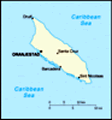
 Discovered and claimed for Spain in 1499, Aruba was acquired by the Dutch in 1636. The island's economy has been dominated by three main industries. A 19th century gold rush was followed by prosperity brought on by the opening in 1924 of an oil refin...