I am lucky enough to be representing Anglian Water on the supporters' trip to India for the charity WaterAid. I'll be going for 2 weeks (24 Feb to 9 Mar) to see for myself how the charity works to give clean water, sanitation and hygiene education to some of the world's poorest people.
Come back to this blog site to read more about the places and people I visit, and see some pictures.
In India, 2 out of 3 people do not have access to any sort of toilet.
Across the world, 5000 children die every day from preventable diseases such as diarrhoea, caused by dirty water and lack of sanitation.
WaterAid projects cost on average just £15 per head.
For more information or to donate see www.wateraid.org
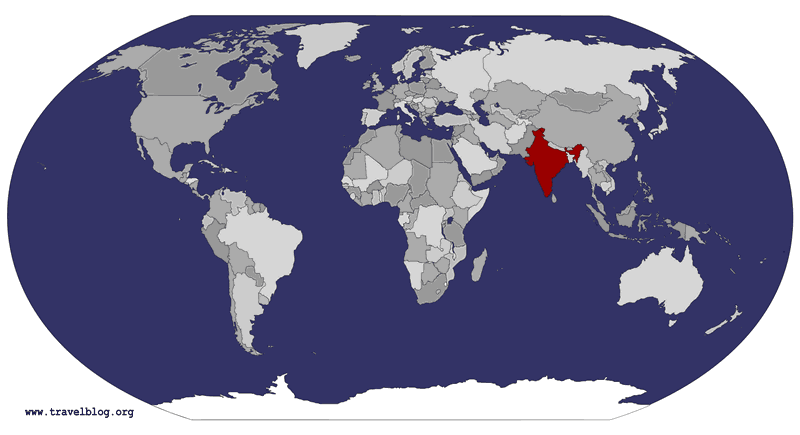
Visited Countries Map

Home sweet home. We are so lucky here, that we are able to take for granted the supply of safe drinking water at the twist of a tap, and the privacy and hygiene of home flush-toilets. Let's be thankful for these facilities and spare a thought for those 1 billion people who have no safe drinking water and over 2.5 billion with no toilets, some of whom I have met on this trip. If you want to help, it costs WaterAid just £15 per head to provide a lasting solution for water, sanitation and hygeine. Please visit WaterAid's website to find out more or donate. Thanks.
... read moreBack in Delhi we are reunited with the 'West' team who have their own set of incredible experiences and stories to tell. The morning is spent reviewing the visit, comparing thoughts and reflections, sharing feedback. I now feel like the trip itself is over. I have seen what I came here to see, a small sample of life in one of the poorest parts of India, and now I want to go home. It's been physically tiring and emotionally draining, a rollercoaster of highs and lows. Instead, there is another day and a half of shopping and sight-seeing before Friday's flight back to London. It is very easy though, to slip back into tourist mode. Most of the group depart to Agra to visit the Taj Mahal this afternoon, returning tomorrow. Having seen that wonder of
... read moreThis morning is our last project visit before returning to Delhi. It is spent at a school in Bhubanaswar set up by a charitable organisation for slum children. Here WaterAid and partners have helped secure water supplies by investing in a roof rain water harvesting system. This collects rain water from the school roof during the rainy season, filters it and stores it in large containers, enough for a few months' supply. In future they hope to increase storage capacity but this would require more complex solutions to ensure the water could be kept clean for longer. Children here have been given a voice by setting up a 'child parliament', and we are priviledged to observe them in session. There is a government and an opposition, with ministers for water, sanitation, health, education and finance. Questions
... read moreLater in the morning we visit another slum where WaterAid have been able to intervene and build a community sanitation block. Obviously in these settings there simply isn't the space to build household latrines, so different solutions are required. The sanitation block, with ladies' and gents' latrines, and showers, and a child-friendly latrine area too, is run by local people, and there is a small charge of 50 paise (half a rupee - less than 1p) for using the toilets, which pays for their cleaning and maintenance. Such a system also ensures that communities take ownership of the facilities and it provides a source of income for some. It's early days here and old habits die hard, but progress is being made, with open defecation now cut by around 50% here. At the third slum of
... read moreThe merriment of yesterday could not have been more greatly contrasted than with today's visit. Nothing I have seen last week could have prepared me for the dire situation that thousands of people face in the slums of Cuttack city, living in extreme poverty. Many of these slums have been here for decades, expanding over time. Often they are on Government-owned land which is vulnerable to reclamation for growing industrial uses. Unfortunately, the government simultaneously represent many conflicting interests, not least the need to grow this area economically by encouraging the development of industry, whilst at the same time the welfare of families who have made their homes here in these slums, desparately in need of safe water and sanitation. Some of the slums are officially recognised by the government, whilst others are not. Slum-dwellers are
... read moreHappy Holi! This morning we are advised to remain in the hotel, as the Hindu festival of Holi (the festival of colours) can get a bit chaotic! Later on though we join in the celebrations, across town at a childrens' home run by the amazing Ruchika social service organisation, which provides schooling for street children from the slums. Each one of us is covered from head to toe in brightly coloured powders, and we dance to lively music in the open air. More and more colours keep coming, being thrown into the air, and smeared on our faces, in our hair, on our clothes, until we all look like psychadelic rainbow aliens! I really think we should export this festival to the UK - it's great fun! However, it does take a very long shower to
... read moreThis is the last of the rural village project visits, as next week we'll be visiting slums. The village we visit today has recently begun work with WaterAid. Nick, Liz, Christina and I begin by meeting with members of the Village Water and Sanitation Committee to discuss how they locally address water and sanitation issues here. Each village in the area has an elected representative. The committee of eleven is deliberately composed of six women and five men, to ensure that women always remain involved and have an active voice - something that has not happened in the past. Meanwhile, some of the other supporters meet with a representative for water quality. I am surprised and impressed to find out that he has test kits for various physical, chemical and biological indicators of drinking water quality,
... read moreToday we spend the day focusing on hygiene education, visiting two schools in the Dhenkanal area. The children, approximately of primary school age, greet us with a Wel Come' chant, in two long lines, boys on the left and girls on the right, in their sky blue shirts and dresses. We observe the assembly which has a special performance of a water and sanitation song, and much cheer. In pairs we then spend the morning with classes. Mike and I visit class 6, who are on average around 10 years of age. They are rather shy at first but soon join in. We play some games with a water and sanitation theme, and ask the children questions like when they wash their hands. I am very impressed with their knowledge and enthusiasm. It's amazing how much
... read moreThis morning the WaterAid supporters group head out to another village in the same area as yesterday, where WaterAid has recently started work, and we have come to help out with the construction of new latrines. I get stuck in at the Nayak family, where Bhagirathi, aged 34, lives with his wife Basanti and two young boys aged 10 and 7. I help collect water from the handpump and use it to mix cement. Two round pits have been dug, about 3 ft deep and the same diameter, each of which will last 5 to 10 years. The toilet building will be offset with a connecting pipe to the pits. After mixing the cement, the first step is to lay out the base row of bricks and start brick-laying, which is hard work in this heat!
... read moreToday we set off to Bhadrak where we will stop for the night. We spend the day in a village where WaterAid has intervened, and now all 82 households have toilets and clean water. As we arrive the crowds chant "Well Come Well Come!" and we are all handed flowers and coconuts with straws. Welcoming speeches are made. The contrast to yesterday is vast. This village has been declared 'Open Defecation Free' and since then no-one has got ill from diarrhoea. The difference in wealth can be measured by the reduction in medical fees and lost labour from sickness. The clothes here are brighter, the children have hair-cuts, wear sandals and go to school. Christina, Robert and I are introduced to a lady called Jemamani Sahoo, aged 63, who is very proud to show us her
... read more