Get Lost
Mark & Leighann Joined: September 21st 2005
Logged in: October 27th 2010
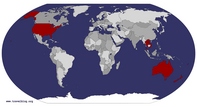
No job. No plans. Just 5 weeks in Thailand, Laos, and Vietnam.
This isn't meant to make you jealous or sad or angry that you are sitting in front of a computer while we float down the Mekong. Mark and I traded in months of free time to work hard toward a goalto travel. It's a choice. That's why we drive one car, so we can afford to see another part of the world. We travel to understand and experience culture. To feel small, scared, excited, humbled, but mostly, free. For that brief moment in time, we shed all responsibilityjobs, furniture, mortgages, commute times, deadlines, carsand we get lost. Nobody knows where we are. And sometimes, neither do we.
Welcome to our Travel Blog. You might find this boring, philosophic travel rhetoric or you might find it entertaining. We'll try to keep the entries short. So you can read it or delete it. But just remember, we included you because we thought you'd appreciate knowing what else is out there.
You can also check out our blogs from our previous trips to New Zealand, Australia and Fiji.
Next Trip: The Yucatan Peninsula, Southern Mexico and Belize, November 2007.

Travel Blog Posts
Some places are made for travelers: Southern Thailand is one of them. Dramatic limestone cliffs abruptly end to reveal white sandy beaches and the warm aquamarine water of the Andaman Sea. After two weeks of exhausting travel in Vietnam, Mark and I finally made it to our last destination: Rai Lei Beach, Krabi. For four days, we drank Singha beer and listened to Reggae as we watched the sun set over the islands. For 1600Baht ($45), we chartered our own long-tail boat to tour the small islands and karsts that sprinkle the sea. Our two Thai sailors knew the best spots for snorkeling, and would anchor just off the colorful coral reefs. Isolated from the rest of the world, we swam with the fish as they nibbled on our fingers and toes. At night, we'd ... read more
This is the town the fashion articles talk about. Surrounded by lush rice fields and beautiful beaches is Hoi An: a quaint Vietnamese village with wall-to-wall tailor shops and floor-to-ceiling fabric depots. Those who have done their research come here armed with pictures from Esquire and Vogue ready to make their dream attire. Whether it's an Armani suit or a wedding dress from the pages of Bride magazine, they'll sew it just for you at 1/10th of the cost. After a few speedy fittings, you could have the dress of your dreams in less than 36 hours. I was giddy at the thought of replacing all my clothes from the 80's. Finally I was going to be fashionable! I scoped out the tailor shops, thumbed through rows of fabric, and talked to some fellow travelers for ... read more
That is how the Vietnamese refer to the war. And one of the sole reasons for our stop in Hue in Central Vietnam was to tour the Demilitarized zone. From the Vinh Moc tunnels and the Ho Chi Minh trail to the notorious Khe Sanh Marine base, we toured what is known as the 17th parallel...the region that saw some of the wars heaviest fighting. We have been told that the locals do not care to talk about the war. Many of them still remember and a few will even show you their wounds. But for the most part, the Demilitarized Tour is set up for tourists. All nationalities come here to see the DMZ, except for Vietnamese and Americans. With three million Vietnamese fatalities and roughly 58,000 Americans, it's no wonder we choose to forget. ... read more
In Hanoi, it's easy to tell the tourists from the locals: they are standing on the street corner waiting to cross the road while hundreds of motorbikes, cyclos, tour buses, cars, and pedestrians whirl pass them without relief. At first, they wait for the light to change, but soon realize the light is merely a suggestion. Soon, this realization suddenly turns to fear, and for some, immediate defeat. You see, the city runs on motorbikes. They swarm like bees, and multiply like ants. It is their major form of transportation. They carry refrigerators, babies, pigs, and 11 foot sections of bamboo on the back of their motorbike. Some text their friends, talk on their cellphone, smoke or all of the above. And they can do this all while traveling at high speeds in heavy traffic while ... read more
If there is one place both visitors and locals will tell you to go to in Vietnam it's Ha Long Bay. Over 3000 limestone and dolomite islets rise out of the of the tropical green waters on the Gulf of Tonkin. For about $60USD you can charter yourself a boat complete with three meals a day, a tour guide, a kayak for exploring, and sleeping quarters for the night. If you want to travel cheaply, you can join a tour for as little as $30(for two days). You can spends days exploring the deep grottoes and caves of the karsts, stalagmites hanging densely from inside their dark interiors. During the warm summer months, you can hang out on remote white sandy beaches, pet the Island monkeys or take diving leaps off the junks sails that cruise ... read more
Good Morning Vietnam... Now that's out of the way, we can talk about Sapa. Located in the Tonkinese Alps just south of the China border, this alpine town sits about 1,650 meters above sea level. Most travelers make the long journey from Hanoi to Sapa to hike through rice fields and picturesque mountain passes and sleep in the small tribal villages of the Black Hmong and Red Zao minority people. When the minibuses first pull into this town of about 3300 (32,000 in the surrounding areas), travelers are awed by the beautiful costumes of the local tribes. The most prominent group to be seen in town is the Black Hmong (50%of Sapa's pop). With large heavy earrings, bracelets and necklaces made out of old French coins, clothing woven out of hemp and dyed with Indigo, and ... read more
The quaint town of Luang Prabang ascends from the banks of the mighty Mekong revealing a unique combination of French and Lao architecture. Upon first arrival, you might think you have just floated down the Seine rather than the Mekong with grand French columns and dining Europeans gracing open terraces. As a UNESCO World Heritage site since 1995, Luang Prabang's uniqueness is guaranteed preservation with over 100 buildings and wats (temples) being restored and strict restrictions on new buildings. Mark and I quickly learned of Luang Prabang's popularity as we were turned away from three booked guest houses. Sweating and tired from two days on the Mekong, we just wanted a shower and a bed. We finally found one tucked away down a quaint alley, but for three times as much as we paid in Thailand. ... read more
We had two choices to get to Laos: fly directly from Chiang Mia to Luang Phabang or take the slow boat. Although its name doesn't sound so appealing, the slow boat delivers the cultural experience of meandering down the infamous Mekong River...for two whole days. And at the time, it sounded like the perfect idea. So at 10am on Wednesday, our Thai driver picked us up for three days and two nights of harrowing fun. The rusty blue van was crammed with nine seats in the back and a bucket seat in the front which could fit three if you squeezed. The driver asked if we had our Laos visa. We replied no, because we were told you get them at the border for $30USD. Suddenly, we were being carted to a seedy Chiang Mai tourist ... read more
Situated about 700km northwest of Bangkok, Chiang Mai is a somewhat quaint, walled city with hundreds of mom and pop guest houses, coffee shops, bars, massage parlours and day spas littering its small alleys. With a population of about 170,300, Chiang Mai has about as many expats and farangs (foreigners) as things to do. In your spare time you can take an elephant ride, build a bamboo raft, visit the infamous longneck Hmong tribe, or trek through the jungle. You can visit the massive food and textile markets to haggle for cheap goods, take a cooking class, talk with a monk, go to massage school, rent a motorcycle and to visit the forest temples or go on a meditation retreat. And if you are here to support one of Thailand's most notorious industries, you can even ... read more
*Pronounced FAR-ONG, this often uttered word is the Thai equivalent to gringo, but nicer, much nicer. Or so we have been told. We're not so sure our hospitable Thai hosts didn't tell us that to be nice. But if you see a FARANG sign outside of any business, you are assured they understand English. You are also assured the FARANG rate--roughly 2.5 times more than the locals. So as a foreigner, you have to bargain, somthing Mark and I aren't very good at (yet), especially when we were bartering for our first Tuk Tuk ride. Pronounced Took-took, these quitessential Thai motorcycle taxis are Thailand's version of Mr.Toad's Wild Ride. But on this ride, you pay not only in Baht, but in years off your life. After talking our tuk tuk driver down from 200 Baht to ... read more