Advertisement
Published: December 25th 2007
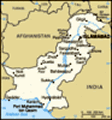
It's been a while since I last posted on this blog - this was due to being in the freezing Hindu Kush mountains, where internet access is sparse, if existent at all. We left for Chitral on 11th December, via propeller plane. Chitral is pretty cut off from the rest of Pakistan, as you can only get there by plane (which is frequently cancelled due to bad weather conditions) or over the Lowari Pass, which isn't really an option at this time of the year, due to snow. It's a lovely little town, and the people there are again completely different. After spending a couple of days in the Chitral Gol National Park, watching markhors (mountain goats) and looking for the elusive snow leopard, we left for the Kalash valleys, in the mountains by the Afghan border on the morning of the 15th.
The Kalasha are Pakistan's last Pagan tribe, and, numbering around 4000 people, live in the Rumbur, Bumboret and Birir valleys. They have a wonderful, interesting culture and live like hundreds of years ago, with no telephone, cars or modern amenities. They make their own bread and clothing, and live from agriculture. We were invited to celebrate part
of the week-long Chamos festival with them: this solstice festival is the biggest for the Kalasha, and there is much singing, dancing, ritual, goat sacrifice and feasting going on. During this time, the God Balomain passes through the valley collecting prayers.
We arrived early in the morning and were met by Saifullah, the chief spokesperson of the Kalash, and his daugher Gulistan. As part of the festivities, we were asked to have a ritual wash, before putting on our Kalasha clothing for the duration of the festival. We saw some women washing by the river below the guest house, but as we were foreigners, Saifullah said that we could wash in the privacy of our rooms with a bucket of warm water. A bucket wash!? How disappointing! As the sun was shining (the narrow Rumbur valley gets about two hours of sunlight a day), I said to Saifullah that I'd prefer to wash with the Kalash women by the river. Ok, he said, and sent me off to the river with Gulistan, who clearly thought I was mad. By the river, we joined some of the other women. I took my clothes off, and amidst much curiosity and giggles,
Gulistan poured warm water (they insisted - not even they use the freezing river water) over me in the sunshine, before helping me to put on my black & green Kalasha dress, headdress and beads. Back at the guesthouse, she braided my hair in typical Kalasha style. The transformation was, once again, complete. The next day, forty goats were sacrificed at the temple in honour of the God (they are later eaten), and the men have to purify themselves with the fresh goat's blood.
Later that day, there was a ritual cleansing ceremony in one of the temples with burning juniper branches and offerings of chapati bread. There was much singing, dancing, and chanting, and we were lucky enough to witness a baby ceremony at the bashali, the Kalasha menstruation house. In the Kalasha tradition, men are pure and women impure, and women live in the bashali for the duration of their menstruation. They also give birth there and remain there with the newborn baby for seven days. Harsh as this may sound, in practice it gives the women a rest time, as they do nothing other than enjoying themselves during their time in the bashali, and I wonder
whether this practice goes back to more ancient times, when women gathered and separated themselves from the men voluntarily during their moontime, knowing how powerful this time is for dreams, visions, etc. In fact, the Kalash women, although having a much lower status than the men (they are not allowed to go to the big temples, for example), are vibrant, vivacious, strong, confident. They seem to run the show. They are also extremely beautiful, with very striking features. I was hoping to spend my moontime with the women in the Bashali and had been granted permission to do so, but in the end, it was just too cold for me in the valley. Four days in Rumbur were more than enough - with no heating, an open-air bathroom, and logging water from the river up the stairs for a wash and the toilet. Yoga had to be done with three layers of thermals, a wooly hat, and gloves. It was a notch up in cold from Tibet. Living in Rumbur was like being in a freezer 24/7. I simply couldn't get warm, the whole group got sick, and so I left for the warmer shores of Islamabad, resolving to return
in the spring for the Kalash spring (Beltane) festival.
The Chamos festival itself was wonderful. There was nightly singing, chanting and dancing around a bonfire (and I was dragged into the circle many times). On the 17th, the most important day, the singing and dancing started early in the morning - the women danced in circles and sang rhymes at the men who left to go up to the temple to offer juniper sticks to the Gods. The women sang 'The men have left us, we sing and dance, we burn our lives for you in the fire, for our tradition, for our beautiful culture'. It was exuberant, joyful and loud. People gave colourful woven ribbons to each other, to every household. Many different circles formed, arm in arm they danced and playfully ran into each other. The men danced on the roof and sang, and I spotted the shaman in his golden robe, swaying in the middle. Men, children, women - they all celebrated like there's no tomorrow. It was getting louder and crazier all the time, and it was only 11.30 am. A little later, the men who were at the temple came down in a single
file, hands on each others' shoulders, and circled the women three times to bless them. I stood in the middle with the Kalash women and felt very emotional. It was all so beautiful.
In the evening, a procession of flaming torches came down the hill, and a gigantic bonfire was lit. The men once again circled the women, singing and chanting, and together with the Kalash, I sang and danced the night away. After a day's rest after the festivities, we left on the 19th, feeling enormously privileged to have been able to be part of this special festival.
Advertisement
Tot: 0.145s; Tpl: 0.013s; cc: 26; qc: 73; dbt: 0.0886s; 1; m:domysql w:travelblog (10.17.0.13); sld: 1;
; mem: 1.3mb






Suzi
non-member comment
You look like a native!