Gambian Government, Gambia Government
Advertisement
Country name: Conventional long form: Republic of The Gambia conventional short form: The Gambia
Government type: Republic under multiparty democratic rule
Capital: Banjul
Administrative divisions: 5 divisions and 1 city*; Banjul*, Central River, Lower River, North Bank, Upper River, Western
Independence: 18 February 1965 (from UK)
National holiday: Independence Day, 18 February (1965)
Constitution: 24 April 1970; suspended July 1994; rewritten and approved by national referendum 8 August 1996; reestablished January 1997
Legal system: Based on a composite of English common law, Koranic law, and customary law; accepts compulsory ICJ jurisdiction, with reservations
Suffrage: 18 years of age; universal
Executive branch: Chief of state: President Yahya A. J. J. JAMMEH (since 18 October 1996; note - from 1994 to 1996 he was Chairman of the Junta); Vice President Isatou Njie SAIDY (since 20 March 1997); note - the president is both the chief of state and head of government head of government: President Yahya A. J. J. JAMMEH (since 18 October 1996; note - from 1994 to 1996 was he Chairman of the Junta); Vice President Isatou Njie SAIDY (since 20 March 1997); note - the president is both the chief of state and head of government cabinet: Cabinet appointed by the president elections: president elected by popular vote for a five-year term; election last held 18 October 2001 (next to be held October 2006) election results: Yahya A. J. J. JAMMEH reelected president; percent of vote - Yahya A. J. J. JAMMEH 52.9%, Ousainou DARBOE 32.7%
Legislative branch: Unicameral National Assembly (53 seats; 48 elected by popular vote, five appointed by the president; members serve five-year terms) elections: last held 17 January 2002 (next to be held February 2007) election results: percent of vote by party - NA%; seats by party - APRC 45, PDOIS 2, NRP 1,
Judicial branch: Supreme Court
Political parties and leaders: Alliance for Patriotic Reorientation and Construction or APRC - the ruling party [Yahya A. J. J. JAMMEH]; Gambian People's Party-Progressive People's Party-United Democratic Party or GPP-PPP-UDP Coalition [Ousainou DARBOE]; National Convention Party or NCP [Sheriff DIBBA]; National Reconciliation Party or NRP [Hamat N. K. BAH]; People's Democratic Organization for Independence and Socialism or PDOIS [Sidia JATTA] note: in August 2001, an independent electoral commission allowed the reregistration of the GPP, NCP, and PPP, three parties banned since 1996
Political pressure groups and leaders: NA
International organization participation: ACP, AfDB, AU, C, ECOWAS, FAO, G-77, IBRD, ICAO, ICCt, ICFTU, ICRM, IDA, IDB, IFAD, IFC, IFRCS, ILO, IMF, IMO, Interpol, IOC, IOM, ITU, MIGA, NAM, OIC, ONUB, OPCW, UN, UNAMSIL, UNCTAD, UNESCO, UNIDO, UNMEE, UNMIL, UNOCI, UPU, WCL, WCO, WFTU, WHO, WIPO, WMO, WToO, WTO
Diplomatic representation in the US: Chief of mission: Ambassador (vacant) chancery: Suite 905, 1156 15th Street NW, Washington, DC 20005 telephone: [1] (202) 785-1379 FAX: [1] (202) 785-1430
Diplomatic representation from the US: Chief of mission: Ambassador Joseph D. STAFFORD, III embassy: Kairaba Avenue, Fajara, Banjul mailing address: P. M. B. No. 19, Banjul telephone: [220] 392856, 392858, 391971 FAX: [220] 392475
Flag description: Three equal horizontal bands of red (top), blue with white edges, and green
Advertisement
The information here has been derived from Public Domain Sources such as the CIA World Factbook. No liability can be taken for any inaccuracies.
Tot: 0.031s; Tpl: 0.007s; cc: 6; qc: 6; dbt: 0.0084s; 1; m:domysql w:travelblog (10.17.0.13); sld: 1;
; mem: 1.1mb


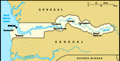
 The Gambia gained its independence from the UK in 1965; it formed a short-lived federation of Senegambia with Senegal between 1982 and 1989. In 1991 the two nations signed a friendship and cooperation treaty. A military coup in 1994 overthrew the pre...